Can Rewriting Questions Help LLMs Solve Problems Better? It Depends on the Problem Type
Rewriting problem statements can boost LLM accuracy, but gains depend on matching rewrite type to problem type.
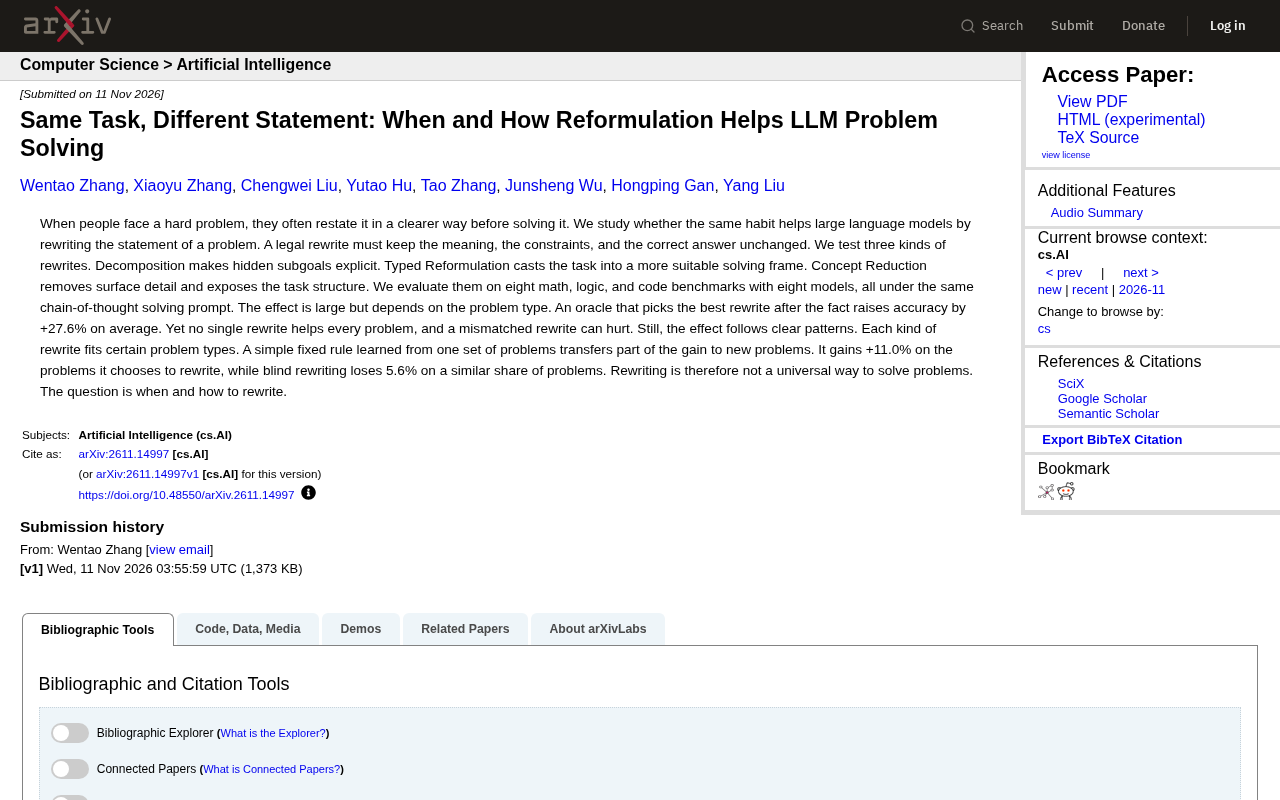
The study systematically examined how making LLMs rewrite problem statements before solving affects performance, defining three valid rewriting strategies—decomposition, typed reformulation, and concept reduction—that preserve meaning and answers, and evaluating them on eight math, logic, and code benchmarks with eight models under a unified chain-of-thought prompt. Results show an oracle best rewrite per problem yields a 27.6% average accuracy gain, indicating substantial potential; but no single rewrite works for all problems, and mismatches can hurt. Gains follow a problem-type/strategy match pattern rather than a random distribution. A simple fixed rule learned from one set of problems transfers part of the gain: selective rewriting improves performance by 11.0%, while blind rewriting a similar proportion loses 5.6%. The core takeaway is to focus on when and how to rewrite, not whether to rewrite.
When people wrestle with a hard problem, they often restate it in their own words first, clarify their thinking, and then start working. Can this habit be transferred to large language models? A study systematically examined the effect of "rewriting the problem statement" on LLM problem-solving, and the conclusion is not simple: rewriting can indeed substantially improve accuracy, but only if the rewriting approach matches the problem type; otherwise it may backfire.
Three Rewriting Strategies: From Decomposition to Abstraction
The study defines three legitimate forms of rewriting, requiring that the meaning, constraints, and correct answer all remain unchanged after rewriting.
Decomposition: Make hidden subgoals explicit so that the model can see the solution steps that were originally implicit. Typed Reformulation: Convert the task into a more suitable solving framework, essentially describing the same problem in a different "language." Concept Reduction: Strip away surface details to expose the structural skeleton of the task.
These three strategies correspond to different intuitions people use when solving problems: breaking down steps, changing perspective, and grasping the essence. The study evaluates on eight math, logic, and code benchmarks with eight models, and all models use the same chain-of-thought prompt to isolate the effect of rewriting itself.
Chain-of-Thought (CoT) prompting is a prompting technique that asks a large language model to output intermediate reasoning steps before giving the final answer. Its core idea comes from the human habit of "writing out one's thinking" when solving problems: the model is guided to generate explicit reasoning sequences such as "first... then... therefore...," thereby externalizing implicit multi-step computation into traceable text. CoT can significantly improve accuracy on math word problems, logical reasoning, and symbolic manipulation tasks, especially for models with larger parameter counts. In this study, all models uniformly use CoT prompting, with the aim of separating the two variables of "rewriting the problem" and "changing the reasoning method," so that the observed accuracy differences can be attributed to the rewriting strategy itself rather than to changes in prompt format.
The Effect Is Significant, but There Is No "Universal Rewrite"
The most striking data comes from an "oracle"-style upper-bound estimate: if, after seeing the results, one could choose the most suitable rewrite for each problem, average accuracy could improve by +27.6%. This shows that the gains contained in the rewriting space are very substantial.
But the key trap is this: no single rewrite is effective for all problems, and mismatched rewrites can even lower performance. In other words, rewriting is not a "free lunch"; blind rewriting may introduce misleading framings or lose key constraints.
The gains are not randomly distributed but follow a clear pattern—each rewriting method suits a specific type of problem. Decomposition suits multi-step reasoning problems with hidden subgoals, typed reformulation suits tasks that require switching to a different solution paradigm, and concept reduction suits problems with redundant surface information and clear structure. This finding shifts the question from "whether to rewrite" to "when to rewrite and how to rewrite."
The "oracle" upper bound is an idealized benchmark commonly used in machine learning evaluation: it assumes the existence of an omniscient selector that, after seeing the correct answer to each problem, chooses the best-performing method or configuration for each problem, and the average performance calculated on this basis is the upper bound. It does not represent an actually deployable system, but is used to measure "if selection were completely correct, how much gain could be extracted at most from the method space." This study uses this upper bound to estimate the potential of the rewriting space and obtains an improvement of +27.6%. Comparing the upper bound with the performance of an actual fixed rule (+11.0%), the gap between them precisely captures the loss caused by "the selector not being perfect enough," and also shows that improving selection judgment is a key direction for future research.
Fixed Rules Can Also Transfer Part of the Gain
A more practical finding is that a simple fixed rule learned from one set of problems can partially transfer to new problems. This rule achieves a +11.0% improvement on the problems it chooses to rewrite, while on a similar proportion of problems, blind rewriting instead incurs a 5.6% loss.
This comparison reveals the real value of rewriting: it lies not in the act of "rewriting" itself, but in the judgment of "selective rewriting." A simple classification rule can capture a considerable portion of the gain, showing that the correspondence between problem types and rewriting strategies has a certain learnability and generalizability.
The contrast between selective rewriting and blind rewriting needs to be understood under the same benchmark: the former means the rule first judges the problem type and applies rewriting only to problems predicted to be suitable, while the latter means uniformly rewriting a similar proportion of problems without distinction. The two cover roughly the same number of problems, so the 11.0% improvement and the 5.6% loss can be directly compared; the difference reflects the value of "judgment" itself, not differences in rewriting coverage. This also explains why a simple fixed rule can still transfer part of the gain: there is a learnable statistical association between problem types and rewriting strategies, and even if the rule is crude, as long as it rewrites when it should and keeps the original problem when it should not, the expected return is positive.
Implications for Prompt Engineering
This study has direct implications for everyday LLM problem-solving. Chain-of-thought prompting has been widely adopted, but rewriting the problem statement is an independent and additive dimension. In practice, rather than uniformly applying some rewriting template to all problems, it is better to first judge the problem type and then decide on the rewriting strategy—for multi-step reasoning problems, try explicitly decomposing subgoals; for problems with mismatched paradigms, try restating the solution framework; and for problems with redundant information, perform concept reduction.
The study also reminds us to beware of the "rewriting illusion": a seemingly clearer statement may quietly change the constraints or introduce false assumptions. Legitimate rewriting must strictly preserve meaning and the answer, and this constraint needs careful verification in practical applications.
Conclusion
Rewriting the problem statement substantively helps LLMs solve problems, and the upper bound is considerable, but the benefit depends heavily on the match between problem type and rewriting strategy. Selective rewriting is better than blind rewriting, and simple rules can transfer part of the gain. The real question is not "whether to rewrite," but "for what problems and in what way to rewrite."
One-line Summary
Rewriting problem statements can improve LLM problem-solving accuracy, but the benefit depends on the match between the rewriting method and the problem type.
Paragraph Summary
The study systematically examined the effect of having large language models "rewrite the problem statement" before solving it. It defined three legitimate rewriting strategies that preserve meaning and the answer—decomposition, typed reformulation, and concept reduction—and evaluated them on eight math, logic, and code benchmarks with eight models using a unified chain-of-thought prompt. The results show that if the optimal rewrite could be selected for each problem after the fact, average accuracy could improve by 27.6%, indicating substantial gains in the rewriting space; however, no single rewrite is effective for all problems, and mismatched rewrites can even reduce performance. The gains follow a pattern of matching between problem types and strategies rather than a random distribution. A simple fixed rule learned from one set of problems can transfer part of the gain: selective rewriting improves performance by 11.0%, while blind rewriting of a similar proportion loses 5.6%. The core conclusion is that attention should be paid to "when to rewrite and how to rewrite," not "whether to rewrite."
Related articles

US Classified National Security Communications Network Outage: A Security Warning for the AI Era
Reuters reports a highly classified US national security communications network outage, sparking Hacker News discussion. This article analyzes critical infrastructure resilience challenges and their implications for AI system security design and failure recovery.

SEC Investigates Nvidia: Behind the Jensen Huang Departure Controversy
The Wall Street Journal reports the SEC is investigating Nvidia following CEO Jensen Huang's departure and admitted affair with an alleged Chinese spy. This article maps the timeline, compliance risks, and potential impact on the AI chip industry, while noting the information awaits cross-verification.

MacBook Neo Sees Rare $50 Discount Ahead of Black Friday — A Good Time for Students to Buy
MacBook Neo gets a rare $50 discount ahead of Black Friday: 256GB at $649, 512GB at $749, all four colors available at Amazon, Best Buy, and Target—great for students.