Can Skills Learned in Games Transfer to Real-World Work?
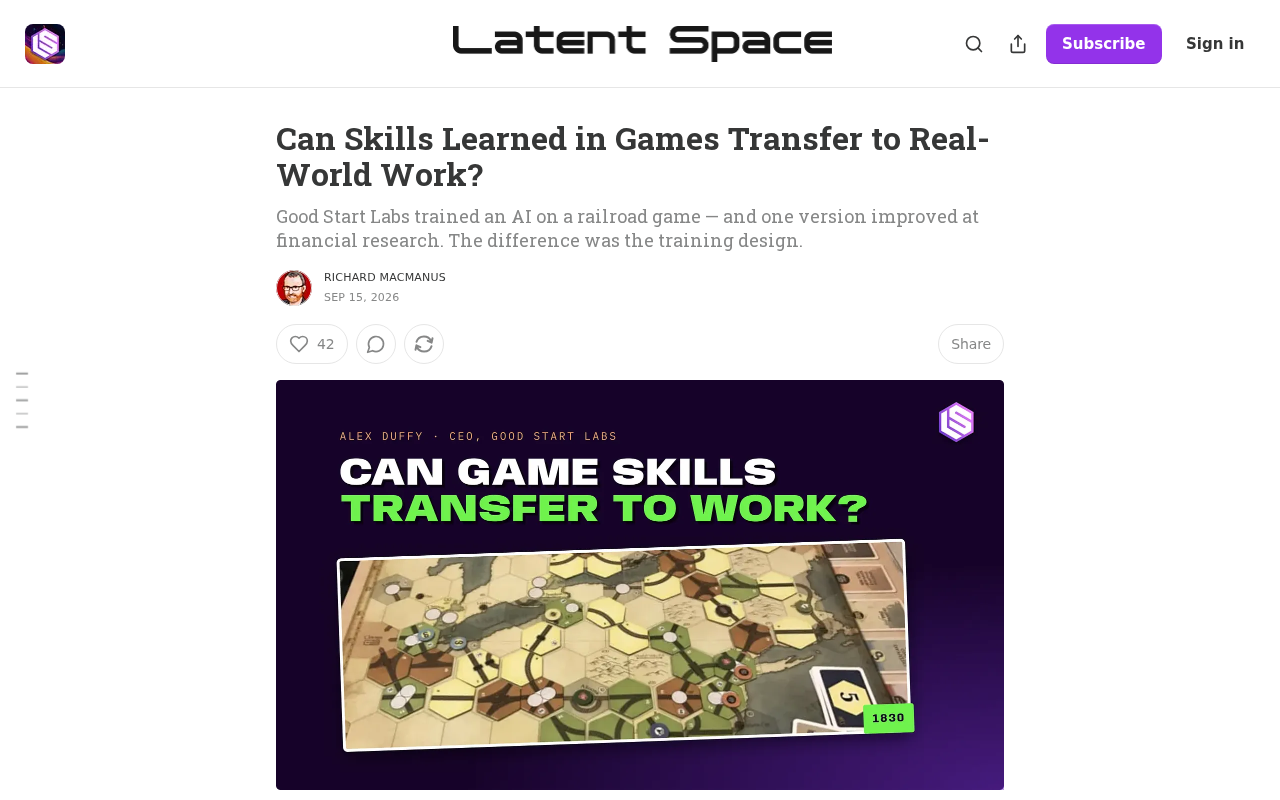
Training AI on a railroad game unexpectedly boosted financial research performance — the key was training design, not the task itself.
Good Start Labs' experiment using a railroad scheduling game to train AI yielded a counterintuitive finding: a specific model version outperformed on an unrelated financial research task. The key determinant of cross-domain capability transfer wasn't the training data or task type, but the training design itself — specifically, whether the reward function guided the model toward general reasoning patterns rather than memorizing scene-specific solutions. Games, with their clear rules and quantifiable feedback, prove ideal for cheaply cultivating transferable capabilities. For AI developers, investing in training methods that build general reasoning ability may be more cost-effective than training separate models per task — though the robustness and generalizability of this finding still awaits systematic validation.
A Transfer Learning Experiment Sparked by a Railroad Game
Good Start Labs did something that seems wildly off-base: they trained an AI using a railroad scheduling game, and one version of the resulting model performed better on a completely unrelated financial research task. This counterintuitive result points to a core question about AI capability transfer — can skills truly migrate across domains, and what determines whether that transfer actually happens?
On the surface, railroad games and financial research have almost nothing in common. One involves route planning, resource scheduling, and timing constraints; the other requires data retrieval, logical reasoning, and information synthesis. But strip away the domain-specific surface, and both share a deeper cognitive structure: making sequential decisions under multiple constraints, weighing trade-offs with incomplete information, and executing multi-step planning toward a goal. That's precisely what transfer learning actually cares about.
What Makes or Breaks It Isn't the Task — It's the Training Design
The most thought-provoking aspect of this experiment is that not every model trained on the railroad game successfully transferred to financial research — only one specific version did. The difference wasn't in the training data itself, but in the training design.
This means capability transfer isn't an automatic byproduct of training on a particular game. It has to be deliberately engineered. Given the same game and the same objective, different training approaches — how the reward function is structured, what strategy the model is guided to optimize, whether it memorizes specific solutions or learns general problem-solving frameworks — can produce models with wildly different generalization abilities.
In other words, if the training process encourages the model to learn transferable reasoning patterns rather than rote-memorizing optimal solutions for specific scenarios, those capabilities are far more likely to resurface on unfamiliar tasks. A model that's only good at "beating the game," by contrast, tends to have its abilities locked firmly within the training distribution.
The reward function plays a pivotal role here. Within a reinforcement learning framework, the reward function defines what behaviors are worth reinforcing. If rewards are tied only to final outcomes (like successfully completing a level), the model is incentivized to take shortcuts and memorize scene-specific solutions. But if the reward is designed to encourage reasoning quality during intermediate steps — such as the efficiency of constraint satisfaction, the flexibility of resource allocation, or the speed of adapting to novel situations — then the model has reason to internalize more abstract strategic patterns. This resonates with the philosophy of curriculum learning: by carefully sequencing the difficulty and diversity of training tasks, you guide the model to progressively build a generalizable capability map, rather than degrading into lookup-table memorization through repetition of a single difficulty level.
Why This Matters
This experiment touches on a high-value direction in current AI research: how to get models to learn genuinely general, reusable capabilities rather than overfitting to a single task.
Games make ideal training grounds because they offer clear rules, quantifiable feedback, and near-unlimited controllable environments. Researchers can cheaply cultivate a particular cognitive capability inside a game, then observe whether that capability transfers to real-world tasks that are costlier and harder to label. The leap from railroad scheduling to financial research is fundamentally a test of whether "abstract capabilities" can exist independently of their original context.
For enterprises and developers, this carries a practical implication: rather than training separate models for every downstream task, it may be worth investing in training environments and methods that cultivate general reasoning abilities. A well-designed "training ground" might produce capabilities that cover multiple seemingly unrelated application scenarios — spreading training costs and improving a model's adaptive flexibility.
Transfer learning itself isn't a new concept — the core paradigm of pretrained large language models is to learn from massive general-purpose data first, then transfer to specific tasks. But what's being discussed here is a more refined form of transfer: using intentionally designed, specialized training environments to "inject" a particular reasoning disposition into a model that already has baseline capabilities, and then letting that disposition emerge naturally on cross-domain tasks. This differs from the conventional path of fine-tuning — fine-tuning typically trades generalization for precision on a specific task, whereas what's being pursued here is reinforcing a certain cognitive structure without sacrificing general-purpose capability. How to strike that balance is one of the central tensions facing both alignment research and capabilities research today.
Open Questions Still Awaiting Answers
It must be noted that this is a preliminary, single-source observation with many questions still unanswered. For instance: how robust is this transfer effect? Can it generalize beyond financial research to other domains? What specific, reproducible principles constitute "the right training design"? And can the highly structured environment of a game meaningfully represent the ambiguous, open-ended, noise-filled problem spaces of the real world?
The information currently available isn't sufficient to answer these questions. Good Start Labs' experiment reads more like a provocation — a suggestion that the leverage point in transfer learning may lie not in data scale, but in the careful design of the training process itself. The real value will depend on whether future work can turn "what training designs enable transfer" from a case study into a reproducible methodology.
Related articles

HuggingFace Censorship Begins? Removed Model Sparks Community Debate
HuggingFace restricted an abliterated GLM model labeled "for offensive cyber," sparking debate about open-source platform censorship, model governance, and transparency.

Cayu: An Open-Source Python Framework for Building Long-Horizon Domain-Specific Agents
Cayu is an open-source Python framework for building domain-specific, long-horizon AI agents. It lets developers assemble a harness of tools, knowledge, and business rules, backed by an integrated durable runtime handling sessions, state, recovery, approvals, and observability.

Is Social Media Really Harming Teenagers? A Scientific Debate Without a Clear Answer
Jonathan Haidt's 'The Anxious Generation' blames social media for teen mental health decline, but academics debate whether the causal link holds up to scrutiny.