Can Smart Home Agents Serve as Grid Operators? First Blackout Resilience Test Reveals Unexpected Behavior
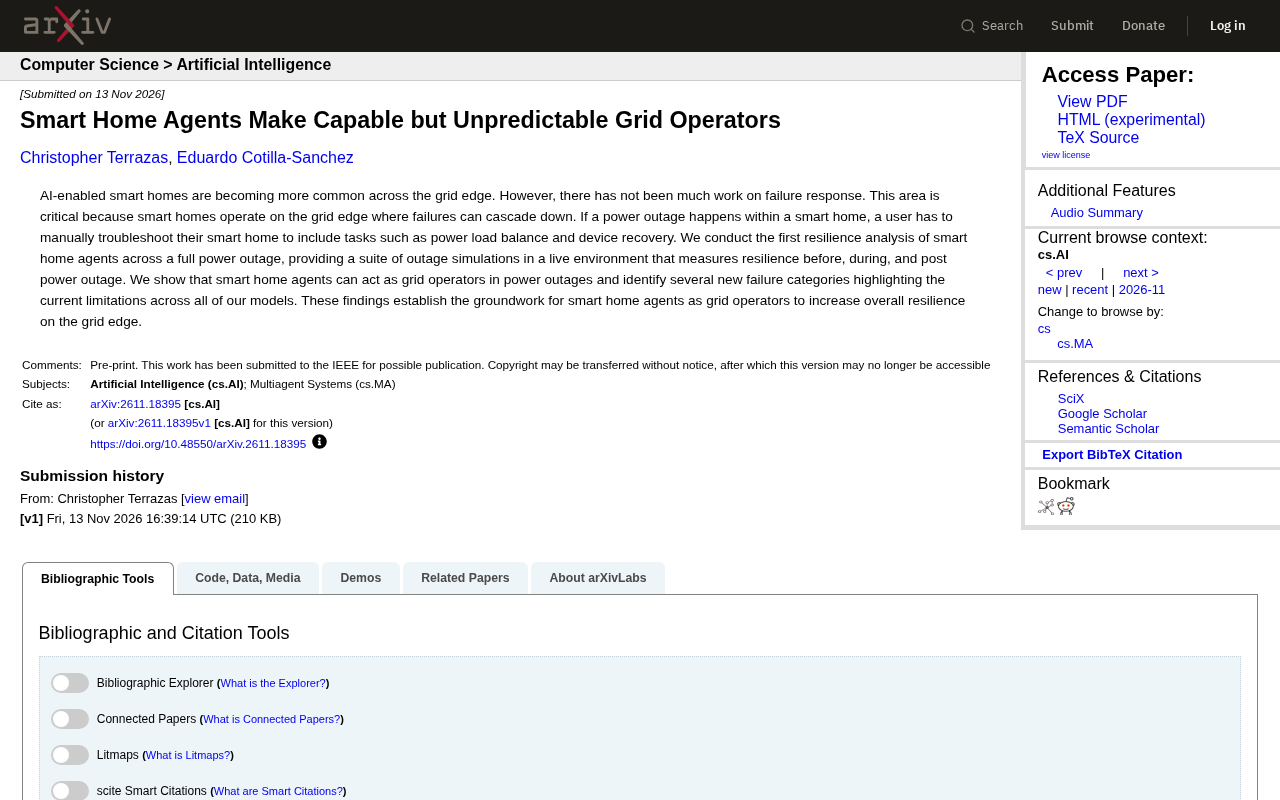
Study is the first to evaluate smart home agent resilience across a complete blackout cycle, finding them capable but unpredictable.
A new study is the first to analyze smart home AI agent resilience across a complete blackout cycle (before, during, after) in a live environment. Agents proved capable of acting as grid operators—handling load balancing, device prioritization, and recovery—which could reduce cascading failure risk at the grid edge. But testing revealed multiple new failure categories spanning all tested models, indicating common methodological limitations. The core weakness is unpredictability: agents can act, but users cannot foresee their behavior, a real risk for high-determinism grid scenarios. The study maps the problem rather than solving it.
Smart home devices are moving from single-point automation toward "home microgrids" orchestrated by AI agents. But a key question has long been overlooked: when a blackout actually occurs, can these agents reliably keep a home running? A new study conducted the first resilience analysis of smart home agents across a complete blackout cycle, and the conclusion is intriguing—they are capable of acting as grid operators, but their behavior is unpredictable.
Why Blackout Response Is a Blind Spot in Smart Homes
The study points out that AI-driven smart homes are increasingly being deployed at the grid edge. What makes this position special is that failures on the edge cascade downstream—a power supply problem inside a single home can be amplified.
The real-world pain point is concrete. Once a blackout occurs within a smart home, users often need to troubleshoot manually—balancing power loads, restoring devices one by one, and confirming which tasks can still continue running. These tasks should ideally be handled automatically by agents, yet almost no research has systematically evaluated agent failure modes in such scenarios.
The authors' core judgment is that blackout response is a necessary milestone on the path to practical smart home agents, and it has previously been largely a research blank.
Grid Edge refers to the part of the power system close to end users, at the末端 of the distribution network, including smart homes, distributed solar, energy storage batteries, and EV charging stations. Unlike the top-down centralized dispatch of traditional grids, grid-edge devices have a degree of autonomous decision-making capability and can perform power balancing and demand response locally. The advantage of this architecture is fast response and reduced pressure on the backbone grid, but the risk is that failures or misoperations of edge devices can cascade downstream along distribution lines—a power anomaly in one home may affect other users on the same feeder. Therefore, the behavioral reliability of edge-side agents directly affects local grid stability.
Simulating a Complete Blackout in a Live Environment
The experimental design of this work deserves attention. The research team did not stop at simulation—they built a blackout simulation setup in a live environment, covering three phases: before, during, and after the blackout, measuring the agent's resilience in each.
This "full-cycle" perspective is critical. Many systems perform stably under normal power supply, and problems surface precisely at the moment of state transitions—blackout triggering, power restoration, devices coming back online. These transition periods are where failures concentrate. Testing only steady state without testing transitions is equivalent to missing the most important part.
Resilience in power systems and cyber-physical systems generally refers to a system's ability to maintain critical functions, recover quickly, and adapt to changes after a disturbance (such as a blackout, communication interruption, or device failure). Unlike "reliability," which focuses on the probability of failure-free operation during normal conditions, resilience emphasizes degraded operation and recovery capability under abnormal conditions. For smart home agents, resilience assessment needs to cover three phases: before blackout (state awareness and contingency planning), during blackout (load management and priority scheduling), and after blackout (devices coming back online and state consistency recovery). Testing only functional performance under steady state cannot reflect the agent's true behavior at the moment of state transitions—and the latter is precisely where failures concentrate.
Agents Can Indeed Play Grid Operator
The study offers a largely positive conclusion: smart home agents can act as grid operators during blackouts. This means that operations such as load allocation and device priority management, which previously required manual intervention, are within the agent's capability.
For the overall resilience of the grid edge, this is a significant finding. If every home node can autonomously maintain critical loads during a failure, the risk of cascading failure could be reduced. The authors position this direction as a foundation for future research—not an endpoint, but a starting point.
But Unpredictability Is the Real Problem
The phrase "Capable but Unpredictable" precisely captures the other side of the study. The team identified several new failure categories during testing, and these failure modes span all the models they tested, indicating that the problem is not an incidental flaw of a particular implementation but a common limitation at the current methodological level.
In other words, the agent can do things, but you don't know how it will act next time. For scenarios like the power grid that demand extremely high determinism, unpredictability itself is a risk. Users cannot predict which device the agent will prioritize during a blackout, whether it will misjudge load status, or whether devices will repeatedly drop offline during the recovery phase.
This study does not offer a solution; it maps the problem terrain: first proving the agent is capable, then pointing out where the uncertainty behind that capability comes from. For teams looking to push smart home agents into production environments, this failure taxonomy list may be more valuable as a reference than the positive conclusions.
Failure Taxonomy is a structured classification of system failure modes. In AI agent research, failure categories are typically divided by trigger conditions, manifestations, and scope of impact—for example, perception misjudgment, decision conflicts, incorrect recovery sequences, and state inconsistency. The finding in this study that "failure categories span all tested models" has methodological significance: it means these failures are not incidental flaws of a specific model or implementation but common limitations of current smart home agents in blackout scenarios. The value of such a taxonomy list lies in providing a reproducible testing benchmark for future research and a checklist for developers to perform targeted validation before deployment.
Implications for the Industry
From the grid-edge perspective, smart homes are no longer just consumer electronics but a large number of small dispatch units distributed at the末端 of the distribution network. Their collective behavior affects local grid stability. The signal from the study is that before deploying agents at scale in homes, resilience validation for blackout scenarios should become a standard step, not an afterthought.
For developers, predictability may need to be treated on par with functionality—in low-frequency but high-risk scenarios like blackouts, an agent with predictable behavior but limited capability may be more suitable for dispatch duties than a more capable but unpredictable one.
One-line Summary
Study is the first to evaluate smart home agent resilience across a complete blackout cycle, finding them capable but unpredictable.
Paragraph Summary
A new study conducted the first resilience analysis of smart home AI agents across a complete blackout cycle (before, during, and after) and built a blackout simulation in a live environment. The study found that agents are capable of acting as grid operators, handling tasks such as load balancing, device priority management, and recovery during blackouts, which could help reduce cascading failure risk at the grid edge. However, testing also identified multiple new failure categories that span all tested models, representing common limitations at the current methodological level. The core weakness is unpredictability—agents can do things, but users cannot predict their behavior, posing a substantive risk for grid scenarios that demand high determinism. The study does not offer a solution but maps the problem terrain, laying a foundation for future research.
Related articles

Gemini 4 Neon vs Claude Opus 5.5: Who Wins Across Five Real-World Tasks?
Bilibili creator tests Gemini 4 Neon vs Claude Opus 5.5 across 3D video, games, design, writing, and advice. Neon matches Opus daily, but 3D and design still lag.

Former Huawei Genius Youth Open-Sources AI Agent Guide: 90+ Hands-On Case Studies
Former Huawei Genius Youth Li Bojie open-sources AI Agent Book, the most systematic Chinese Agent learning repo on GitHub, with 90+ runnable examples covering context compression, memory frameworks, MCP tool calling, prompt injection attack and defense, and other enterprise-level hands-on content.

The Most Detailed FDE Tutorial on Bilibili: Case-Based Teaching from Business Practice to Interviews
B站UP主推出FDE从入门到面试实战教程,讲师深入业务一线,用马氏学习平台真实案例讲解FDE岗位要求。本文分析案例教学法、笔记策略与私密信息处理,为AI岗位求职者提供参考。