Can't Stick with Self-Studying Deep Learning? The Study Buddy Model Can Carry You Through 60 Days

Use study buddy accountability to survive 60 days of self-studying deep learning.
Self-studying deep learning is notoriously hard to sustain alone. Inspired by a Reddit student's real post seeking study partners, this article explores why peer accountability beats solo willpower, backed by psychology research. It includes a practical 60-day deep learning roadmap covering foundations, core architectures, and Transformers, plus tips for building an effective co-learning group.
A Real Cry for Help: The Loneliness of a Self-Taught Deep Learning Student
I recently came across a post on Reddit from a junior studying Computer Science (AI/ML track) — simple in tone, yet incredibly representative. He had just finished learning the fundamentals of machine learning and was ready to formally dive into deep learning. In his own words: "I'm an average student, but I know that with consistency, I have the potential to learn and keep improving."
He candidly admitted that his biggest challenge wasn't ability — it was the difficulty of maintaining self-discipline and accountability when studying alone. So he was looking for 2–3 equally serious and committed partners to co-create a 60-day deep learning roadmap, set weekly goals, share resources, and hold brief Zoom discussions on weekends.
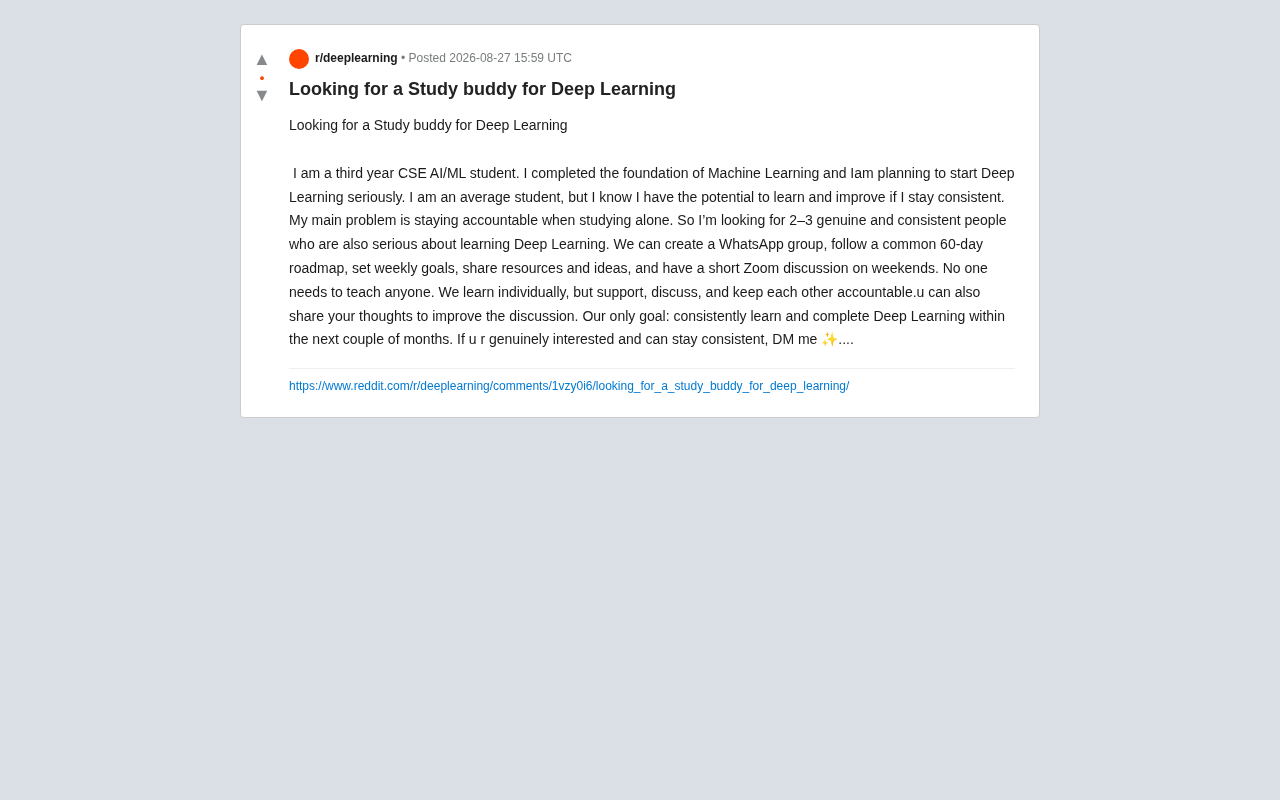
You might have missed it, but he explicitly stated that "nobody needs to teach anybody" — everyone studies independently but supports, discusses, and holds each other accountable. Behind this post lies a widely overlooked truth: In the AI learning boom, consistency is rarer than intelligence.
Why Is Self-Studying Deep Learning So Hard?
The Learning Curve Is Steep, Making It Easy to Give Up Halfway
Deep learning has a fairly high barrier to entry. From backpropagation and gradient descent, to Convolutional Neural Networks (CNNs) and Recurrent Neural Networks (RNNs), to today's Transformers and Large Language Models — the knowledge density is extreme.
It's worth unpacking why these concepts create such a steep learning curve. Backpropagation is the core algorithm behind deep learning training — it uses the chain rule to propagate output errors back through the network layer by layer, computing the gradient of each parameter with respect to the loss function. Gradient Descent then uses this gradient information to iteratively update parameters, steering the model toward an optimal solution. These two concepts involve extensive multivariable calculus and matrix operations, and for first-time learners, understanding the mathematical derivation at every step of the computation graph is often the first major obstacle. The evolution from CNNs to Transformers represents architectural innovation across different data modalities — CNNs efficiently process spatial information through local receptive fields and weight sharing, RNNs capture temporal dependencies through hidden states, and Transformers model global context in parallel through the self-attention mechanism. The theoretical complexity of these architectures compounds progressively.
For an undergraduate who has just finished the basics of machine learning, facing these concepts alone makes it easy to feel defeated at the first failed mathematical derivation or unsuccessful hyperparameter tuning session.
Lack of Immediate Feedback Slowly Drains Motivation
The biggest enemy of self-study is the "feedback vacuum." When you finish writing model training code and it won't converge, there's nobody to tell you whether the problem lies in data preprocessing, the learning rate, or the network architecture. This uncertainty continuously erodes motivation, leaving you in a loop of wondering whether you're just "not cut out for this."
The Psychological Dilemma of Self-Discipline
Psychological research has long demonstrated that public commitment and social accountability significantly increase goal completion rates. When you're only accountable to yourself, procrastination costs virtually nothing. But when a few people are expecting your weekend progress report, persistence gains external reinforcement. This is exactly the core logic behind this student's search for study buddies.
The public commitment effect was systematically described by social psychologist Robert Cialdini in his classic work Influence. Its core mechanism is the "consistency principle" — once people make a public commitment, they feel a strong internal drive to keep their behavior consistent with that commitment, because breaking a public promise creates cognitive dissonance and social evaluation pressure. Research on social accountability further shows that when individuals know their behavior is being observed and evaluated by others, their goal persistence rate can reach 1.5 to 2 times that of working alone. A study by the American Society for Training and Development (ATD) found even more specifically that sharing a goal with someone else raises the completion probability from 25% to 65%, and establishing a regular check-in mechanism can push it further to 95%. This provides a solid psychological foundation for the study buddy model.
What Makes the Study Buddy Model So Effective?
From Individual Struggle to Group-Driven Momentum
The poster's proposed model is remarkably practical:
- Shared roadmap: A unified 60-day study plan that prevents chaotic, fragmented progress
- Weekly goals: Breaking the big objective into actionable small tasks
- Resource sharing: Exchanging quality tutorials, papers, and code repositories
- Weekend discussions: Regular Zoom sync-ups to review progress and troubleshoot
This hybrid model of "independent study + collective accountability" preserves the flexibility of individual learning while leveraging group dynamics to solve the self-discipline problem. At its core, it's a lightweight peer learning community.
The theoretical foundation of peer learning traces back to Vygotsky's "Zone of Proximal Development" theory and the social constructivist view of learning. Vygotsky argued that when learners interact with peers of similar ability, they can reach cognitive zones inaccessible through solo study. Modern educational research further confirms that the knowledge construction process among peers — including questioning, explaining, and debating — activates deeper cognitive processing. Unlike traditional classrooms, equal learning relationships remove authority pressure, making learners more willing to expose their knowledge gaps — and this "safe vulnerability" is precisely the prerequisite for deep understanding. In online learning contexts, early data from platforms like Coursera and edX showed that learners who participated in study groups had course completion rates 3 to 5 times higher than solo learners.
Why Not a "Teacher-Student" Model
The poster deliberately emphasized that "nobody needs to teach anybody," and this is a wise distinction. Traditional mentor-mentee models burden the more advanced person with teaching responsibilities, creating an imbalance that's hard to sustain. In an equal learning relationship, everyone is both a contributor and a beneficiary. The intellectual collisions that emerge from discussion are often more valuable than one-way instruction — the Feynman Technique has long told us that explaining a concept to someone else is the best way to solidify your own understanding.
The Feynman Technique is named after Nobel Prize-winning physicist Richard Feynman. Its core steps are: choose a concept, try to explain it in the simplest language to someone who knows nothing about it, identify where you get stuck or vague during your explanation, return to the source material to re-study those weak spots, and finally refine and polish your explanation until it's clear and fluent. This method works because the act of "teaching" forces the brain to reorganize fragmented knowledge into a coherent narrative structure while exposing "pseudo-knowledge" — things you thought you understood but were merely familiar with. In the deep learning domain, this means that when you try to explain to a study buddy why BatchNorm accelerates training, or the logic behind multi-head attention's dimension splitting in Transformers, your understanding of these concepts will make a qualitative leap.
A Practical 60-Day Deep Learning Plan
If you're looking to join or form a similar study group, here's a reference roadmap framework.
Phase 1 (Days 1–20): Building Foundations
- Review core concepts in linear algebra, calculus, and probability theory relevant to deep learning
- Master fundamental neural network principles: forward propagation, backpropagation, loss functions
- Get comfortable with a mainstream framework (PyTorch or TensorFlow) and complete your first handwritten digit recognition (MNIST) project
Regarding framework selection, PyTorch and TensorFlow are the two dominant deep learning frameworks today. PyTorch, developed by Meta (formerly Facebook) AI Research, is known for its dynamic computation graphs and Pythonic API design, and it holds an overwhelming advantage in academic research — as of 2024, over 80% of papers at top AI conferences (such as NeurIPS, ICML, ICLR) use PyTorch implementations. TensorFlow, developed by Google Brain, has a more mature production deployment toolchain (including TensorFlow Serving and TensorFlow Lite) and still sees widespread use in industry. For beginners, PyTorch's debugging experience more closely resembles standard Python development with more intuitive error messages, making it the increasingly preferred entry point in recent years. Regardless of which framework you choose, the core concepts — tensor operations, automatic differentiation, model definition, and training loops — are transferable.
MNIST (Modified National Institute of Standards and Technology), the handwritten digit dataset released by Yann LeCun and colleagues in 1998, has long been considered the "Hello World" of deep learning. It contains 60,000 training images and 10,000 test images, each a 28×28 pixel grayscale handwritten digit (0–9). The dataset's special value lies in its simplicity (modern models easily achieve 99%+ accuracy), allowing beginners to focus their attention on understanding the framework workflow and building the training pipeline rather than getting overwhelmed by complex data preprocessing or model tuning.
Phase 2 (Days 21–40): Core Architectures
- Deep dive into Convolutional Neural Networks (CNNs) with hands-on image classification tasks
- Study Recurrent Neural Networks (RNN/LSTM) and understand sequence modeling
- Master commonly used training techniques like regularization, batch normalization, and Dropout
Phase 3 (Days 41–60): Advanced Topics & Real-World Projects
- Learn the attention mechanism and Transformer architecture
The Attention Mechanism was first introduced by Bahdanau et al. in 2014 for machine translation. Its core idea is to allow the model to dynamically "attend to" the most relevant parts of the input sequence when processing each output element, rather than relying on a fixed-length vector to compress all information. In 2017, a Google team proposed the Transformer architecture in the paper Attention Is All You Need, completely abandoning RNN's recurrent structure and building models solely with self-attention and feed-forward networks. Self-attention computes the association strength between any two positions in a sequence using three sets of matrices — Query, Key, and Value — enabling modeling of global dependencies while allowing parallelized computation that dramatically improves training efficiency. Transformers have not only given rise to revolutionary large language models like BERT and GPT but have also triggered paradigm shifts in computer vision (ViT), speech processing, protein structure prediction (AlphaFold2), and other fields — making it the most important architectural cornerstone in today's AI technology stack.
- Experiment with transfer learning and fine-tuning pre-trained models
Transfer Learning operates on the core assumption that general feature representations learned on large-scale data can be transferred to downstream tasks, even when downstream data is scarce. In computer vision, ResNet or EfficientNet models pre-trained on ImageNet have already learned hierarchical features from edges and textures to semantic objects. In NLP, GPT or BERT have acquired rich linguistic knowledge through pre-training on massive text corpora. Fine-tuning is the most common transfer learning strategy — typically freezing the lower layers of a pre-trained model (since lower-level features tend to be highly generalizable) and training only the top layers, or all parameters, to adapt to a specific task. This approach dramatically reduces the need for labeled data and computational resources — a student with a consumer-grade GPU and a few hundred images can train an image classifier with excellent performance, something nearly unimaginable in the era of training from scratch. Hugging Face's Model Hub now hosts over 500,000 pre-trained models, making transfer learning the default paradigm in modern AI development.
- Complete an end-to-end project and add it to your portfolio
The Key to Maintaining Momentum
Report in weekly, share progress publicly, and ask questions in your group chat as soon as problems arise. Completion always matters more than perfection — it's better to study 30 minutes a day for 60 consecutive days than to binge 8 hours in a burst and disappear for a week.
What One Post Reveals About the Changing AI Self-Study Ecosystem
This seemingly ordinary help-wanted post actually reflects a widespread anxiety among today's AI learners: resources are never in short supply — what's missing is a method and companionship for staying the course. In an era overflowing with MOOCs, YouTube tutorials, and open-source code, information overload actually worsens the "know a lot but can't learn it" paradox.
The explosive growth of AI learning resources has created a paradox: the more choices available, the worse decision paralysis becomes. Searching "deep learning tutorial" on YouTube alone returns over a million results. Coursera, Udacity, fast.ai, Stanford CS231n — each has its strengths and weaknesses. Open-source projects on GitHub are equally overwhelming. The "Paradox of Choice" in psychology points out that too many options don't improve satisfaction but instead increase anxiety and regret — learners often waste enormous amounts of time in the recurring hesitation of "Did I pick the best tutorial?" The deeper problem is that fragmented free resources lack systematic curriculum design and progressive difficulty sequencing, making it easy for learners to fall into the trap of "skipping ahead" or "repeatedly studying material they've already mastered." This is precisely why a 60-day roadmap with clear milestones and goals, along with a learning community that provides a sense of direction, has become so precious in an age of resource abundance.
The truly scarce resource isn't knowledge itself — it's sustained execution. Study buddies, co-learning communities, and daily check-in systems are becoming increasingly popular in the AI field precisely because they address the most genuine need of our time — finding a few people willing to persevere together on the lonely self-study journey.
For everyone who is currently on or about to embark on the deep learning path, this post serves as a reminder: Don't underestimate the power of learning together.
Related articles

Why Does the Tesla Roadster Need to Fly? A Deep Dive into Musk's Wild Demo
Tesla's Roadster launch showed wall-climbing, upside-down driving, and flying stunts—but The Vergecast notes the demo car may lack a battery, the Rocket version is invite-only and not street-legal, and the website terms don't guarantee delivery. After nine years of delays, why does this car still need to exist?

AI Is Not a Replacement: Human-AI Collaboration Through the Lens of Factory Root Cause Analysis
Starting from factory root cause analysis, this article explains how AI accelerates evidence chain construction rather than replacing human experts, exploring the pragmatic implementation logic and business value of 'AI supporting people rather than replacing them.'

AI Agent Decision Auditing: Building an Evidence Chain in Regulated Workflows
Starting from a Reddit discussion, this article analyzes three core issues in AI agent decision auditing within regulated workflows: what fields audit records should contain, how to handle feedback latency for erroneous decisions, and how to continuously calibrate LLM judge consistency with human judgment.