Can't Use Claude Code? Hands-On Guide to Accessing Opus 4 via Cursor and Windsurf

Chinese developers can access Opus 4 via Cursor or Windsurf with Alipay, bypassing Claude Code restrictions.
Claude Code requires overseas phone verification, blocking access for Chinese developers. This article introduces two alternatives: Cursor and Windsurf, both built on the VS Code core, supporting Opus model access and Alipay payment without needing international credit cards or phone numbers. Considering community ecosystem maturity and feature completeness, Cursor is recommended as the best Claude Code alternative.
Why Claude Code Isn't Accessible for Chinese Developers
Many developers in China want to experience the programming capabilities of the Opus model in Claude Code, but they encounter a hard barrier in practice — Claude officially requires verification through a foreign phone number. Without an overseas phone number, you're essentially locked out.
Claude Code is a command-line AI programming tool launched by Anthropic that runs directly in the terminal. It can understand the entire project's codebase structure and autonomously perform file read/write operations, execute commands, handle Git operations, and more. Unlike traditional chat-based AI assistants, Claude Code adopts an Agentic working mode — it can autonomously plan multi-step tasks and execute them progressively, rather than just answering individual questions. Agentic AI is one of the most important paradigm shifts in the AI field during 2024-2025. Traditional AI assistants use a "question-and-answer" interaction model where the user asks a question, the AI returns a result, and the interaction ends. In Agentic mode, AI possesses four core capabilities: autonomous Planning, Tool Use, Environment Perception, and Self-Reflection. In programming scenarios specifically, this means AI no longer just generates a code snippet — it can autonomously analyze requirements, formulate implementation plans, write code step by step, run tests, and fix bugs based on error messages, forming a complete closed loop. The underlying foundation for this capability relies on large language models' long context windows, Function Calling mechanisms, and the maturation of the ReAct (Reasoning + Acting) inference framework.
Notably, Agentic Coding has become the main battleground of AI programming in 2025. Besides Claude Code, OpenAI launched Codex CLI, Google released Jules, and Microsoft's GitHub Copilot rolled out its Agent mode — all major players are investing heavily. This trend is driven by three technical factors: the leap in model capabilities (especially the widespread adoption of 200K+ context windows, enabling AI to understand large codebases in a single pass), the standardization of tool-calling protocols (such as Anthropic's Model Context Protocol, or MCP, which unifies how AI interacts with external tools), and the maturation of sandbox execution environments (allowing AI to safely run code and system commands in isolated environments without damaging the user's system). This deeply integrated working approach is the core reason Claude Code attracts so many developers.
Opus 4 is currently the strongest code generation and reasoning model in the Claude series, achieving industry-leading results on authoritative code evaluation benchmarks like SWE-bench. It particularly excels at complex cross-file refactoring, long-chain logical reasoning, and contextual understanding of large codebases. SWE-bench is a software engineering capability benchmark introduced by Princeton University researchers in 2023 and is widely regarded as one of the most authoritative standards for measuring AI programming ability. It extracts thousands of real Issues and corresponding Pull Requests from real open-source GitHub projects (such as Django, scikit-learn, sympy, etc.), requiring AI models to understand an Issue description, autonomously locate the code files that need modification, generate correct patches, and pass the project's unit tests. Unlike evaluations like HumanEval that focus on algorithm problems, SWE-bench assesses AI's comprehensive capabilities in real software engineering environments — including cross-file code comprehension, dependency analysis, test-driven development, etc. — making it more reflective of a model's performance in actual development work. SWE-bench also has subsets of varying difficulty: SWE-bench Lite contains 300 manually curated high-quality test cases, while SWE-bench Verified has each test individually validated by human developers for reliability and fairness. As of mid-2025, Opus 4 achieves a pass rate exceeding 72% on SWE-bench Verified, significantly leading other competing models. This means it can independently solve over 70% of real software engineering problems — a figure that was below 40% just a year ago, showing remarkable progress. Compared to the Sonnet series which prioritizes speed and cost efficiency, the Opus series focuses on reasoning depth and task completion quality, which is the core reason many developers are willing to pay more to use Opus.
Since Claude Code can't be used directly, are there other ways to access the same Opus model? The answer is yes. Below are two tested alternatives to Claude Code, both supporting domestic payment methods with very low barriers to entry.
Alternative 1: Accessing Opus 4 via Cursor
Cursor is currently the hottest AI code editor, with built-in support for multiple large language models, including Claude Opus 4. For developers looking for a Claude Code alternative, Cursor is the top choice.

Cursor is deeply customized based on VS Code's open-source core, inheriting VS Code's massive plugin ecosystem and familiar user interface while natively integrating AI capabilities into the underlying architecture. VS Code (Visual Studio Code) was open-sourced by Microsoft in 2015, with its core code hosted on GitHub under the MIT license, allowing anyone to build their own editor product on top of it. VS Code became the preferred foundation for AI code editors for three reasons: first, it has an ecosystem of over 40,000 extension plugins covering virtually all programming languages and development scenarios; second, its Extension API is mature enough to allow deep customization of editor behavior; third, its cross-platform architecture based on the Electron framework enables unified operation across Windows, macOS, and Linux. Cursor, Windsurf, and earlier products like Gitpod and Theia all chose to fork the VS Code core, allowing developers to seamlessly migrate their existing keyboard shortcuts, theme configurations, and plugin dependencies, greatly reducing switching costs.
Cursor's core technologies include: Codebase Indexing, which builds a semantic index of the entire project so the AI has global contextual awareness when answering questions. The core process of codebase indexing works as follows: first, all source code files in the project are parsed, and code snippets are converted into high-dimensional vector representations through an Embedding model; then these vectors are stored in a local vector database; when a user asks a question or initiates an edit request, the system finds the most relevant code snippets through semantic similarity search and injects them as context into the large language model's prompt. This RAG (Retrieval-Augmented Generation) architecture solves the limited context window problem of large language models — even if a project has hundreds of thousands of lines of code, the AI can precisely locate the most relevant parts for analysis and modification. It's worth noting that code Embedding differs significantly from natural language: semantic understanding of code requires consideration of Abstract Syntax Tree (AST) structure, type information, function call graphs, and other dimensions, so code Embedding models typically need specialized training on large code corpora. The precision of vector retrieval directly determines the quality of AI responses — if the retrieved code snippets aren't relevant to the user's question, the output may be inaccurate regardless of how capable the underlying model is.
Additionally, Cursor provides a multi-model routing mechanism, allowing users to freely switch between GPT-4o, Claude Sonnet, Claude Opus, and other models; as well as Agent mode, similar to Claude Code's agentic capabilities, which can autonomously execute terminal commands and create/modify files. Both Cursor and Windsurf now support Anthropic's MCP (Model Context Protocol). MCP is an open standard designed to unify how AI models interact with external tools and data sources — think of it as "the USB port of the AI world." By configuring MCP Servers, users can have their AI programming assistants directly connect to databases, call internal APIs, read tickets from Jira or Linear, access Figma designs, and more, extending AI capabilities from "reading and writing local files" to "interacting with the entire development toolchain." The widespread adoption of this protocol is reshaping the capability boundaries of AI programming tools.
Steps to Use Opus 4 in Cursor
After opening Cursor, switch in the editor's model selection interface to find the Opus 4 option. The entire process doesn't require configuring an API Key or using a VPN — the editor handles model calls internally. The reason Cursor doesn't require users to configure their own API Key is that it manages model call quotas uniformly through its subscription system, essentially acting as a middleware layer between users and model providers, greatly simplifying the user experience.
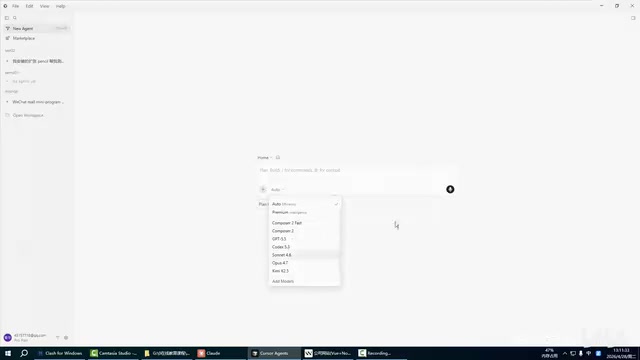
A major highlight of Cursor is that it already supports Alipay payment. Chinese users don't need to bind a Visa or MasterCard — they can simply complete their subscription with Alipay to unlock the full capabilities of the Opus 4 model. This payment integration is implemented through international payment gateways like Stripe. Stripe is one of the world's largest online payment infrastructure providers, processing payments for millions of businesses in over 100 countries. Stripe partnered with Alipay as early as 2017, integrating Alipay as one of its supported Local Payment Methods in its payment gateway. When a Chinese user selects Alipay payment in Cursor, the actual fund flow is: the user completes the RMB deduction through Alipay → Stripe handles currency conversion and compliance settlement as the intermediary → final settlement in USD to Cursor's operating entity. This model is fully compliant and falls under normal cross-border service trade payments. According to China's State Administration of Foreign Exchange (SAFE), individuals enjoy an annual facilitated foreign exchange quota equivalent to $50,000 USD, and purchasing overseas SaaS services through Alipay falls under normal expenditure in the service trade category, well within policy limits. Stripe's compliant operations in the Chinese market are completed through its licensed partners, ensuring complete settlement records and tax documentation for every transaction. This is fundamentally different from gray-channel approaches like virtual credit cards, eliminating the payment barriers that Chinese developers have long faced.
After purchase, you can directly use Opus 4 in Cursor for code writing, debugging, and refactoring — the AI programming experience is virtually indistinguishable from Claude Code. For most Chinese developers, this is currently the most convenient, lowest-barrier way to use Opus.
Alternative 2: Accessing Opus via Windsurf
Windsurf is another code editor with AI model integration that also offers access to the Opus model, serving as an alternative AI programming tool beyond Cursor.
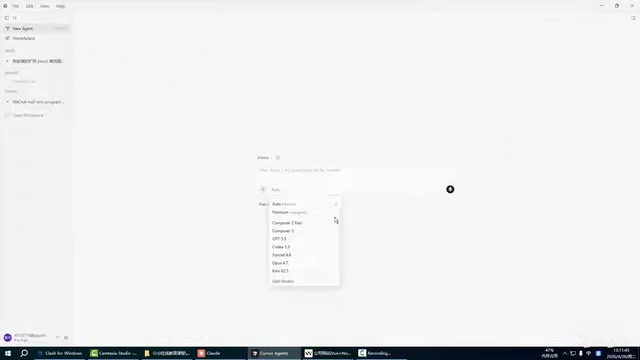
Windsurf is developed by the Codeium team, which previously built a large user base in the developer community with its free AI code completion plugin (according to official data, over 700,000 registered developers globally). In late 2024, Codeium was acquired by OpenAI for $3 billion, which further validates the strategic value of the AI programming tool space. Windsurf is also built on the VS Code core but takes a different approach to AI interaction design — it emphasizes the Cascade workflow, where AI can automatically decompose a complex task into multiple sub-steps and continuously perceive context changes during execution, dynamically adjusting subsequent operations. The Cascade workflow draws inspiration from the Task Decomposition methodology in software engineering. In traditional AI-assisted programming, users need to manually break a large task into multiple smaller tasks and feed them to the AI one by one. Cascade attempts to automate this process: when a user describes a high-level requirement (such as "add user authentication to this project"), the AI automatically decomposes it into sub-tasks like creating data models, writing authentication middleware, modifying route configuration, adding a front-end login page, writing test cases, etc., and executes them in dependency order. While executing each sub-step, the AI perceives the output of preceding steps and potential side effects, dynamically adjusting subsequent plans. This "plan-execute-observe-adjust" loop essentially encodes software engineering best practices into the AI's workflow, similar to Claude Code's Agentic mode, and is suitable for development scenarios requiring multi-step complex tasks.
How to Use Opus in Windsurf
After opening Windsurf, you can find the Opus model option in the model selection area at the bottom right of the editor. Note that the free version of Windsurf has limited functionality, and calling the Opus model requires purchasing the corresponding paid plan.
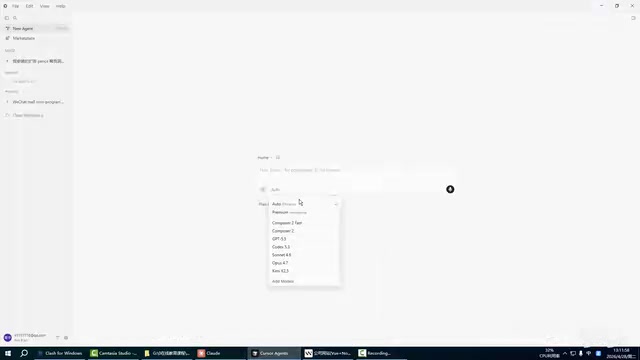
Like Cursor, Windsurf also supports China-friendly payment methods like Alipay. After subscribing to an appropriate plan based on your usage frequency, you can normally use the Opus model for AI-assisted programming in the editor. Besides Claude Opus, Windsurf also integrates products from multiple model providers, giving users more options.
Cursor vs. Windsurf: Feature and Experience Comparison
Both AI code editors can serve as alternatives to Claude Code, but they differ in the details. Here's a comparison across key dimensions:
| Dimension | Cursor | Windsurf |
|---|---|---|
| Opus Model Version | ✅ Opus 4 | ✅ Opus |
| Alipay Payment | ✅ Supported | ✅ Supported |
| Free Version Usability | Partially available | Partially available |
| Learning Curve | Low | Low |
| Community Ecosystem | More mature, larger user base | Relatively newer |
| AI Interaction Mode | Multi-model routing + Agent mode | Cascade workflow |
| Underlying Architecture | Deep VS Code core customization | VS Code core + Codeium tech stack |
| MCP Protocol Support | ✅ Supported | ✅ Supported |
From a practical experience standpoint, Cursor has higher community momentum and a more complete plugin ecosystem, making it easier to find solutions when encountering issues. If you can only choose one AI programming tool, Cursor is the recommended first choice. Windsurf is equally reliable as an alternative — its Cascade workflow has unique advantages when handling multi-step complex tasks, making it suitable for developers who want an additional option or a comparative experience.
Summary: The Shortest Path for Chinese Developers to Access the Opus Model
For Chinese developers who cannot directly use Claude Code, accessing the Opus model through third-party AI code editors is currently the most practical solution. Both Cursor and Windsurf have integrated domestic payment channels — no overseas phone number needed, no international credit card required — significantly lowering the barriers to entry.
For a long time, one of the biggest obstacles Chinese developers faced when using overseas AI tools was the payment problem. API services from companies like OpenAI and Anthropic typically only accept Visa, MasterCard, and other international credit cards, while many developers in China — especially students and indie developers — don't hold such cards. By integrating international payment gateways that support Alipay, Cursor and Windsurf have eliminated this critical access barrier, enabling Chinese developers to compliantly use top-tier AI programming tools.
Cursor is the recommended first choice — it has the most complete support for Opus 4, and the Alipay purchase process is smooth. If you're looking for a powerful AI programming assistant to replace Claude Code, start with Cursor and experience Opus 4's capabilities in code generation, logical reasoning, and project refactoring. Tools are just means to an end — what matters is using AI to genuinely boost your development productivity.
Key Takeaways
- Claude Code's Opus model requires overseas phone number verification, limiting access for Chinese users
- Cursor supports the Opus 4 model and accepts Alipay payment, making it the most convenient alternative
- Windsurf also supports the Opus model but requires a paid subscription
- Both solutions have integrated domestic payment channels, lowering the barrier for Chinese developers
- The widespread adoption of the MCP protocol is expanding the capability boundaries of AI programming tools, with both Cursor and Windsurf supporting it
Related articles
 Tutorials
ChatGPT Plus Subscription Guide: Are GPT-5.5, image-2, and Codex Worth the Upgrade?
A detailed look at ChatGPT Plus features — GPT-5.5, image-2, and Codex — with a Plus vs Pro comparison and a complete step-by-step subscription guide for users outside the US.
 Tutorials
Harness AI Engineering in Practice: Using Claude Code to Master Enterprise-Level E-Commerce Development
Deep dive into Harness AI Engineering: master enterprise e-commerce development with Claude Code using the Rules, Skills, Wiki, and Changes framework.
 Tutorials
Cursor + Codex Dual-IDE Collaboration: A Practical Methodology for Open-Source Project Customization
A complete methodology for open-source project customization based on real-world experience, detailing the Cursor+Codex dual-IDE workflow, seven-stage process, MVP validation, and AI source code reading techniques.