Can Uploading Consciousness to a Machine Body Achieve Immortality? A Deep Analysis of Pros, Cons, and Philosophical Dilemmas

A deep philosophical analysis of whether consciousness uploading to machine bodies can truly deliver immortality.
This article examines a Reddit thought experiment about uploading consciousness to a machine body for immortality. It explores the tempting benefits—freedom from disease, aging, and human limitations—against profound costs including loss of embodied emotions, the meaning-dissolving paradox of infinite time, technological vulnerabilities, and the fundamental question of whether the uploaded "you" is still you.
A Soul-Searching Question from Reddit
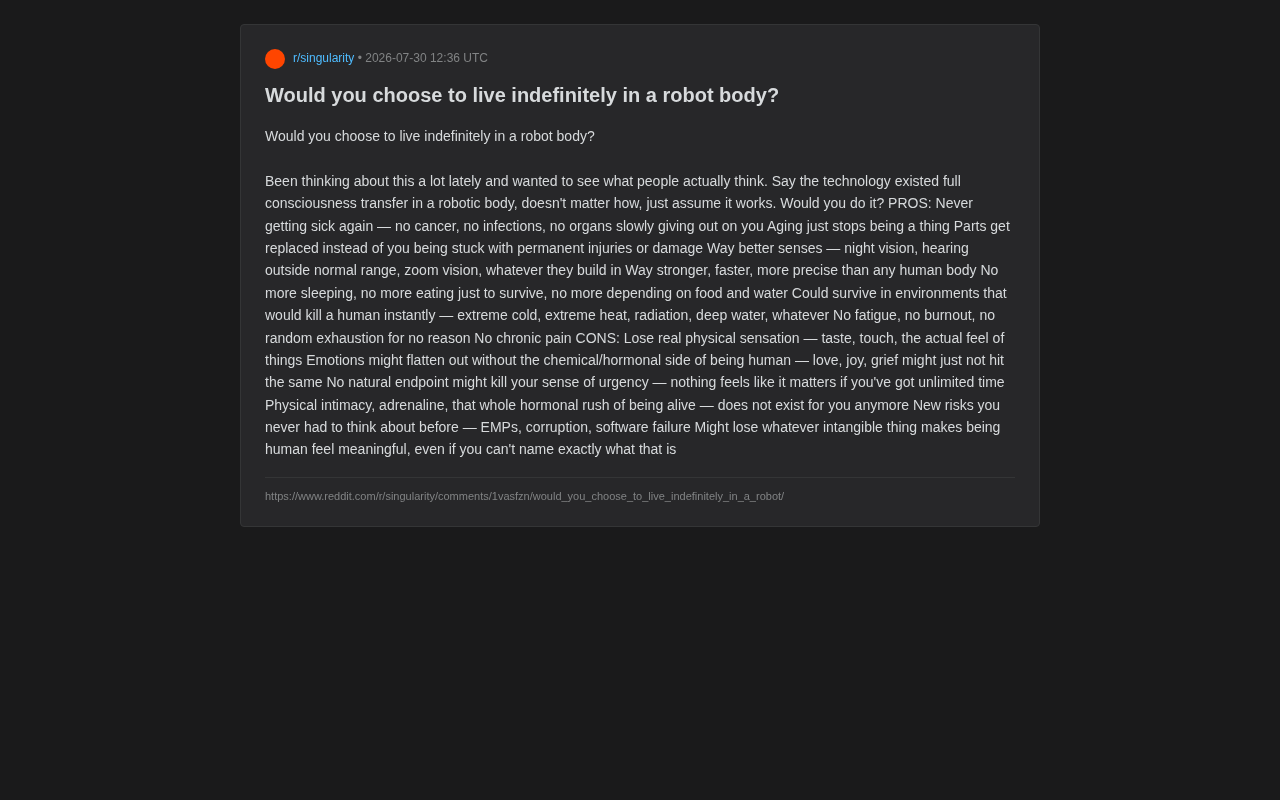
Recently, a post on Reddit sparked intense discussion: assuming consciousness transfer technology has matured, and you could upload your entire consciousness into a robotic body, gaining a form of "immortality"—would you choose to do it?
The poster's hypothesis was pure: regardless of how the technology works, simply assume it "works perfectly." This thought experiment strips away all technical barriers and strikes at a deeper question: When the limitations of flesh are completely removed, what do we have left?
This isn't purely science fiction fantasy. With the rapid advancement of brain-computer interfaces, AI consciousness research, and bionic robotics, "digital immortality" and "consciousness uploading" have gradually moved from science fiction into serious philosophical and technical discourse. Current representative advances in brain-computer interface (BCI) technology include Neuralink's N1 chip human implant trials, the BrainGate project enabling paralyzed patients to control cursors with their thoughts, and Synchron's endovascular stent electrodes. These technologies can currently only read and decode limited neural signals, remaining orders of magnitude away from "full consciousness uploading."
To understand the scale of this gap, we need to recognize a core fact: the human brain has approximately 86 billion neurons, each with an average of 7,000 synaptic connections, forming roughly 600 trillion synapses. The most advanced Neuralink N1 chip has only 1,024 electrode channels, and even Utah arrays have only a few hundred channels. This means our current reading capability is approximately 10^11 orders of magnitude away from complete brain activity. More critically, "reading" signals and "understanding" consciousness are entirely different problems—even if we could record every neuron's activity, we still wouldn't know how consciousness "emerges" from these activities.
The theoretical foundation of consciousness uploading typically relies on the "computationalism" hypothesis—that consciousness is essentially an information processing process that can be reproduced on different substrates. But the neuroscience community is far from consensus on this, particularly regarding whether consciousness has irreducible biophysical properties (such as whether quantum effects participate in consciousness generation). Nevertheless, this question deserves our serious consideration.
The Allure of Machine Body Immortality
The poster listed a rather convincing "pros list" that covers virtually all pain points of the human body.
Farewell to Aging and Disease
The most direct attraction lies in escaping biological fragility. No cancer, no infections, no gradual organ failure. Aging simply "ceases to exist." When a body part breaks down, you simply replace it, rather than being plagued by permanent injuries for life.
For anyone who has experienced chronic pain or witnessed a loved one tormented by disease, this promise carries enormous weight. Biological "entropy increase"—that irreversible, slow bodily decay—is one of the root sources of human fear. From a thermodynamic perspective, biological organisms are dissipative structures far from equilibrium that must continuously consume energy to maintain order, and aging is essentially the gradual decline of this ability to combat entropy.
Capability Upgrades Beyond Human Limits
A machine body also means comprehensive capability upgrades: night vision, hearing beyond normal range, zoom vision, and strength, speed, and precision far exceeding human capabilities. You no longer need sleep or food to survive, freed from dependence on sustenance.
Furthermore, you could survive in extreme environments that would instantly kill humans—extreme cold, extreme heat, radiation, deep water. No fatigue, no burnout, no inexplicable exhaustion. This is essentially a "superhuman" state of existence.
The Price of Consciousness Uploading: What We Might Lose Forever
However, the "cons list" in the post carries no less weight than the pros, and touches on far more fundamental issues.
The Irreversible Loss of Sensation and Emotion
First and foremost is real physical sensation—taste, touch, the genuine texture of things. You might receive sensor data, but whether that's equivalent to the experience transmitted through biological nerves, no one can say for certain.
Even more unsettling is the emotional dimension. Human emotions are largely built on chemical and hormonal foundations. Love, joy, sadness—would these intense emotional experiences become "flat" after losing their biochemical basis? If happiness no longer has dopamine's rush, if sadness no longer carries the body's heaviness, are these emotions still the same emotions?
In fact, human emotions are not purely "information processing" but are deeply embedded in complex neuroendocrine systems. The dopamine system regulates reward anticipation and motivation, serotonin influences mood stability, oxytocin promotes social bonding and trust, and adrenaline drives stress responses. More importantly, neuroscientist Antonio Damasio's "somatic marker hypothesis" posits that emotions are essentially neural representations of bodily states—we "feel" emotions because the brain is monitoring changes in heartbeat, muscle tension, and visceral reactions in real time.
Damasio's hypothesis is supported by extensive clinical evidence. The most famous cases involve patients with prefrontal cortex damage (such as the historical case of Phineas Gage), who retained intelligence and reasoning ability but, unable to normally perceive the body's emotional signals, showed severe deficits in decision-making—unable to make even the simplest everyday choices. This discovery gave rise to the "Embodied Cognition" research paradigm, which holds that cognitive processes don't occur solely in the brain but are distributed across the interactive system of the entire body and environment. Philosopher Alva Noë further argues that consciousness itself is a "skill in action"—fundamentally dependent on the dynamic coupling relationship between organism and environment.
This means that without a body, emotions might not merely become "flat" but may be fundamentally unable to exist in the same way. This finding adds a weighty scientific footnote to the question of whether consciousness can exist independently of the body.
The Immortality Paradox: Infinite Time May Dissolve Life's Meaning
The poster raised a profound insight: Without a natural endpoint, your sense of urgency might die. If you have infinite time, what could possibly seem important?
This touches on a classic proposition in philosophy. Existentialists argue that it is precisely the inevitability of death that gives life meaning and urgency. Martin Heidegger proposed the concept of "Being-toward-death" (Sein-zum-Tode) in Being and Time: it is the anticipatory awareness of death that awakens us from everyday fallenness toward authentic existence. Sartre argued that human freedom and choice carry weight precisely because life is finite and irreversible. Bernard Williams argued in his famous essay The Makropulos Case that immortality inevitably leads to "fatal boredom"—when all possible experiences have been exhausted, existence loses all meaning and motivation. Contemporary philosopher Shelly Kagan takes a different stance, arguing that even in infinite time, people might continuously discover new sources of meaning. The core of this debate lies in: Is meaning "created" by the finitude of time, or does it exist independently of temporal constraints?
From a psychological perspective, this question is equally profound. The human motivation system is essentially a "difference detector"—we are sensitive to change and novelty, and adapt to constant stimulation (hedonic adaptation). Nobel laureate Daniel Kahneman's research shows that human happiness has little to do with absolute conditions and is primarily determined by change and contrast. In infinite time, any finite set of experiences will eventually be exhausted, and adaptation effects will render all experience neutral. Does this mean that an immortal consciousness would ultimately fall into an inescapable psychological equilibrium—an eternal neutral state that is neither happiness nor suffering?
We treasure time, pursue achievement, and deeply love others, to some extent all because of the premise that "life is finite." When this premise is removed, the human motivational structure might completely collapse.
From Biological Fragility to Technological Fragility
A machine body also brings unprecedented risks: EMP electromagnetic pulses, data corruption, software failures. You escape biology's fragility only to fall into technology's fragility. Whether this trade is worthwhile deserves deep consideration.
Electromagnetic pulse (EMP) is an instantaneous release of a strong electromagnetic field that can destroy unshielded electronic devices. Sources include high-altitude nuclear detonations, solar flares (such as a Carrington Event-level solar storm from 1859), and directed energy weapons. For a consciousness carrier dependent on electronic systems for "survival," a single natural disaster or malicious attack could mean "death." Additionally, software-level risks are equally severe: memory bit flips (caused by cosmic rays), storage media degradation, and operating system vulnerabilities being exploited. A deeper question is: who maintains your system? If your "body" depends on a specific company's proprietary technology, then company bankruptcy, technological obsolescence, or license expiration could all become existential threats. Your "immortality" might actually be bound to a technological supply chain that continuously requires updates, maintenance, and payment.
This also raises profound political-economic questions. If your "existence" depends on servers running, then the entity controlling those servers has unprecedented power over you—a power that exceeds any historical form of enslavement, because it's control over existence itself. Digital rights researchers have already pointed out that in the current digital ecosystem, "digital legacy" and "account perpetuity" are already unsolved legal puzzles. Imagine: your consciousness runs on a company's cloud service, and the company changes its terms of service or gets acquired by another company—how are your "human rights" protected in this situation? Can you "migrate" to another platform? If not, you are the most thorough "digital serf" of the digital age.
The Core Philosophical Controversy: What Counts as "Human" After Consciousness Transfer?
This discussion ultimately points to an unavoidable question. The poster captured it precisely in one sentence: "You might lose that intangible thing that makes 'being human' feel meaningful, even if you can't articulate exactly what that is."
The Teleporter Paradox: Is the Uploaded "You" Still You?
Even setting aside emotions and sensation, there's an even more fundamental philosophical puzzle: Is the uploaded "you" still "you"? If consciousness is copied or transferred, is the being that awakens in the machine body a continuation of the original you, or a completely new entity possessing your memories? Did the original "you" die in the transfer process?
This problem, known as the "teleporter paradox," was systematically articulated by Derek Parfit in his landmark work Reasons and Persons (1984). Parfit distinguished between two theories of personal identity: the "psychological continuity" theory holds that as long as memories and psychological characteristics are continuous, identity is maintained; the "physical continuity" theory requires the continuous material existence of the body (particularly the brain). In consciousness uploading scenarios, if a "copy-delete" mode is used (scanning the brain then destroying the original), it faces the paradox of "the original is dead, the copy claims to still be alive." Even a "gradual replacement" mode (replacing neurons one by one with electronic components) faces the classic Ship of Theseus dilemma—when the last biological neuron is replaced, is this entity still "you"? Contemporary philosopher David Chalmers calls this an extension of the "hard problem" of consciousness.
Interestingly, the human brain itself already undergoes a degree of "gradual replacement." Although it was long believed that adult neurons don't regenerate, 21st-century research has found that neurogenesis does occur in regions like the hippocampus. More broadly, the molecules composing neurons—proteins, lipids, ions—are completely renewed within weeks to months. From a purely material perspective, your brain today may share very few atoms with your brain from ten years ago. So what maintains the continuity of "you"? The current mainstream view is that it's the continuity of information patterns (connectivity patterns)—the topological structure and overall pattern of synaptic weights in neural networks remain relatively stable. But this is precisely the argument computationalists use to justify that consciousness can be uploaded: if "you" are essentially an information pattern rather than specific matter, then copying that pattern to another substrate should theoretically preserve "you." The power and danger of this argument is that it both provides a possibility argument for consciousness uploading and implies an unsettling conclusion—"you" may never have been the stable entity you thought you were.
This means the promise of "immortality" itself might be an illusion—the one achieving immortality might not be the current "you" at all.
Can Humanity Be Modularly Optimized?
This pros and cons list reveals a fascinating pattern: almost everything listed as a "pro" involves eliminating human limitations; while almost all the "cons" involve eliminating human experientiality.
In other words, the "defects" we're trying to remove (pain, fatigue, aging) may be precisely two sides of the same coin as the "experiences" we cherish (passion, post-rest satisfaction, the preciousness of time). Human nature perhaps cannot be deconstructed into a modular engineering project of "keep the good, remove the bad." This recognition aligns with insights from complex systems theory: in highly coupled systems, you cannot remove a "bad" attribute without simultaneously affecting the "good" attributes that depend on it. The human mind-body system has been finely tuned through millions of years of evolution, where "defects" often simultaneously serve multiple roles as signals, protection, and meaning generation.
Pain is the most typical example: patients with congenital insensitivity to pain typically have much shorter lifespans than normal people because they lack the instinctive signal to avoid harm. Fatigue is a protective mechanism against excessive wear. Even aging itself, from an evolutionary biology perspective, may serve species-level adaptability by promoting generational turnover. When we attempt to engineer away these "defects," we may be unknowingly dismantling the foundations of the entire meaning structure.
Conclusion: Philosophical Scrutiny That Technological Progress Cannot Avoid
This Reddit post resonates precisely because it uses an extreme hypothesis to force us to think about the essence of human existence.
As AI and bionic technologies accelerate, similar ethical and philosophical questions will no longer be purely intellectual exercises. When technology truly approaches this tipping point, we need not only technical answers about "can it be done" but also value judgments about "is it worth doing."
For the question "would you live in a machine body for immortality," perhaps there is no standard answer. But seriously contemplating this question itself is a precious examination of the eternal proposition "what does it mean to be human." And this, precisely, is a form of thinking that belongs to humanity—one that no machine can replace.
Key Takeaways
Related articles

After Being Laid Off by AI, a Programmer Open-Sourced an AI CEO: Who Should the Automation Axe Really Fall On?
A CEO used AI as a reason to fire developers. They responded by open-sourcing an AI CEO, exposing the power bias in automation narratives and who really should be replaced.

A 4-Year Engineering Study Plan: The Path from Zero to Landing Your First Offer
A systematic 4-year engineering study plan covering foundation building, specialization, interview prep, and job hunting to help students build an actionable technical growth path.

Roc 0.1.0 Preview: A Fast, Friendly, and Functional New Programming Language
Roc language nears its first numbered release 0.1.0, transitioning from experimental to usable. Explore its platform architecture, core features, and toolchain.