Can You Deadlift an Asteroid in Space? The Physics of Mass vs. Weight

Microgravity removes weight, not mass — inertia makes moving objects in space just as challenging.
Using the question "can you deadlift an asteroid in space?" as a springboard, this article tackles a widespread physics misconception: microgravity eliminates weight, not mass. A 100-metric-ton boulder in space has virtually no weight but retains full inertia — 500 newtons of force produces only 5 mm/s² of acceleration, making a 1-meter move take about 20 seconds. The article also highlights a counterintuitive danger: small asteroids have such weak gravity that a normal jump can exceed escape velocity, potentially launching the jumper into space. The key takeaway is that mass and weight are fundamentally different concepts, and the laws of physics are very much alive in space.
Can You "Deadlift" an Asteroid in Space?
Hidden behind what seems like an absurd question lies a widespread misconception about physics: could you lift an asteroid in space the way you'd lift weights at the gym? The answer is — in a sense, yes, but nothing like the way weightlifting works on Earth.
Imagine a boulder weighing 100 metric tons (about 110 US tons). In a microgravity environment, its weight is essentially zero — so in that sense, you could "hold it up." But here's the catch: space doesn't eliminate its mass, and it doesn't eliminate its inertia. That rock still has every bit of its 100 metric tons of mass.

Why "Weightless" Doesn't Mean "Easy to Move"
This is where Newton's Second Law (F=ma) comes in. Suppose you're firmly anchored and push the boulder with 500 newtons of force (about 110 pounds-force). The resulting acceleration is only about 5 millimeters per second squared.
What does that actually mean? Even if you just want to move it 1 meter (about 3 feet) from rest, it would take roughly 20 seconds — and that's just to get it moving. Don't forget: stopping it again requires the same force applied in the opposite direction for just as long.
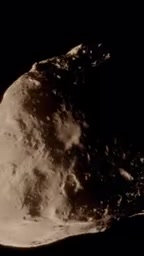
In other words, something that would crush a truck on Earth can technically be pushed in space. But if you wanted to move something even larger, the timescale falls somewhere between "Superman" and "glaciers reshaping continents" — theoretically doable, but agonizingly slow in practice.
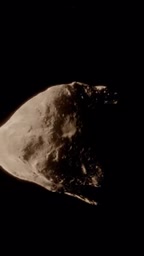
Newton's Second Law (F=ma) describes the relationship between force, mass, and acceleration: the greater the force, the greater the acceleration; the greater the mass, the less acceleration a given force produces. On Earth, moving a heavy object means fighting two things simultaneously — gravity (weight) and inertia (mass). Microgravity eliminates the first, but the second remains fully intact. 500 newtons is roughly the horizontal pushing force an adult can sustain. Applied to 100 metric tons (100,000 kg), F=ma gives us a = 500 ÷ 100,000 = 0.005 m/s² — meaning the object gains only 5 millimeters per second of velocity each second. Even the most basic task of "getting something moving" becomes a prolonged battle against inertia in space.
The Flip Side: One Jump Might Send You Flying Off
Flip the question around and things get even more interesting. On a small asteroid only a few hundred meters across, gravity can be so feeble that a casual jump could exceed the escape velocity.
This leads to a scenario that sounds absurd but is physically real: you're painstakingly nudging a 100-ton rock centimeter by centimeter, when a firm push off the ground accidentally launches you off the asteroid's surface — sending you drifting into space forever.

Escape velocity is the minimum speed needed to break free from a body's gravitational pull, and it depends on the body's mass and radius. Earth's escape velocity is about 11.2 km/s. A small asteroid just 500 meters in diameter with typical rock density might have an escape velocity of only 0.3 to 0.5 m/s — while a human can easily jump at 2 to 3 m/s, far exceeding that threshold. This is precisely why NASA's OSIRIS-REx spacecraft had to control its contact time and thruster output with extreme precision when sampling asteroid Bennu: a slight miscalculation could have caused the probe's own reaction forces to bounce it away. For the same reason, future asteroid mining or deflection missions will require specially designed anchoring systems to prevent equipment — or astronauts — from "escaping."
The Core Lesson: Mass and Weight Are Not the Same Thing
This thought experiment ultimately points to a physical concept that's frequently confused:
- Weight: The gravitational force acting on an object, which depends on the local gravitational environment. In space, weight can approach zero.
- Mass: The amount of matter in an object — a measure of its inertia — which never changes, regardless of location.
Space removes weight. It does not remove mass. These are fundamentally different things. Once you understand this distinction, it becomes clear why astronauts in orbit can effortlessly "hold up" heavy objects yet still can't "fling" them around freely — and why moving around on a low-gravity body requires extraordinary care.
The laws of physics don't stop working in space. They just manifest in ways that defy everyday intuition.
Related articles

iPhone Duo Battery Life Tested: One Charge a Day Is Unavoidable, and the Large Screen Is the Culprit
iPhone Duo battery test: heavy use needs at least one charge a day, and about 30% remains after 6.5 hours of screen-on time. How often the large screen is unfolded is key; a MagSafe battery pack helps, and long-term degradation is also worth watching.

Kimi K3.1 Pro Open-Sourced: 2.8 Trillion Parameters Close In on Opus
Moonshot releases the open-source MoE model Kimi K3.1 Pro, with 2.8T total parameters and 104B activated, trailing Opus 5.5 by under 1 point on Terminal Bench 4.0.

Costco Tech Price Guessing: Are Monitors, Keyboards, Mice, and Bose Speakers Worth It?
A YouTube blogger guesses prices of Costco tech products: 2K 180Hz monitor, Logitech keyboard and mouse, Bose speaker, and CyberPower UPS, revealing warehouse-store selection and brand premium.