"Can You See Everything?" Review: The Addiction to Fame and the Web of Manipulation
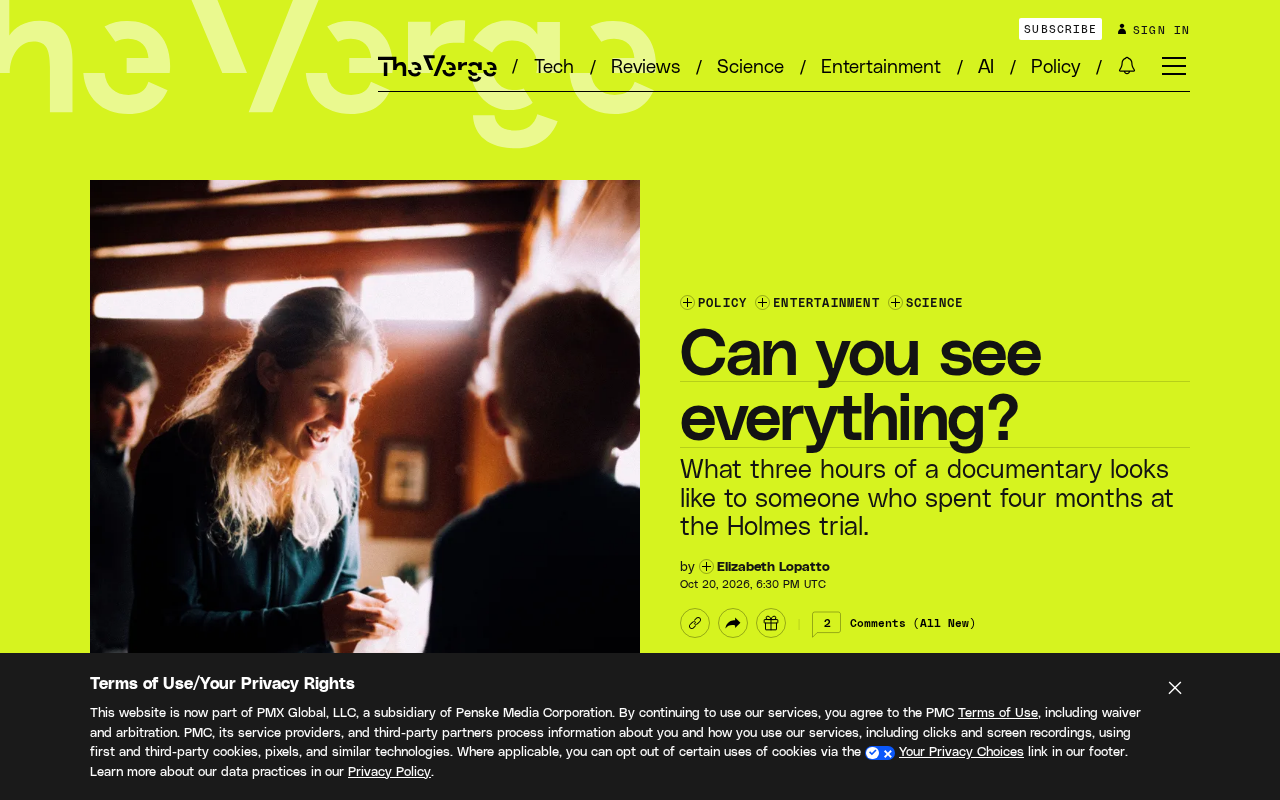
A review uses Holmes's story to explore fame addiction and the many faces of manipulation, asking whether viewers can truly see everything.
This article compiles a review of the film "You Can See Everything," centered on Elizabeth Holmes. Using the idea that fame is the most addictive drug, it explains why the Holmes phenomenon endures. The film goes beyond whether she lied to unpack manipulation of investors, employees, the public, and herself. The title is read as a challenge to viewers' cognitive limits: we see only what we want to see. The film's value lies in rearranging known facts so viewers see themselves as part of the manipulation chain.
Category: expert_opinions
This article is compiled from a public film review and contains spoilers.
Fame: The Most Addictive "Drug"
"Of all the drugs, fame is the most addictive." This widely circulated saying seems to have been confirmed in the case of Elizabeth Holmes. The reviewer admits that this may be the only reason to explain why the film "You Can See Everything" exists—a work whose core explores several varieties of manipulation.
Holmes's story long ago transcended the realm of business news to become a cultural phenomenon. From Silicon Valley star to courtroom defendant, her trajectory has been repeatedly written about, filmed, and interpreted. This film does not stop at the surface level of "did she lie," but attempts to unpack a more complex question: how a person is shaped by her own narrative, and how she uses that same narrative to shape others.
Elizabeth Holmes is the founder of the blood-testing company Theranos, which once claimed it could run hundreds of tests from a single drop of blood and was valued at as much as $9 billion, with Holmes herself regarded as Silicon Valley's most dazzling female entrepreneur. A 2015 investigative report by The Wall Street Journal exposed the technological fraud, the company subsequently collapsed, and Holmes was sentenced in 2022 on fraud charges. Her story became a cultural phenomenon precisely because it condenses the "change the world" rhetoric of Silicon Valley narratives, the media's star-making machinery, and the blindness of capital. Understanding this background is essential to grasping why the review treats "fame addiction" as the core clue for interpreting her—her rise and fall are themselves a public experiment in trust and performance.
The Many Faces of Manipulation
The review points out that the film's core is "several varieties of manipulation." This is not deception along a single dimension but an interwoven web—manipulation of investors, of employees, of the public, and possibly even of herself.
"It is the only explanation for You Can See Everything, a movie that is, at its core, about several varieties of manipulation."
This sentence deserves close reading. "The only explanation" implies the necessity of the film's existence: when a person's story has already been told too many times, a new telling must find a new angle. That angle is "manipulation" itself, rather than a simple "scam."
A telling detail: the review does not portray Holmes as a one-dimensional villain. The addictive nature of fame provides an interpretive framework: what she chased may not have been merely money, but the state of being seen, believed, and looked up to. Once obtained, that state is far harder to withdraw from than one might imagine.
Theranos's manipulation was not an isolated act but unfolded in layers: toward investors, Holmes used forged demonstrations and endorsements from prominent board members to secure massive financing; toward employees, she built a mission-driven closed culture, using non-disclosure agreements and internal intimidation to suppress doubt; toward the public and media, she carefully crafted a "female Steve Jobs" image, reinforcing credibility through symbols such as the dark turtleneck and the deep voice. This multi-faceted manipulation worked because each layer of audience saw only what it expected to see—investors saw returns, employees saw mission, the media saw legend. The review's emphasis on "several varieties of manipulation" is precisely a reminder to viewers: a scam is not a single-point lie but a narrative system customized for different targets.
The Film as a Mirror
The review's title, "Can You See Everything?" is itself a provocative question. It points to the viewer's situation: we think we have seen the whole picture, but what the film asks is—have we really seen it? Or have we only seen the parts we wanted to see?
The value of this film may not lie in offering a new "truth," but in rearranging known facts so that viewers realize they too are a link in the chain of manipulation—manipulated by narrative, and also participants in consuming that narrative. The addiction to fame belongs not only to Holmes but also to the onlookers.
The review's title "Can You See Everything?" carries an implicit reflection on the act of viewing. In the realm of documentaries and biopics, audiences often assume by default that the camera provides objective truth, but a film's editing, selection of material, and narrative framing are themselves a form of construction. When viewers consume Holmes's story, they easily develop a sense of superiority—"I saw through it long ago"—while overlooking that they themselves may have initially been drawn in by a similar narrative. This "hindsight" cognitive bias is precisely part of what the review calls being "manipulated by narrative." The film does not offer new truths but, by rearranging known facts, forces viewers to examine their own viewing position—are they bystanders, consumers, or accomplices?
Editor's Commentary
This is a review with a clear authorial stance, with its core arguments centered on two dimensions: "fame addiction" and "the diversity of manipulation." The original text is limited in information, offering more critical opinion than factual reporting, but its angle is worth discussing. For readers interested in narratives about tech figures, business ethics, and media culture, this film offers a text worth pondering.
One-line Summary
The review uses Holmes's story to explore fame addiction and the many faces of manipulation, and asks whether viewers can truly see everything.
Paragraph Summary
This article is a compiled review of the film "You Can See Everything," centered on the story of Elizabeth Holmes. Taking "fame is the most addictive drug" as its entry point, the review explains why the Holmes phenomenon continues to fascinate the public. The film does not stop at whether she lied, but unpacks various forms of manipulation—of investors, employees, the public, and even herself. The title "Can You See Everything?" is interpreted as a provocation regarding viewers' cognitive limits: we think we see the whole picture, but in fact see only what we want to see. The review notes that the film's value lies not in offering new truths but in rearranging known facts so that viewers realize they too are a link in the chain of manipulation—both consumers of narrative and possible accomplices in the cult of fame.
Related articles

A Single Prompt Triggers a Global PHP Security Storm: Is AI a Savior or a Hidden Risk?
A single AI prompt triggered a global PHP security crisis affecting Wikipedia and the Internet Archive. This article reviews the incident, analyzes the OpenAI-Amazon controversy, and explores the security paradox of lowered vulnerability discovery barriers in the AI era and developer response strategies.

When AI Is Taken Away: How Reliance on Shortcuts Undermines Your Problem-Solving Resilience
A study of 1,222 people found that after using AI to answer questions, once AI was removed, people gave up on more problems than a control group that never used AI. The article analyzes the impact of AI reliance on learning resilience and metacognition, and explores design implications for AI learning tools.

Carta and NewView Partner to Let Startup Employees Cash Out Equity Early
Carta and NewView Capital partner to simplify startup tender offers, helping employees sell equity early. Analysis of the mechanism, liquidity pain points, and impact.