Can Zero-Shot Decision Models Replace Fine-Tuned Classifiers? Testing 24 ACL Papers

Zero-shot typed decision models replaced fine-tuned classifiers on 12/46 ACL test sets, but annotation conventions remain the key weakness.
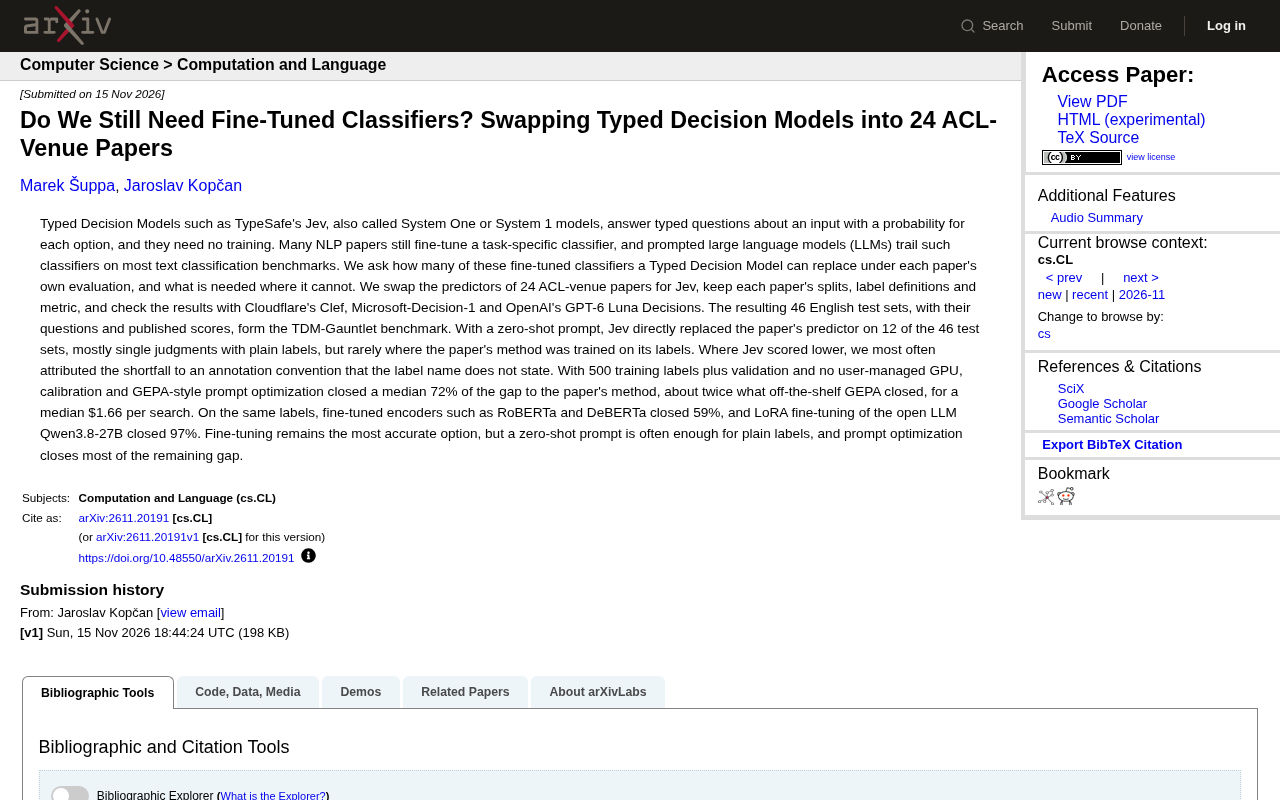
The study swaps TypeSafe's Jev zero-shot decision model into 24 ACL papers, building the 46-test-set TDM-Gauntlet benchmark. Jev directly matched original predictors on 12 test sets, mainly single-judgment and plain-label tasks; gaps mostly stem from annotation conventions. With 500 labels plus validation, calibration and GEPA-style prompt optimization bridge 72% of the gap at a median cost of $1.66; fine-tuned encoders bridge 59%, and LoRA-tuned Qwen3.8-27B bridges 97%. Fine-tuning remains most accurate, but zero-shot prompting suffices for plain-label tasks, and prompt optimization closes most of the remaining gap.
Introduction: Fine-Tuned Classifiers Still Dominate NLP, but Zero-Shot Approaches Are Catching Up
In NLP, fine-tuning a classifier for a specific task is almost standard practice. But a new paper raises a sharp question: if there were a training-free "Typed Decision Model" that could directly answer typed questions and give a probability for each option, would we still need fine-tuning? The researchers swapped TypeSafe's Jev (also called System One or the System 1 model) into the predictors of 24 ACL conference papers, keeping each paper's data splits, label definitions, and evaluation metrics unchanged, and built the TDM-Gauntlet benchmark containing 46 English test sets. They found that Jev under zero-shot prompting directly replaced the original paper's predictor on 12 test sets, but in more cases, fine-tuning remained the most accurate option.
Typed Decision Model (TDM) refers to a class of models that, at inference time, accept a question with type constraints (e.g., "Is the sentiment of this sentence positive, negative, or neutral?") and output a probability for each candidate option. Unlike traditional fine-tuned classifiers, a TDM does not update weights for a specific dataset; instead, it relies on knowledge acquired during pre-training and the label definitions given in the prompt to make zero-shot judgments. TypeSafe's Jev is one representative of this class, also called System One or the System 1 model, emphasizing fast, intuitive single-step decisions. The core advantages of TDMs are low deployment cost and no need for labeled data, but their performance depends heavily on whether the label names and question phrasing can clearly convey the task intent.
Experimental Design: Plugging Decision Models into the Evaluation Frameworks of 24 Papers
The researchers' approach was straightforward: for each ACL paper, they replaced the original classifier with Jev while retaining the paper's own train/test splits, label definitions, and evaluation metrics. To cross-validate the results, they also used Cloudflare's Clef, Microsoft-Decision-1, and OpenAI's GPT-6 Luna Decisions as auxiliary checks. The resulting TDM-Gauntlet benchmark contains 46 English test sets, each with its question format and published score. This "in-place replacement" method most faithfully reflects how zero-shot models perform in real academic evaluations, rather than re-scoring on a unified new benchmark.
GEPA is an evolutionary-algorithm-based prompt optimization method, short for Gradient-free Evolutionary Prompt Adaptation. It iteratively generates prompt variants, evaluates performance on a validation set, retains the winning variants, and continues mutating, thereby searching for more effective prompts without computing gradients. Compared with traditional few-shot example selection or manual tuning, GEPA can automatically explore prompt wording, structure, and example combinations. The "GEPA-style prompt optimization" mentioned in this article combines a calibration step, i.e., after optimization, applying temperature scaling or threshold adjustment to the model's output probabilities to better match the target evaluation metric.
Direct Zero-Shot Replacement: 12/46 Success Rate and Limitations
Under zero-shot prompting, Jev directly matched the original paper's predictor on 12 of the 46 test sets. These successes were mainly concentrated in single-judgment tasks, and the labels were plain labels, i.e., label names that clearly express their meaning on their own. However, when a paper's method was trained on its labels, Jev rarely replaced it directly. This shows that zero-shot decision models excel at tasks where "the question itself makes things clear," while for tasks that require learning annotation conventions from data, zero-shot methods still lag behind.
Gap Attribution: Annotation Conventions Are the Main Weakness
When Jev scored lower, the researchers most often attributed the gap to annotation conventions—annotation rules not explicitly expressed by the label names. For example, a label might be called "positive," but in actual annotation it might include irony or neutral expressions in specific contexts, rules that cannot be directly inferred from the label name. This explains why zero-shot models perform well on plain labels but lose points on complex annotation tasks.
Annotation convention refers to rules that data annotators follow when actually labeling but that are not explicitly written in the label names. For example, a sentiment classification task might label "sarcastic praise" as negative even though it is literally positive; a topic classification task might assign an article with blurry boundaries to a certain category, and the label name itself cannot reflect that boundary. Annotation conventions are key information that supervised learning can capture but zero-shot models struggle to infer, because the model can only see label names and question descriptions and cannot observe annotators' decision patterns. This also explains why fine-tuning still prevails on complex tasks: it learns these implicit rules directly from data.
Prompt Optimization and Calibration: Bridging Most of the Gap with a Small Number of Labels
The researchers further explored how to narrow the gap using only 500 training labels plus a validation set and without user-managed GPUs. They used calibration and GEPA-style prompt optimization, and the median bridged 72% of the gap to the paper's method, roughly twice that of off-the-shelf GEPA, with a median cost per search of $1.66. By comparison, on the same labels, fine-tuned encoders (such as RoBERTa and DeBERTa) bridged 59% of the gap, while LoRA fine-tuning of the open-source LLM Qwen3.8-27B bridged 97%. This shows that prompt optimization can capture most of the performance at lower cost, but fine-tuning still leads in accuracy.
Conclusion: Fine-Tuning Is Still the Most Accurate, but Zero-Shot + Prompt Optimization Is Enough for Many Scenarios
Overall, fine-tuning remains the most accurate option, but zero-shot prompting is often sufficient for plain-label tasks, and prompt optimization can further bridge most of the remaining gap. For scenarios with limited resources or a need for rapid deployment, zero-shot decision models offer an effective training-free path; for tasks with complex annotation conventions and high accuracy requirements, fine-tuning remains irreplaceable. This study provides an evidence-based answer to "do we still need fine-tuned classifiers?": it depends on the task type and the clarity of the labels.
Key Points
- On 46 test sets from 24 ACL papers, zero-shot Jev directly replaced the predictor on 12 test sets, mainly limited to single-judgment and plain-label tasks.
- When Jev performed poorly, the main reason was that annotation conventions were not reflected in the label names.
- Using 500 training labels plus a validation set, calibration and GEPA-style prompt optimization bridged 72% of the gap at a median cost of $1.66.
- On the same labels, fine-tuned encoders bridged 59%, and LoRA fine-tuning of Qwen3.8-27B bridged 97%; fine-tuning remains the most accurate approach.
- Zero-shot prompting is sufficient for plain-label tasks, and prompt optimization can bridge most of the remaining gap.
One-line Summary
A zero-shot typed decision model directly replaced fine-tuned classifiers on 12/46 ACL test sets, but annotation conventions remain the main weakness.
Paragraph Summary
This article swaps TypeSafe's Jev zero-shot decision model into the predictors of 24 ACL papers, building the TDM-Gauntlet benchmark of 46 English test sets. Jev directly matched the original papers on 12 test sets, mainly limited to single-judgment and plain-label tasks; when it performed poorly, the gap was mainly attributed to annotation conventions not reflected in label names. Using 500 training labels plus a validation set, calibration and GEPA-style prompt optimization bridged 72% of the gap at a median cost of $1.66; fine-tuned encoders bridged 59%, and LoRA fine-tuning of Qwen3.8-27B bridged 97%. The conclusion is that fine-tuning remains the most accurate, but zero-shot prompting is already sufficient for plain-label tasks, and prompt optimization can bridge most of the remaining gap.
Related articles

Gemini 4 Neon Leak: A Potential Strong Contender Against Opus 5.5
A Hacker News thread suggests Gemini 4 Neon looks like an Opus 5.5 competitor. This article unpacks the product positioning behind this community signal, shifts in the top-model competitive landscape, and what it means for developers' model selection strategy.

Claude Fable 5.2's Self-Authored Short Film 'Fable' Sparks Discussion
A short film 'Fable,' credited to Claude Fable 5.2 for script, visuals, and directing, appears on Hacker News. This article analyzes the significance of full-pipeline AI creation, community reactions, and what it means for content creators.

Anthropic IPO Pricing: A Signal of AI Giants Going Public
Anthropic's IPO pricing draws attention. This article analyzes its potential impact on AI industry valuation, commercialization paths, and the competitive landscape, and highlights public-market expectations and challenges for AI companies.