Canva Launches Its First AI Image Model: A Design Revolution That Plans Before It Generates

Canva unveils its in-house AI image model Craft, using a plan-then-generate architecture to boost controllability.
Canva has officially released Canva Craft, its first in-house AI image generation model, directly competing with OpenAI, Microsoft, and Google. The model uses a two-stage architecture that creates a design plan before rendering the image, improving precision, consistency, and control. Its edge is deep integration with Canva's template library, brand guidelines, and design tool ecosystem, enabling a design-aware capability general models struggle to match. The article sees this as reducing trial-and-error for users and making AI a collaboration tool for designers, while signaling a shift from "can it generate" to "can it generate on demand." Technical details and availability remain undisclosed.
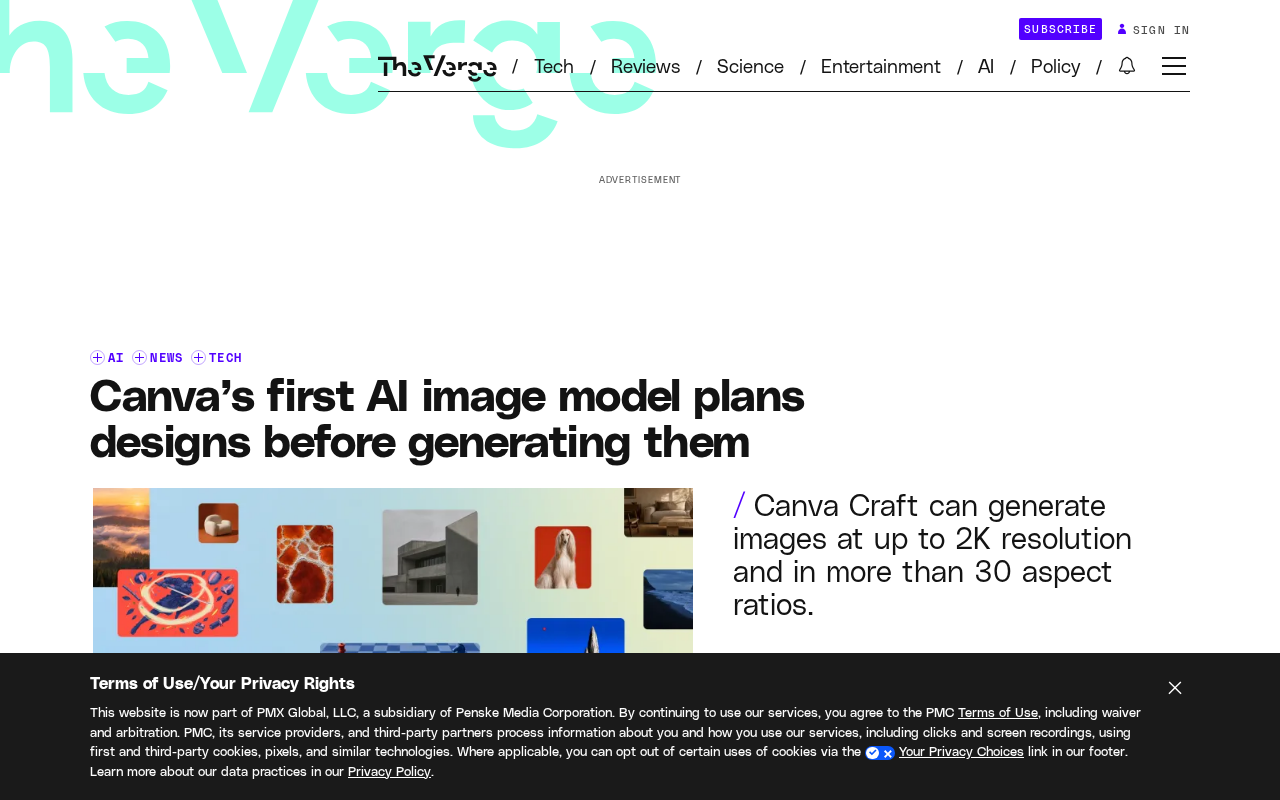
Canva has officially entered the AI image generation space, launching its own in-house model called Canva Craft, directly competing with similar products from OpenAI, Microsoft, and Google. The model's biggest highlight is its two-stage architecture, which plans the design before generating the image, achieving greater precision, consistency, and control. For designers and content creators, this may mark a key step in AI image generation's shift from "random luck" to "controllable creation."
Two-Stage Architecture: Plan First, Generate Later
Traditional AI image generation models typically use an end-to-end approach: the user enters a prompt and the model outputs an image directly. While fast, the results are often difficult to control precisely—especially in scenarios requiring specific layouts, element positions, or brand consistency. Canva Craft's two-stage architecture changes this process: the first stage understands user intent and plans the design, and the second stage generates the actual image based on that plan.
According to Canva, this architecture delivers "greater precision, consistency, and control." In other words, the model no longer blindly "draws" an image from a prompt; it first figures out "what to draw and how to draw it," then executes. This resembles how human designers work—sketching a concept first, then refining the render.
End-to-end models are a modeling paradigm in deep learning where a single unified neural network maps raw input (such as a text prompt) directly to final output (such as a pixel image), without explicitly splitting planning, layout, and rendering into subtasks. Early generative models like GANs and VAEs, as well as later diffusion models, mostly adopted this end-to-end approach. The advantages are a simple training pipeline and fast inference; the drawbacks are that the intermediate process is invisible and non-intervenable, the model has weak control over spatial layout and element relationships, and it is prone to "semantically correct but structurally messy" results. Canva Craft's two-stage architecture supplements the end-to-end paradigm: by explicitly introducing a planning stage, it externalizes implicit layout decisions into an inspectable intermediate representation, thereby improving controllability.
Head-to-Head Competition with OpenAI, Microsoft, and Google
The launch of Canva Craft means Canva is no longer content to merely integrate third-party AI capabilities—it is beginning to build its own underlying image generation technology. Previously, Canva had integrated various AI features into its platform, but the emergence of an in-house model marks a strategic upgrade. Compared with OpenAI's DALL·E, Microsoft Designer, and Google's Imagen, Canva Craft's differentiated advantage lies in its deep integration with design scenarios.
Canva has a vast template library and design tool ecosystem, and the Craft model can fully leverage these resources to understand design intent. For example, when a user needs to generate an accompanying image for a social media post, the model can combine Canva's layout suggestions and brand guidelines to generate images that better meet actual usage needs. This "design-aware" capability is difficult for general-purpose image generation models to match.
The DALL·E, Designer, and Imagen mentioned above represent three types of competitor approaches: OpenAI's DALL·E is a general-purpose text-to-image system based on diffusion models, emphasizing semantic understanding and creative diversity; Microsoft Designer is an AI design tool for office scenarios, mostly relying on OpenAI models under the hood and deeply integrated with the Microsoft 365 ecosystem; Google's Imagen focuses on high-fidelity photorealistic generation and has spawned editing capabilities such as Imagen Editor. Most of these products center on general-purpose image generation, with design specifications, brand assets, and layout constraints left for users to address through prompts or post-editing. Canva Craft's positioning differs in that it embeds generation capabilities into an existing design toolchain, making templates, brand kits, and layout suggestions part of the model's context rather than external constraints.
Impact on Design Workflows
For ordinary users, Canva Craft may mean fewer rounds of trial and error. In the past, when using AI to generate images, users often needed multiple attempts to get a usable result, and two-stage planning is expected to reduce this trial-and-error cost. For professional designers, the control the model provides may make AI a genuine collaboration tool rather than merely a source of inspiration.
However, Canva has not yet disclosed the specific technical details or availability scope of the Craft model. Whether it will be open to all users, what the generation quality is like, and how deeply it will be integrated with existing Canva features all remain to be seen. But one thing is certain: competition in AI image generation is shifting from "can it generate" to "can it generate on demand," and Canva Craft's planning-first approach offers a new direction for this competition.
Brand consistency refers to maintaining unified visual identity elements (such as primary colors, fonts, logo placement, and graphic language) across different media and touchpoints. In AI generation scenarios, general-purpose models often only obey prompts and struggle to automatically comply with brand guidelines, resulting in generated assets that require manual rework. The "consistency" emphasized by Canva Craft is likely built on Canva's existing Brand Kit feature: colors, fonts, and logos preset by users in Canva can be read during the planning stage and passed as generation constraints to the rendering stage. If this mechanism is realized, brand consistency will shift from "post-hoc proofreading" to "built-in at generation time"—one of the key capabilities that distinguishes design-aware models from general-purpose text-to-image models.
Conclusion
The release of Canva Craft is not only a showcase of Canva's technical capabilities but also reflects a trend in the AI image generation industry: control and precision are becoming the new focal point of competition. When generating images becomes effortless, the next problem to solve is how to make generated images truly meet design needs. Canva's answer is to plan first and generate later—whether this approach can stand up to market testing is worth watching closely.
One-line Summary
Canva launches its in-house AI image model Craft, using a two-stage plan-then-generate architecture to improve controllability.
Paragraph Summary
Canva has officially released its first in-house AI image generation model, Canva Craft, directly competing with similar products from OpenAI, Microsoft, and Google. The model uses a two-stage architecture that generates a design plan first and then renders the image, improving precision, consistency, and control. Its differentiated advantage lies in deep integration with Canva's template library, brand guidelines, and design tool ecosystem, giving it a "design-aware" capability that general-purpose models find hard to match. The article argues this could reduce trial-and-error costs for ordinary users, make AI a collaboration tool for professional designers, and signal that competition in AI image generation is shifting from "can it generate" to "can it generate on demand." However, specific technical details and availability scope for Craft have not yet been announced, and its market performance remains to be seen.
Related articles

AgentCore in Practice: Connecting Custom Tools and MCP Servers to Agents
DebuggerCafe tutorial shows how to connect custom tools and MCP servers to Amazon Bedrock AgentCore agents, covering tool contract design, MCP reuse, and production concerns.

816B Parameters Scores Only 39? The Real Cost-Effectiveness of the Open-Source LLM Parameter Race
Meta's 816B Muse Spark Open scores just 39 on Artificial Analysis, while 180B Qwen3.8-Flash-Next scores 40. This article analyzes 11 open-weight models' parameters vs. scores, exploring the real impact of activated parameters, quantized size, and deployment cost.

Aerial Manipulators: The Next Step for Drones from 'Seeing' to 'Changing'
Starting from a Reddit discussion, this article analyzes the technical challenges, potential applications, and deployment bottlenecks of aerial manipulators, exploring the key challenges for drones moving from environmental perception to physical manipulation.