Canva Releases First In-House Text-to-Image Model: Lower Cost, Greater Controllability

Canva launches its first in-house text-to-image model for all users, touting better quality, customizability, and lower cost.
Canva has officially released its first in-house image generation model, available to all users, marking its shift from AI capability consumer to builder of underlying generative capabilities. The company highlights three selling points: generation quality closer to usable assets, finer-grained control over the generation process, and lower usage costs. The article argues that in-house models are inevitable for design platforms—general-purpose text-to-image models struggle to meet design needs such as layout constraints, brand guidelines, and editable layers, while in-house development also offers room to optimize inference overhead. For ordinary users, image generation will shift from an add-on to a default option; for the industry, generative capability is evolving from a differentiator into infrastructure. However, Canva has not disclosed model architecture or training details, and actual capability remains to be validated at scale.
Canva has officially launched its first in-house image generation model and made it available to all users. This move signals that the company, which started as an online design tool, is no longer content to be just a model consumer—it is now extending into underlying generative capabilities.
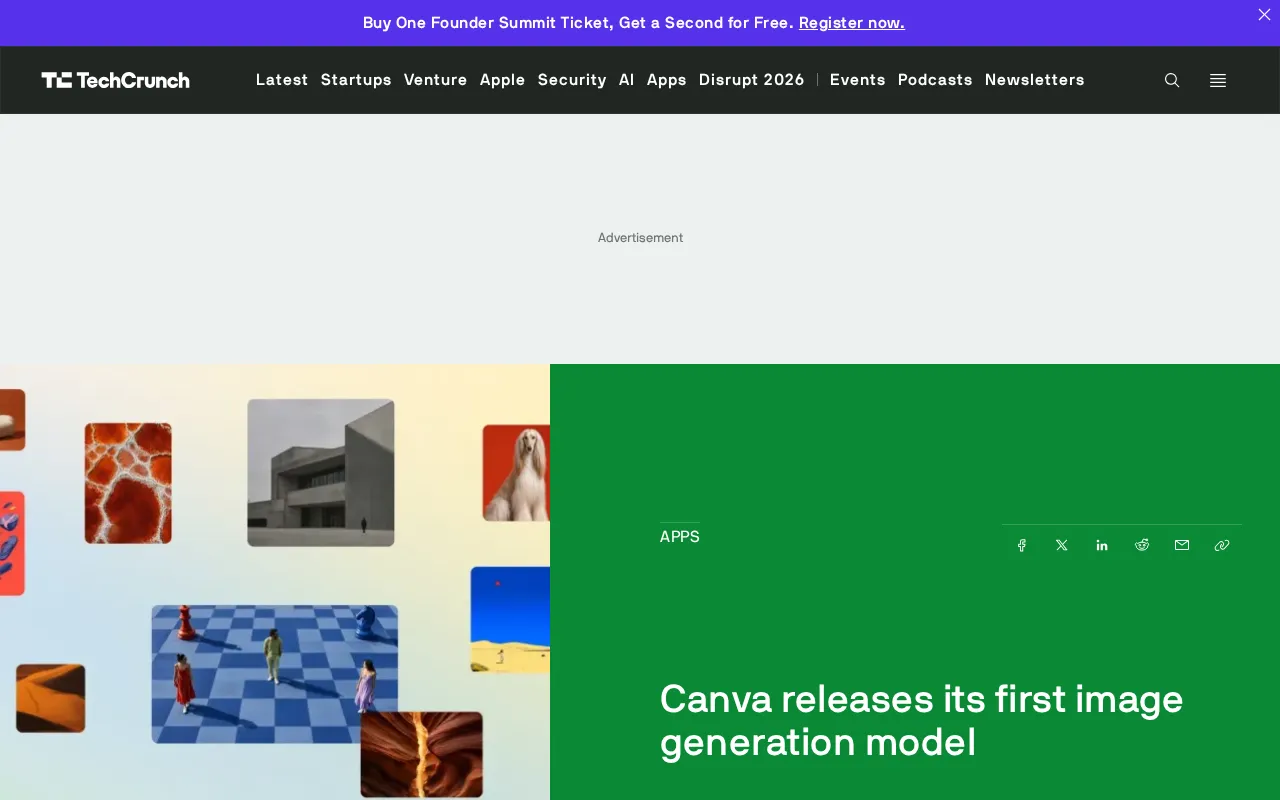
From Design Tool to In-House Model: Canva's Leap Forward
For years, Canva has lowered the barrier to creating visual content through templated design, and its AI features have largely relied on external models or partner capabilities. The launch of its own image generation model marks a key step up the generative AI value chain.
The official positioning is straightforward: available to all users, with simultaneous commitments on quality, customizability, and cost. For a design platform with an enormous user base, driving down inference costs is the prerequisite for turning image generation from a "novelty feature" into an "everyday feature."
A text-to-image model is a class of generative AI model that takes text prompts as input and directly outputs images, typically built on diffusion model or autoregressive Transformer architectures. Diffusion models start from pure noise and progressively reconstruct an image matching the text semantics through a multi-step denoising process; during training, noise is gradually added to real images so the model learns the reverse denoising path. In recent years, mainstream text-to-image models (such as Stable Diffusion, Midjourney, and the DALL·E series) have largely adopted latent diffusion, performing denoising in a compressed latent space to drastically reduce compute overhead. For platform companies, whether to build such models in-house determines whether they have room to independently tune inference costs, output style, and domain adaptation.
Three Keywords: Better, More Customizable, Cheaper
According to Canva, the new model's core selling points center on three things:
- Quality improvement: Generated results look closer to usable assets rather than mere demo-grade output;
- Customizability: Users have finer-grained control over the generation process, which aligns with the real needs of design scenarios regarding composition, style, and element placement;
- Lower cost: The company emphasizes reduced usage costs, which is particularly meaningful for users who rely heavily on design tools.
The combination of these three points is unsurprising. Design users differ from general chat users—they often need to repeatedly adjust the same image, so the real barrier to use is the cost per generation multiplied by the number of iterations.
Why Design Platforms Must Build Their Own Models
General-purpose text-to-image models are already quite mature, but design platforms have special requirements. Templates, brand guidelines, size specifications, and editable layers mean the platform cannot simply be a "generate an image, then download it" pipeline.
An in-house model lets the platform optimize for design scenarios during both training and inference—for example, more reliably respecting layout constraints, or making generated results easier to integrate with downstream editing workflows. Canva's emphasis on "customizability" largely points to this layer of capability, not just prompt-level tweaking.
Another practical consideration is the cost structure. When image generation becomes a baseline platform feature rather than a paid add-on, inference overhead directly hits the platform's gross margin. An in-house model gives the platform room to optimize costs, which is why the company touts "lower cost" alongside "better performance."
Inference cost refers to the compute overhead consumed by a model to fulfill a single generation request. Unlike training cost, it grows linearly with user usage and represents an ongoing expense in a platform's long-term operations. Image generation inference is especially expensive because diffusion models require multi-step iterative denoising—a single image often involves dozens of neural network forward passes, and higher resolution and more steps mean greater overhead. When generation features are opened to a massive free user base, cost per generation multiplied by call volume directly erodes gross margin. Common industry cost-reduction techniques include model distillation, reducing sampling steps, using smaller latent-space resolutions, and optimizing inference on dedicated acceleration hardware. This also explains why platforms building in-house models often promote cost control as equally important as quality improvement.
Editable layers and layout constraints are what distinguish design tools from general-purpose text-to-image products. Traditional text-to-image output is a flattened bitmap that users find hard to decompose into elements, adjust text, or replace local assets; design workflows, however, require generated results to have layer structure, selectable objects, and inheritable brand styles. Making models output structured, editable results usually requires introducing layout control, segmentation masks, or interfaces with vector/layer formats during generation—beyond the default capabilities of general-purpose models. One value of a platform's in-house model is the ability to encode such "generation-as-asset" constraints directly into training and inference, so generated results flow seamlessly into downstream editing rather than remaining at the one-shot demo level.
Impact on Ordinary Users and the Design Ecosystem
For ordinary users, the most direct change is that image generation goes from an "extra feature" to a default option within the platform, further lowering the barrier to use. For professional designers, what's worth watching is how deeply this model integrates with existing editing workflows—whether generated results retain editability is often more important than the polish of a single image.
For the design tool sector as a whole, the signal from Canva's in-house model is clear: generative capability is shifting from a differentiator to infrastructure, and tool-layer companies must either build their own or bind deeply with model providers—the middle ground will only narrow.
Canva did not disclose the model's specific architecture, training data scale, or parameter details in this release, and the absence of this information makes it hard for outsiders to independently judge its true capability level. The model's actual performance will need to be validated by real-world usage feedback at scale.
One-line Summary
Canva launches its first in-house image generation model, open to all users, emphasizing better quality, customizability, and low cost.
Paragraph Summary
Canva has officially released its first in-house image generation model, available to all users, marking the online design tool company's shift from AI capability consumer to builder of underlying generative capabilities. The company summarizes the selling points in three areas: generation quality closer to usable assets, finer-grained control over the generation process, and lower usage costs. The article argues that in-house models are inevitable for design platforms—general-purpose text-to-image models struggle to meet design needs such as layout constraints, brand guidelines, and editable layers, while in-house development also offers room to optimize inference overhead. For ordinary users, image generation will shift from an add-on to a default option; for the industry, generative capability is evolving from a differentiator into infrastructure. However, Canva has not disclosed model architecture or training details, and actual capability remains to be validated at scale.
Related articles

Will GitHub Die? Open Source Maintainer Burnout and the Collaboration Crisis in the AI Era
Lex Fridman podcast discussion on open source maintainer burnout and GitHub's predicament: massive pull requests overwhelm core maintainers, and AI worsens code bloat. Using math journal peer review and Poincaré conjecture verification as analogies, the article analyzes why verification in knowledge production must be deliberately slow, and how open source communities can avoid the failure mode of maintainers exiting.

Stop Building Cookie-Cutter AI Websites: 3 Tools That Transform Your Coding Agent
Three tools that boost AI coding agents: FFmpeg skill for local video editing in Claude Code and Cursor, Hallmark's 50 design themes to fix cookie-cutter AI sites, and Jailbreaks' 25+ model prompts.

How America's Gerontocracy Squeezes the Younger Generation
Americans over 55 hold nearly three-quarters of national wealth, alongside an 80-year-old president and elderly congressional leaders. The Atlantic's Idrees Kahloon explains how gerontocracy drives up housing costs, squeezes opportunities for the young, and explores zoning reform and child poverty reduction as practical fixes.