Caphlon-Model: Pruning + Vocabulary Shrinking Packs a 27B Model into 8GB of RAM
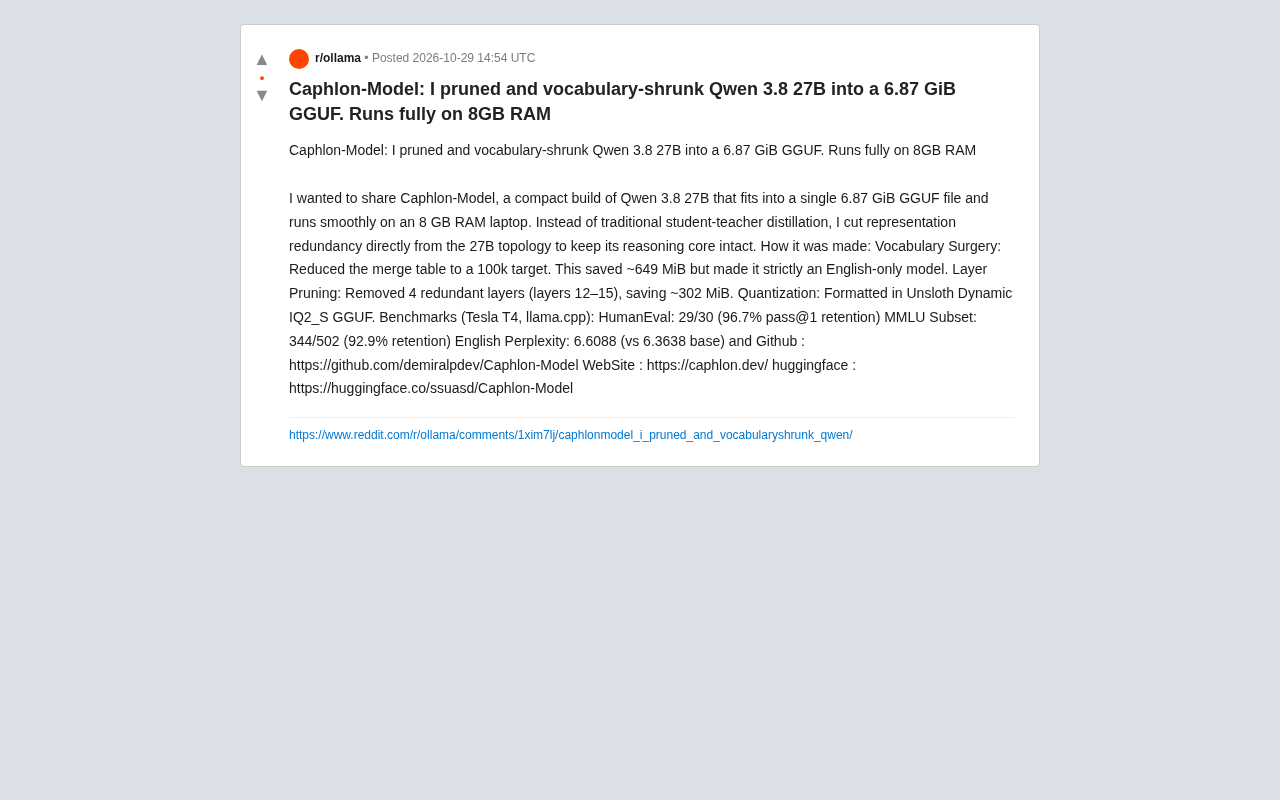
A developer compresses Qwen 3.8 27B into a 6.87 GiB single file via vocabulary shrinking, layer pruning, and ultra-low-bit quantization, runnable on an 8GB RAM laptop.
The Caphlon-Model project proposes a non-distillation large model compression path: directly subtracting from Qwen 3.8 27B's topology instead of having a small model learn the large model's outputs. Compression has three steps—shrinking the merged vocabulary to 100k (saving ~649 MiB but making it strictly English monolingual), removing layers 12-15 (saving ~302 MiB), then quantizing to a single GGUF with Unsloth Dynamic IQ2_S, yielding 6.87 GiB. On a Tesla T4 with llama.cpp, HumanEval pass@1 retention is 96.7%, MMLU subset retention is 92.9%, and English perplexity rises slightly from 6.3638 to 6.6088. It targets English, low-memory, single-file scenarios, but results are single-source self-reports with limited independent reproduction, so verify before production use.
From 27B to 6.87 GiB: A Non-Distillation Compression Path
The tension between large model parameter counts and hardware requirements has long been a pain point for local deployment. A developer on Reddit shared a project called Caphlon-Model: it compresses Qwen 3.8 27B into a single 6.87 GiB GGUF file and claims it runs smoothly on a laptop with 8 GB of RAM. Unlike the common "student-teacher" distillation approach, the author directly operates on the 27B topology, cutting away representational redundancy and preserving the reasoning core.
What makes this path worth noting is that it does not use a smaller model to "learn" the larger model's outputs; instead, it tries to subtract from the original network. For people who want to run large models on consumer-grade hardware, this offers a new way of thinking.
A Three-Step Compression Surgery: Vocabulary, Layers, Quantization
According to the author's public explanation, Caphlon-Model is built in three steps, each with a clear space saving.
Vocabulary Surgery: Merge Table Cut to 100k, Saving About 649 MiB
The first step is so-called "Vocabulary Surgery." The author reduced the merge table to a 100k target, saving about 649 MiB in size. The cost is also direct: the model becomes strictly English monolingual and no longer supports multiple languages.
Layer Pruning: Removing 4 Redundant Layers, Saving Another ~302 MiB
The second step is layer pruning. The author removed layers 12 through 15, four redundant layers, saving another 302 MiB. Based on the description, these four layers were judged to contribute little to the reasoning core, and the network structure remains intact after removal.
Layer pruning differs from quantization: it directly deletes entire decoder layers in the Transformer (usually a complete block consisting of self-attention plus feed-forward network), thereby reducing parameter count and computation rather than merely lowering numerical precision. A common way to determine which layers are redundant is to calculate each layer's contribution to the final output, for example by using cosine similarity to measure the change in hidden states before and after removing a layer. After deleting middle layers, adjacent layers connect directly and the network can still perform forward propagation, but long-tail knowledge or specific language capabilities carried by the removed layers may be lost. Therefore, layer pruning often requires a small amount of recovery fine-tuning; otherwise, performance degradation can be more noticeable than with quantization.
Quantization: Unsloth Dynamic IQ2_S GGUF
The final step is quantization, outputting to GGUF in the Unsloth Dynamic IQ2_S format. This step compresses the remaining weights into a low-bit representation, ultimately producing a single-file size of 6.87 GiB.
With the three steps combined, the model is compressed from its original 27B scale to a level that can fit into an 8GB RAM device.
GGUF is a binary model file format defined by the llama.cpp project, designed specifically for efficient inference on CPUs and consumer-grade GPUs. It packages model weights, tokenizer, and metadata into a single file and supports multiple quantization types (such as Q4_K_M, IQ2_S, etc.). Compared with PyTorch's .bin or .safetensors, GGUF's advantages lie in memory-mapped loading and cross-platform compatibility, making it the de facto standard for local deployment scenarios. File size is directly determined by parameter count and quantization bit width, so the number 6.87 GiB itself shows that the average is only a little over 2 bits per parameter.
IQ2_S belongs to llama.cpp's i-quant series, a quantization format of about 2 bits that uses importance matrices and lattice coding to reduce error at extremely low bit widths. Unsloth Dynamic refers to the dynamic quantization strategy proposed by the Unsloth team: assigning different bit widths to different layers or tensors based on sensitivity, for example preserving higher precision for key attention projections and compressing redundant parts to lower bits. Compared with uniform quantization, dynamic quantization can better preserve model capability at the same average bit width, which is also an important reason why the 6.87 GiB file can still maintain a relatively high benchmark retention rate.
Benchmarks: Reasoning Retention Is the Core Selling Point
The author evaluated the model on a Tesla T4 using llama.cpp, with the following results:
- HumanEval: 29/30, pass@1 retention rate 96.7%
- MMLU subset: 344/502, retention rate 92.9%
- English perplexity: 6.6088, compared with the baseline 6.3638
From the numbers, code generation capability has the highest retention rate, close to full marks; knowledge question-answering tasks retain more than 90%; perplexity rises slightly, indicating a minor loss in language modeling fluency. For such a large compression, this trade-off is quite aggressive but also reasonable—especially the 96.7% pass@1 retention rate, which suggests that pruning did not damage the model's reasoning backbone.
It should be noted that these results are currently self-reported from a single source, and the evaluation sets are also limited in size (30 HumanEval problems and a 502-question MMLU subset), so they cannot be equated with comprehensive performance conclusions.
Perplexity is a classic intrinsic metric for language modeling that measures the model's predictive uncertainty over given text; a lower value means the model is less "surprised" by real text. It is usually calculated on a fixed validation set, making it convenient for horizontal comparison across models, but it does not directly correspond to downstream task accuracy. HumanEval is a code generation benchmark containing 30 hand-written function problems, using pass@1 to measure the proportion of generations that pass unit tests on the first attempt; MMLU is a multiple-choice knowledge benchmark covering 57 subjects, and subset evaluations often sample only part of the questions due to cost. Together, the three characterize the compressed model from language fluency, code capability, and knowledge breadth.
Applicable Boundaries and the Need for Community Verification
Caphlon-Model's positioning is very clear: English, low memory, single file. Vocabulary shrinking makes it completely give up multilingual capability, while layer pruning and low-bit quantization may affect long-tail knowledge and the stability of complex reasoning. It is suitable for resource-constrained local inference, edge device experiments, or as a lightweight base for English tasks.
The author has released the model and code on GitHub, the project website, and Hugging Face (demiralpdev/Caphlon-Model, caphlon.dev, ssuasd/Caphlon-Model). However, independent community reproduction and cross-validation are still scarce at present. Actual throughput under 8GB RAM, performance on different hardware, and the generality of the pruned layer selection are all worth observing in the future.
If you are looking for a large model compression path that does not rely on distillation, this project provides a reproducible sample you can try by hand. But before using it in production, it is advisable to first run a round of validation on your own task distribution.
One-line Summary
A developer used vocabulary shrinking, layer pruning, and extremely low-bit quantization to compress Qwen 3.8 27B into a 6.87 GiB single file that can run on an 8GB RAM laptop.
Paragraph Summary
The Caphlon-Model project proposes a non-distillation large model compression path: directly subtracting from the topology of Qwen 3.8 27B rather than having a small model learn the large model's outputs. Compression is done in three steps—reducing the merged vocabulary to 100k (saving about 649 MiB but making the model strictly English monolingual), removing layers 12 through 15 (saving about 302 MiB), and then quantizing to a single GGUF file with Unsloth Dynamic IQ2_S, for a final size of 6.87 GiB. The author evaluated it on a Tesla T4 using llama.cpp: HumanEval pass@1 retention is 96.7%, MMLU subset retention is 92.9%, and English perplexity rises slightly from 6.3638 to 6.6088. The project targets English, low-memory, single-file scenarios, but the results remain single-source self-reports with limited independent community reproduction, so users should verify before production use.
Related articles

Salesforce Acquires Rune for $375M: AI Logistics Tech Bolsters Defense Business
Salesforce reportedly acquires defense tech startup Rune for $375M. Rune's AI logistics tech will strengthen Salesforce's Missionforce defense platform, continuing its M&A spree.

Why Fair Use Benefits Everyone in the AI Era
Starting from a Hacker News discussion, this article analyzes the legal logic and controversies of the fair use principle in AI training and content creation, and its dual impact on creators and the tech ecosystem.

Mistral Large 4 Open-Sources a Trillion Parameters, Microsoft Offers Voluntary Severance to 60,000 Employees
Mistral Large 4 open-sources a trillion-parameter multimodal model with a coding agent score of 48; SanDisk earnings show AI inference reshaping NAND demand; Google Gemini adds in-app file editing, OpenAI raises Codex quotas, and Microsoft offers voluntary severance to 60,000 employees.