Carbon-X: A 14.8B Open-Source Model That Handles DNA and Text Simultaneously

Open-source 14.8B model Carbon-X unifies DNA and text with 6-mer tokenization, deployable locally on a single GPU.
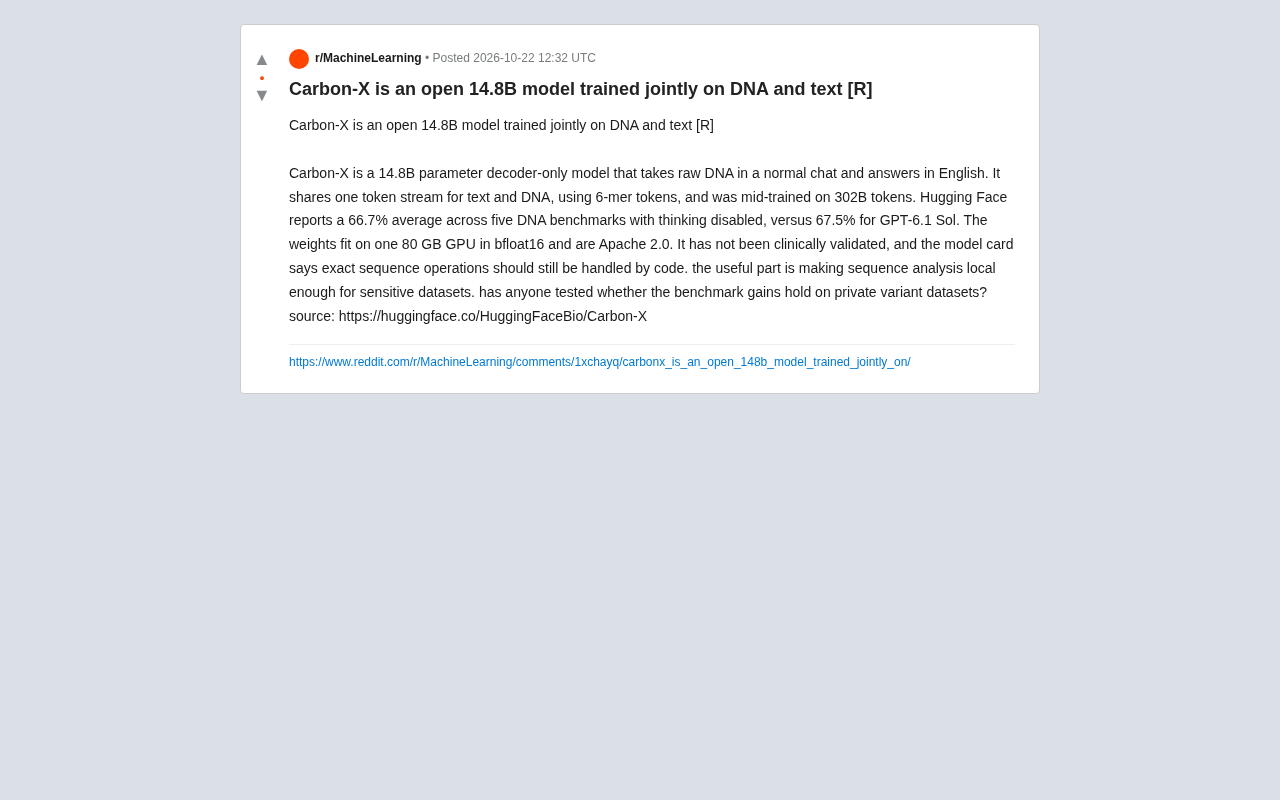
Carbon-X is a 14.8B-parameter decoder-only open-source model that splits DNA into 6-mers sharing the same token stream as natural language. Mid-trained on 302B tokens, users can input raw DNA sequences directly in a chat interface and receive English answers. It scores 66.7% average on five DNA benchmarks (thinking disabled), close to closed-source GPT-6.1 Sol's 67.5%. Weights are Apache 2.0, bfloat16 precision fits a single 80GB GPU. Core value: sensitive genomic data can be processed locally or on internal networks, but the model is not clinically validated and precise sequence operations should still go to code. The article also notes 6-mer tokenization trade-offs for single-base variant resolution, and that public benchmark scores don't represent generalization on private data.
Why Should DNA and Text Share the Same Model?
Traditionally, DNA sequence analysis and natural language processing have been two separate pipelines: one uses specialized bioinformatics tools for sequence alignment and variant annotation, while the other uses large language models to process text. Carbon-X's approach is to put both into the same token stream—DNA is split into 6-mers (groups of 6 bases) and shares a vocabulary with natural language. The model undergoes mid-training on 302B tokens, ultimately producing a single 14.8B-parameter, decoder-only model. Users can paste raw DNA sequences directly into an ordinary chat interface, and the model responds in English.
The significance of this design isn't about "showing off"—it's about lowering the barrier to sequence analysis to the level of conversation. According to the official Hugging Face model card, with thinking mode disabled, Carbon-X scores an average of 66.7% across five DNA benchmarks, essentially on par with GPT-6.1 Sol's 67.5%. Considering the former is an open-source model with Apache 2.0 weights that can be deployed on a single GPU, this gap is nearly negligible.
What Is a Decoder-Only Model?
Decoder-only is the architecture adopted by current mainstream large language models (such as the GPT series): the model uses only the Transformer decoder stack and predicts the next token one at a time in an autoregressive manner. During training, the model predicts subsequent content based on preceding context, using a causal attention mask to ensure each position can only see left-side context; during inference, it generates sequences step by step starting from a prompt. Compared to encoder-decoder architectures (like T5), the decoder-only structure is simpler and naturally suited to conversational interaction of "given some input, continue or answer." Carbon-X adopting this architecture means it can directly accept DNA sequences as prompts in a chat interface and generate answers token by token in natural language or sequence text, without needing an additional encoder or task-specific head.
What Is Mid-Training?
Mid-training refers to a large-scale continued training phase using domain-specific or modality-specific data, occurring after the model completes large-scale general pre-training but before task-specific fine-tuning. Its scale typically falls between pre-training and instruction fine-tuning: much larger than fine-tuning data with broader domain coverage, but not using trillion-level general corpora like pre-training. Carbon-X's mid-training on 302B tokens is precisely aimed at letting the model fully engage with the joint distribution of DNA sequences and biomedical text while maintaining general language capabilities, thereby learning to handle both modalities within the same token stream.
Runs on a Single 80GB GPU—Sensitive Data Never Leaves the Internal Network
Carbon-X's weights in bfloat16 precision can fit into a single 80GB GPU, which is a pragmatic design point for biomedical teams. Genomic data often involves patient privacy and ethical review, and many institutions simply cannot upload raw sequences to third-party APIs for compliance reasons. A locally deployable DNA model supporting conversational interaction means researchers can complete preliminary sequence Q&A and analysis within their internal network, then hand off parts requiring precise computation to code.
The model card also clearly sets boundaries: precise sequence operations should still be performed by code, and the model itself has not undergone clinical validation. In other words, Carbon-X is positioned as "a conversational analysis assistant," not "a clinical tool that can replace workflows." This self-restraint is rare among current genomic AI products.
Beyond Benchmark Scores, Where Are the Real Questions?
The original poster raised a very practical question: do these benchmark improvements still hold on private variant datasets? Public benchmarks are typically cleaned and standardized, while real-world variant data suffers from batch effects, uneven sequencing depth, and population-specific issues. The 66.7% average score is a convincing starting point, but it measures the model's performance on known tasks, not its generalization ability on unfamiliar data distributions.
This is also where the verifiable advantage of open-source models lies: public weights mean research teams can fine-tune and evaluate with their own private data, rather than relying solely on vendor benchmark reports.
6-mer Tokenization Is a Double-Edged Sword
Splitting DNA into 6-mers and mapping them to tokens is essentially a trade-off between sequence length and information granularity. Grouping 6 bases significantly compresses sequence length, allowing the model to see longer genomic regions within a limited context window; the cost is that single-base resolution information is merged, and point mutations—variants involving only one base—may be diluted at the token level.
Neither the paper nor the model card details the specific impact of 6-mer splitting on single nucleotide variant (SNV) detection, which may be something subsequent users need to verify themselves. For tasks dominated by indels or structural variants, the 6-mer compression ratio may be more favorable; for SNV-dense regions, whether an additional single-base encoding channel is needed is worth observing in practice.
How to Interpret the Comparison with GPT-6.1 Sol
67.5% versus 66.7%—a gap of less than one percentage point. But their comparability requires caution: details of the closed-source model's evaluation, prompt design, and whether additional toolchains were enabled are not transparent. Carbon-X's score was obtained with thinking disabled; if reasoning mode were enabled, the score might have room to change. A more reasonable reading is—the open-source community now has, for the first time, a locally deployable option that approaches top closed-source models on DNA benchmarks, rather than "open source has caught up with closed source."
What Are 6-mer and k-mer Tokenization?
k-mer refers to short fragments obtained by sliding a fixed-length window of k across nucleic acid sequences; 6-mer means each group of 6 bases. It's a classic representation method in bioinformatics, commonly used for sequence assembly, species classification, and alignment seeds. In the language model context, 6-mer tokenization is equivalent to expanding DNA's "alphabet" from 4 bases to 4^6=4096 possible 6-mer tokens, then mapping them to token IDs in a shared vocabulary. The effect is similar to BPE subword tokenization in natural language: using longer units compresses sequence length and increases information density, but sacrifices single-base-level resolution. Theoretically, larger k yields higher compression and broader context coverage, but lower sensitivity to fine variants like point mutations; smaller k yields higher resolution but greater sequence length and computational cost. Carbon-X's choice of 6-mer is an engineering compromise between context window and variant detection precision.
What Are SNVs, Indels, and Structural Variants?
Single nucleotide variants (SNVs) refer to the substitution of a single base in the genome, such as A changing to G—the most numerous variant type, associated with many genetic diseases and cancers; insertions/deletions (indels) refer to the insertion or deletion of one or a few bases, which changes sequence length and reading frame; structural variants refer to larger-scale genomic changes such as fragment deletions, duplications, inversions, and translocations, typically involving hundreds to millions of bases. The three variant types differ significantly in detection difficulty: SNVs depend on single-base resolution, indels require handling length changes, and structural variants depend on long-range context and alignment information. This explains why 6-mer tokenization affects different tasks inconsistently—it's most sensitive to SNV resolution while being relatively friendly to large-scale variants.
What Is Thinking Mode?
Thinking mode refers to the model first generating an explicit internal reasoning process (chain of thought) before giving a final answer, then outputting conclusions based on that reasoning. This mode typically improves accuracy on complex reasoning tasks but increases latency and token consumption. The article mentions that Carbon-X's benchmark scores were obtained with thinking mode disabled, meaning the scores reflect the model's "direct answer" capability; if reasoning mode were enabled, the model might improve results through multi-step analysis, with room for score increases—at the cost of higher inference costs. When comparing with closed-source models, whether such modes are enabled is one of the key variables affecting comparability.
Who Should Pay Attention to This Model
From practical use cases, Carbon-X is best suited for three types of people: first, bioinformatics teams that need to process sensitive genomic data within internal networks; second, developers who want to integrate DNA analysis capabilities into their own agent workflows—the Apache 2.0 license provides room for commercial use; third, scholars researching genomic foundation models, for whom the 14.8B scale and multimodal training approach provide a reproducible baseline.
It's not recommended as a clinical decision-making tool—the model card explicitly states this. Nor is it recommended to replace traditional alignment and variant annotation pipelines—precise operations go to code, the model handles understanding and interpretation. This division of labor currently appears to be the most reliable usage pattern.
FAQ
Can Carbon-X directly read FASTA files? The model accepts raw DNA sequence text in conversation, with 6-mer tokenization performed internally. File parsing and format conversion are still best handled by external scripts.
Can it run on consumer-grade GPUs? The official deployment requirement is a single 80GB GPU (bfloat16). Whether quantized versions are available and how much performance is lost is not mentioned in the model card and requires community testing.
Do benchmark scores represent actual analysis accuracy? Not directly. There are distribution differences between public benchmarks and private variant datasets; it's advisable to validate with your own data before deciding whether to incorporate it into your pipeline.
One-line Summary
Open-source 14.8B model Carbon-X unifies DNA and text with 6-mer tokenization, deployable locally on a single GPU.
Paragraph Summary
Carbon-X is a 14.8B-parameter decoder-only open-source model that splits DNA into 6-mers and shares the same token stream with natural language. Mid-trained on 302B tokens, users can input raw DNA sequences directly in a chat interface and receive answers in English. It scores an average of 66.7% across five DNA benchmarks (with thinking disabled), close to closed-source GPT-6.1 Sol's 67.5%. Weights are released under Apache 2.0, and bfloat16 precision fits into a single 80GB GPU. The core value lies in processing sensitive genomic data locally or within internal networks, but the model has not been clinically validated, and precise sequence operations should still be handled by code. The article also notes that 6-mer tokenization involves a trade-off in single-base variant resolution, and public benchmark scores do not represent generalization ability on private data.
Related articles

Gemini 4 Argon Hands-On: AI Builds Board Games, Constructs Temples, and Trains Robots Autonomously
Gemini 4 Argon hands-on roundup: AI autonomously builds a desk racetrack and temple in Blender, writes a ray tracing engine, trains a humanoid robot to sink 7 shots, plus API pricing and developer access.

The Magic Octagonal Coin: Why Only 9% of People Can Predict Its Flip?
Only 9% of people can correctly predict the Magic Octagon coin flip. This article explains its spatial rotation mechanism, common cognitive pitfalls, and a new hypothesis based on Relevance Theory, exploring the limits of human spatial reasoning.

Sam Altman: AI Is Entering the Era of Scientific Discovery — Math Breakthroughs Will Replicate in Biology and Energy
Sam Altman says AI is entering the era of scientific discovery — math breakthroughs will replicate in biology, materials science, and energy to help develop new drugs and energy sources.