Catch a Bird: An Open-Source Mini-Game Made for "Mental Health"

A little bird-catching game one developer made for himself reflects how indie development is shifting from a money-making narrative to self-repair.
Using the small Hacker News project Catch a Bird as an entry point, the article discusses why minimalist "made for myself" projects deserve serious attention. The title directly states the motivation—preserving mental clarity—rather than funding, growth, or business models. From a design perspective, "catching a bird" embodies the classic minimalist loop of goal, action, and feedback: low barrier, high repetition, clear emotional anchor, ideal for testing whether you'd play for five minutes. The piece places it within the indie development wave, where more developers use small but complete projects to counter fragmented and politicized work, turning them into a kind of "technical psychological massage." It ends with three lessons: state the motivation, limit scope, and ship it.
When a Developer Decides to Build Something "for Themselves"
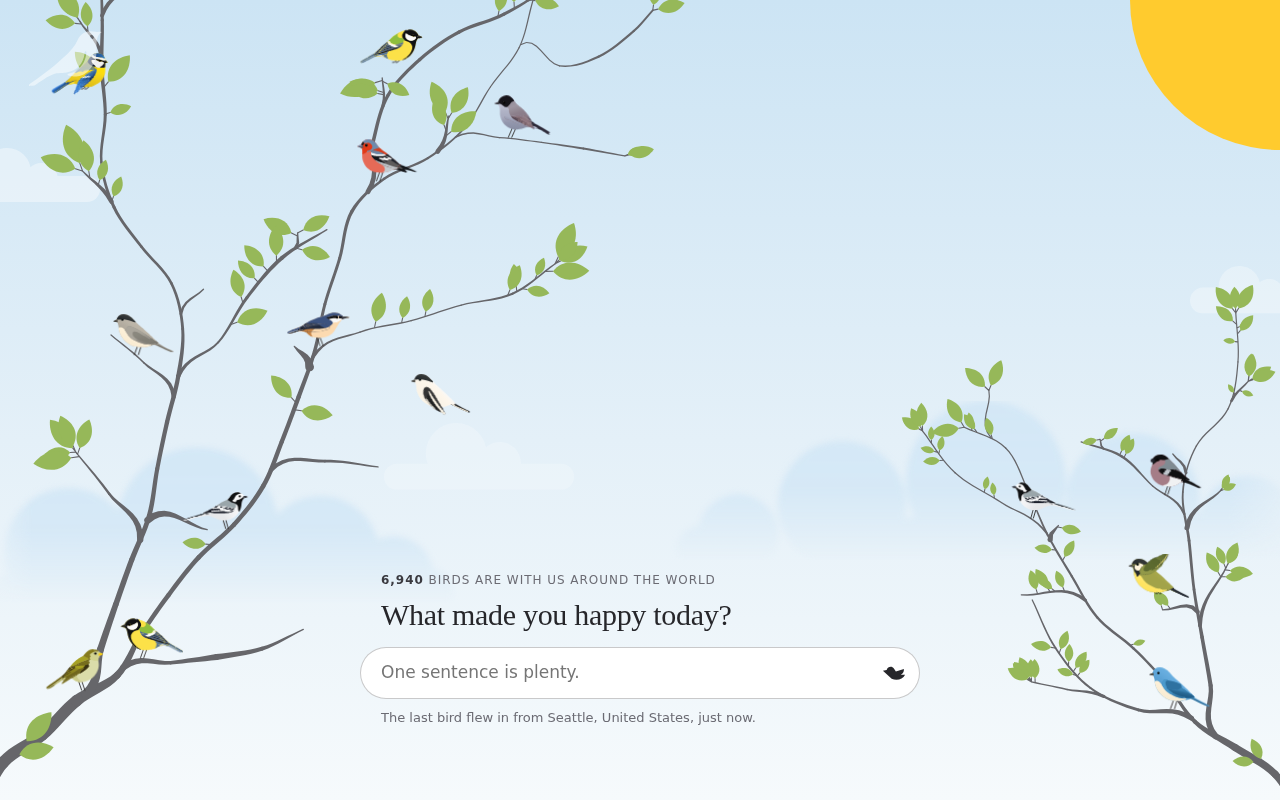
In an ordinary thread on Hacker News, a project called Catch a Bird quietly appeared, with the title reading: "I made it for my own sanity."
No buzz of funding news, no grand narrative from a big company—just one person, one problem, and something that got built.
That phrasing itself is worth pondering. The word "sanity" in English usually carries a weary self-deprecation—it hints at some kind of pressure, some kind of drain, and a moment when you have no choice but to "make something small" to regain a sense of control.
Why "Small Projects" Deserve to Be Taken Seriously
Every year, a large number of similar projects appear and disappear in the tech community. They usually don't get attention from product media because they aren't "big" enough—no business model, no growth metrics, no technical breakthrough.
But it's precisely these kinds of projects that often best reflect a developer's true creative motivation.
From the original information, Catch a Bird is an interactive mini-game (literally "catch a bird"), and the author didn't explain the tech stack in the title, didn't emphasize performance optimization, and didn't mention labels like "AI-driven." He put the motivation first: this was made for himself.
This stance is becoming more and more common in today's indie developer circle. When work projects get more complex, collaboration processes get longer, and code reviews feel more like political maneuvering, writing something "only you care about" becomes a kind of self-repair mechanism.
Seeing the Core of Game Design in the Tiny Action of "Catching a Bird"
Although project information is limited, the action of "Catch a Bird" itself contains a classic game loop: goal (bird), action (catch), feedback (caught or not caught).
This kind of minimalist design usually means a few things:
- Low barrier to entry: Players don't need a tutorial to understand what to do
- High replayability: The action itself is simple, but the result has randomness
- Clear emotional anchor: The satisfaction of catching, or the slight frustration of failing
For the creator, this loop is also the easiest way to verify "whether what I made can keep me willing to play for five minutes." If a developer can't even keep themselves engaged, then the project's meaning may be reduced to just "I made it."
And "I made it"—in the tech environment of 2026—is already no small achievement.
Game Loop is one of the most fundamental and core concepts in game design, referring to the repeated cycle of "action—feedback—adjustment" that players experience in a game. A typical loop contains three elements: the goal state perceived by the player, the actions the player can perform, and the immediate feedback the system gives in response to the result of those actions. Taking "catching a bird" as an example, the bird is the perceivable goal, clicking or swiping is the action, and whether it is caught is the feedback—these three form a minimal loop that can be completed within seconds.
Game designers usually use "loop length" to measure the rhythm of the experience: the shorter the loop, the faster players get into the state, but the easier it is to feel repetitive; the longer the loop, the stronger the immersion, but the higher the cost of entry. Minimalist works like Catch a Bird compress the loop almost to the extreme, letting players understand all the rules on their first click. This design approach is called "one-button game" or "micro-loop design" in indie game circles. Its value is not depth, but verifying whether an idea can prove itself interesting within thirty seconds.
Open-Source Mini-Projects Are Becoming a Kind of "Technical Psychological Massage"
Putting Catch a Bird into a larger context, it is actually a typical sample of the indie development wave in recent years.
More and more developers are using "small but complete" projects to counter the fragmentation of daily work. These projects usually share a few common traits:
- Clear boundaries: No need to consider user growth, commercialization, or long-term maintenance
- Freedom in tech choices: You can use the framework you like, even if it's not mainstream in production environments
- Release is completion: Throw it onto Hacker News or GitHub; if people play it, fine, and if no one does, that's fine too
This is very different from the narrative of "indie developers earning over ten thousand a month" from a few years ago. There is no "make money" and no "side hustle" in the title of Catch a Bird, only "sanity." This change in wording may be more informative than the project itself.
It shows that some developers no longer treat personal projects as a path to financial freedom, but as a kind of daily survival mechanism—just as some people go running after work, some go fishing, and some open an editor to write a little bird-catching game.
Indie Hacking was popularized in the 2010s by people like Pieter Levels, and initially had a strong commercial flavor—one person, one computer, one product that could generate passive income. But over the past few years, there has been a clear split within this community: one camp continues to pursue MRR (monthly recurring revenue) and growth metrics, while another has turned to the so-called "small web" or "personal software" movement, treating projects as vehicles for expression and self-regulation rather than startup springboards.
Echoing this is the evolution of the "Show HN" section on Hacker News. Early Show HN tended more toward technical demonstration, while today more and more post titles are directly written as "I built this for myself" or "I made this to scratch an itch." The popularity of this phrasing reflects a weary backlash among tech practitioners against the narrative that "everything can be commodified." The criterion for judging a project's value has quietly shifted from "how many users does it have" to "does it let me sleep more peacefully tonight."
Three Lessons This Project Offers Ordinary Developers
If you are also considering making something of your own, Catch a Bird offers at least a few points worth borrowing:
First, make the motivation clear. The "for my own sanity" in the title helps people understand why this project exists better than any technical description. This is not just marketing, but also a kind of reminder to oneself.
Second, control the scope. One action, one loop, one playable result is enough. No leaderboard, no account system, no "social share" button.
Third, ship it. Even if it's just one post and a few comments on Hacker News, the project completes the transition from "a local file" to "something others can access." The psychological feedback from this transition is often more important than the quality of the project itself.
Catch a Bird may not become a well-known work. But it was made, put online, and seen. For the author, this is probably the process of "sanity" being recovered.
One-line Summary
A little bird-catching game one developer made for himself, reflecting how indie development is shifting from a money-making narrative to self-repair.
Paragraph Summary
Using the small Hacker News project Catch a Bird as an entry point, the article explores why minimalist projects "made for oneself" deserve to be taken seriously. The author points out that the project title directly states the motivation—to preserve one's own mental clarity—rather than funding, growth, or a business model. From a game design perspective, "catching a bird" contains the classic minimalist loop of goal, action, and feedback: low barrier, high repetition, and a clear emotional anchor, making it the easiest way to verify "whether I'd be willing to play for five minutes myself." The article further places it within the indie development wave: more and more developers use "small but complete" projects to counter the fragmentation and politicization of daily work. Such projects have clear boundaries, free tech choices, and are complete upon release, becoming a kind of "technical psychological massage." The author concludes with three lessons: state the motivation clearly, control the scope, and ship it.
Related articles

Low-Cost Abstention Strategy: How LLM Ticket Classification Reduces Misrouting Costs
Cost-aware abstention framework cuts ticket routing costs by 38.1%, reduces misrouting from 15.3% to 3.5% on 47,837 IT tickets, outperforming LLMs.

METTA: Memory-Enhanced Meta-Reinforcement Learning for Test-Time Adaptation
METTA proposes dual-timescale memory decomposition for efficient test-time adaptation in meta-RL with linear complexity, exceeding 50% success on Meta-World ML10/45 and outperforming Transformer baselines on PointMaze.

Two Major Numerical Bugs in Softmax and Cross-Entropy and Their Fixes
Standard softmax and cross-entropy have two numerical bugs: Softmax Collapse causes non-zero-sum gradients, and Softmax Cancellation produces spurious gradients in distillation. This article presents fixes and their effects on grokking, accuracy stability, and knowledge distillation.