Causal Machine Learning Solves the Dynamic Tolling 'Trilemma'

Causal ML framework reconciles efficiency, equity, and climate goals of congestion pricing via zone-specific effects and adaptive quotas.
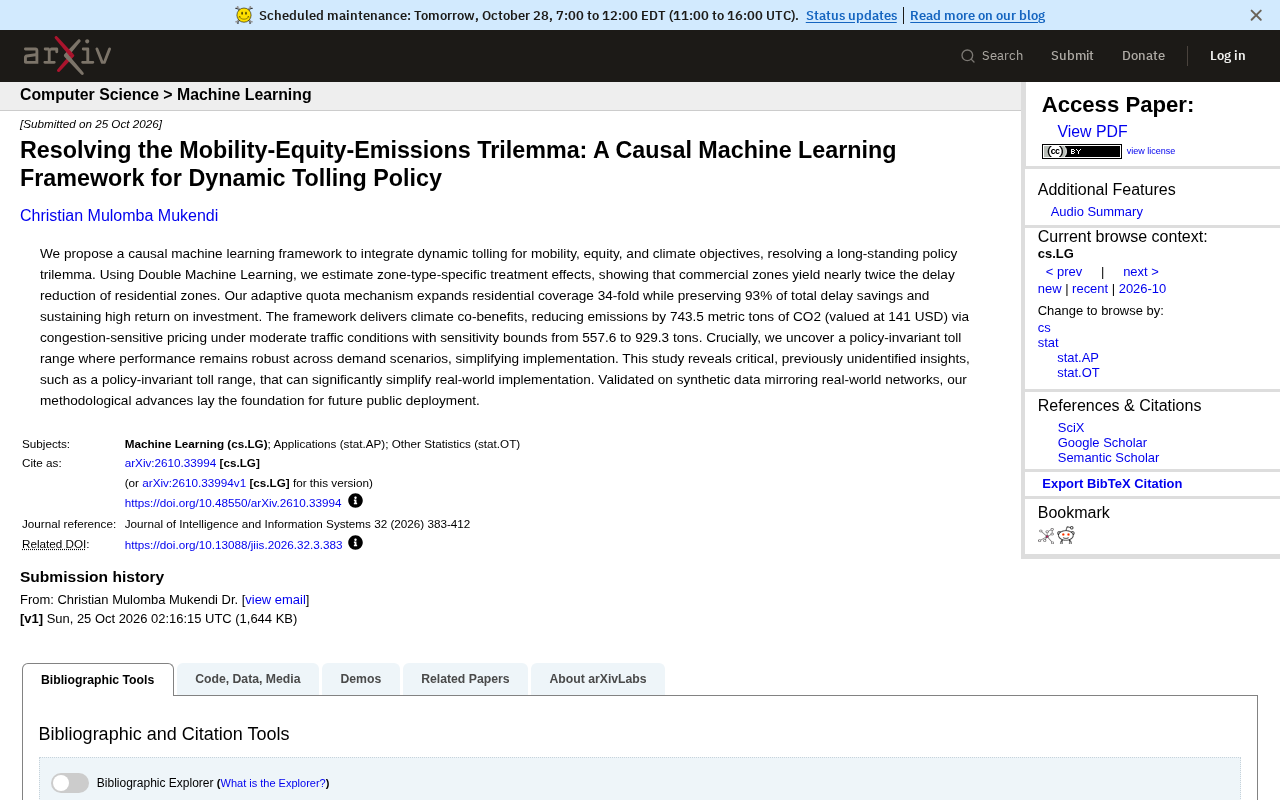
A recent study proposes a causal machine learning framework to address the trilemma of congestion, equity, and emissions in urban transport policy. Using Double Machine Learning to estimate zone-specific treatment effects, it finds commercial districts see nearly twice the delay reduction of residential ones. An adaptive quota mechanism expands residential coverage 34-fold while retaining 93% of delay savings and maintaining high ROI. Congestion-sensitive pricing yields 743.5 metric tons of CO2 reduction under moderate traffic, with a sensitivity range of 557.6 to 929.3 tons. The study also identifies policy-invariant tolling ranges that keep performance robust across demand scenarios, simplifying implementation. Validation is on synthetic data, with real deployment still pending.
The Policy Trilemma and Causal ML's Breakthrough Approach
Urban transportation policy has long faced a thorny "trilemma": alleviating congestion (mobility), ensuring equity, and reducing emissions (climate goals) often work against one another. Dynamic tolling is seen as a promising demand management tool, but traditional methods struggle to finely characterize differentiated responses across regions and populations, causing policies to either fall short on efficiency or suffer from equity losses.
A recent study proposes a causal machine learning framework that attempts to reconcile these three objectives simultaneously in a data-driven way. The core innovation lies in the fact that it does not stop at the level of "average treatment effects" but instead uses Double Machine Learning to estimate zone-type-specific treatment effects. In other words, the model can answer: how much does the effect differ between levying a congestion charge in a commercial district versus a residential one?
The value of this approach is that it pushes policy evaluation from "one-size-fits-all" toward fine-grained spatial heterogeneity, laying the foundation for subsequent differentiated quota design.
Double Machine Learning (DML) is a causal inference method proposed by Chernozhukov et al. in 2018, designed to robustly estimate treatment effects under high-dimensional covariates. Its core idea is to use machine learning models to separately fit the outcome variable and the treatment variable, then eliminate regularization bias through orthogonalization (Neyman orthogonality) and cross-fitting, thereby obtaining unbiased and √n-consistent estimators. Compared with traditional methods, DML can flexibly handle nonlinear relationships and complex interactions while maintaining the validity of statistical inference. In policy evaluation, DML is particularly suited to estimating heterogeneous treatment effects—that is, the differentiated responses of different subgroups (such as commercial versus residential districts) to the same intervention, which is precisely the methodological basis for this study's estimation of "zone-type-specific treatment effects."
Effect Differences Between Commercial and Residential Districts
One of the study's most intuitive findings is that the delay-reduction effect in commercial districts is nearly twice that in residential districts. This means that if only traffic efficiency were pursued, tolling policies should prioritize commercial districts—where vehicle density is high and trip purposes are concentrated, making the price lever more effective at adjusting travel times and routes.
But a problem follows: if the policy covers only commercial districts, residents of residential areas may bear an unfair burden (for example, being forced to detour or give up trips), while congestion is merely "transferred" rather than eliminated. This is precisely why the "equity" dimension was incorporated into the framework. The study does not avoid this tension but instead quantifies the response differences across regions through causal estimation, providing a basis for subsequent quota adjustments.
Average Treatment Effect (ATE) is a foundational concept in causal inference, referring to the average difference in outcomes across the entire population when an intervention (such as congestion pricing) is implemented versus when it is not. ATE provides an overall overview of policy effects but conceals heterogeneity between groups—for example, commercial and residential districts may respond very differently to tolling. If relying solely on ATE, policymakers may misjudge the true impact of a policy across different regions, leading to resource misallocation or equity losses. The innovation of this study lies in going beyond ATE to estimate the Conditional Average Treatment Effect (CATE), that is, the treatment effect given a zone type (commercial or residential), thereby revealing spatial heterogeneity and providing a basis for differentiated policy design.
Adaptive Quotas: Rebalancing Equity and Efficiency
To address the above tension, the study designs an adaptive quota mechanism. Its core result: while maintaining 93% of total delay savings, it expands coverage in residential districts by 34-fold. This figure deserves closer scrutiny—it shows that a substantial improvement in equity does not necessarily come at the cost of efficiency, provided that quota allocation is dynamically adjusted rather than statically averaged.
From a return-on-investment perspective, the mechanism still maintains a relatively high ROI. This offers policymakers an actionable middle path: they need not choose between "charging only commercial districts" and "uniform citywide charging" but can instead achieve gradual coverage through quota adjustment.
Climate Co-benefits and Sensitivity Boundaries
On the emissions dimension, the study quantifies climate co-benefits: under moderate traffic conditions, congestion-sensitive pricing can achieve a reduction of 743.5 metric tons of CO2, corresponding to a value of $141; the sensitivity boundary ranges from 557.6 to 929.3 tons.
This needs to be viewed objectively: the monetized value of $141 is relatively limited, indicating that under current pricing parameters, climate benefits are more of a "co-benefit" than the main selling point. But the absolute scale of emissions reduction (hundreds of tons) still has reference value for city-scale policy evaluation. The existence of a sensitivity range also suggests that actual effects will fluctuate with traffic conditions, and policy design needs to leave room for flexibility.
Congestion-sensitive pricing is a dynamic tolling strategy in which rates adjust with real-time traffic congestion levels: the more severe the congestion, the higher the charge, using the price lever to guide travel demand to redistribute across time and space. Compared with fixed rates, this pricing approach more precisely reflects marginal social costs and encourages travelers to choose off-peak times or alternative routes. In this study, the strategy is used to quantify climate co-benefits—by curbing low-speed driving and idling emissions during congestion peaks, CO2 reductions are achieved. The sensitivity boundary (557.6 to 929.3 tons) reflects the range over which emissions reduction effects fluctuate with traffic conditions (such as demand levels and road network capacity), suggesting that policy design must account for scenario flexibility.
Policy-Invariant Tolling Range: A Key Finding for Simplifying Implementation
The study reveals a previously unidentified insight: there exists a policy-invariant tolling range within which policy performance remains robust across different demand scenarios. The practical significance of this finding may be greater than the emissions reduction figures—it means implementers need not re-tune parameters for every demand fluctuation scenario, greatly reducing implementation complexity.
In their conclusion, the authors emphasize that such "policy-invariant" characteristics can significantly simplify real-world implementation processes. For urban transportation management agencies, interpretable and robustly executable rules often have more staying power than theoretically optimal but parameter-sensitive schemes.
Methodological Boundaries and Deployment Prospects
As a caveat, the study was validated on synthetic data mirroring a real road network and has not yet entered real public deployment. Synthetic data can control variables and validate methodological effectiveness but cannot fully reproduce the heterogeneity and unpredictability of real travel behavior. The authors also explicitly list "future public deployment" as a follow-up direction.
From a methodological perspective, introducing Double Machine Learning into transportation policy evaluation is a noteworthy signal: the combination of causal inference and machine learning is moving from an academic tool to the frontier of policy analysis. Its value lies not in more accurate prediction but in answering the question "if a policy were implemented, how would different groups be affected?" more credibly.
For readers interested in AI applications in public governance, this study offers a transferable paradigm: first use causal models to decompose heterogeneous effects, then use a quota mechanism to correct for equity, and finally use robustness analysis to lower the implementation threshold. With these three steps, a seemingly intractable trilemma at least has a quantifiable compromise path.
One-line Summary
A causal machine learning framework reconciles the efficiency, equity, and climate goals of congestion pricing through zone-specific effect estimation and adaptive quotas.
Paragraph Summary
A recent study proposes a causal machine learning framework to address the trilemma of alleviating congestion, ensuring equity, and reducing emissions in urban transportation policy. Using Double Machine Learning to estimate zone-type-specific treatment effects, the study finds that delay reduction in commercial districts is nearly twice that in residential districts. To balance equity, it designs an adaptive quota mechanism that expands residential coverage 34-fold while retaining 93% of total delay savings and maintaining a relatively high ROI. On the climate dimension, congestion-sensitive pricing under moderate traffic conditions can achieve 743.5 metric tons of CO2 reduction, with a sensitivity range of 557.6 to 929.3 tons. The study also identifies a policy-invariant tolling range that keeps policy performance robust across demand scenarios and simplifies implementation. The method was validated on synthetic data and has not yet entered real deployment.
Related articles
AWS AgentCore Gateway: Connecting AI A…
AWS AgentCore Gateway: Connecting AI Agents to Enterprise Backends with MCP
How AWS AgentCore Gateway acts as a primary MCP server to aggregate REST APIs, Lambda, and existing MCP services? Analyzing its AST real-time mapping, zero cold start, semantic search for tool overload, session isolation, and key injection security design, plus the architectural approach to decoupling enterprise AI agents from backends.

One Link Gives Figma AI a New Skill: Hands-On with MCP Connectors
Paste one MCP server link and the AI Agent in Figma gains new tool capabilities. We break down the setup flow, 20+ one-click apps, read/write permissions and execution policies, and the public HTTPS requirement.

Cognition SWE-2 in Practice: One Prompt to Handle the Whole Product Launch Process
Analyzing a YouTube creator's prompt for using Cognition SWE-2 to launch a product: a landing page, seven-email sequence, and non-buyer follow-up tool, plus how the 'test and report' constraint changes AI delivery quality.