CBT vs. Psychoanalysis: Who Won the Psychotherapy Wars?

CBT defeated psychoanalysis not just on efficacy, but through institutional advantages in research training and grant funding.
This article traces how CBT rose from the soil of post-WWII history to replace psychoanalysis as the dominant form of psychotherapy. Historian Andrew Scull argues the victory wasn't about superior outcomes, but about clinical psychologists having research-first training, knowing how to win federal grants, and offering treatments that could be packaged and tested. Key figures like Aaron Beck made the transition from psychoanalysis to CBT and drove the DSM-3 diagnostic reform. Yet Scull remains clear-eyed: CBT's evidence base is murkier than its advocates claim — Cochrane rates it only low-to-moderate certainty — with especially limited effectiveness for serious conditions like schizophrenia, though it does have some empirical support for mild depression and everyday psychological distress.
Cognitive Behavioral Therapy (CBT) has become nearly synonymous with psychotherapy today — but its rise was anything but accidental. In a conversation between historian Andrew Scull and Lex Fridman, Scull reveals a largely overlooked history: CBT didn't defeat psychoanalysis simply because it worked better, but because it had a whole set of institutional advantages — in research training, grant applications, and the verifiability of its evidence.
How World War II Reshaped American Psychiatry
The story begins with World War II. As large numbers of soldiers suffered psychological breakdowns, the military appointed William Menninger of the Menninger Clinic as the Army's chief psychiatrist. He believed these soldiers were suffering from trauma, and that the best treatment was psychotherapeutic in nature. Freudian ideas were thus absorbed — in a diluted form — by people who had been hastily trained as military psychiatrists.
After the war, this cohort formed a relatively cohesive group, diverging from the traditionally biologically-oriented psychiatrists still working in state hospitals. By 1958, roughly 80% of psychiatrists were working in outpatient settings rather than hospitals — a fundamental shift in the center of gravity of the field.

The real turning point came with the unexpected rise of another group. Because the military couldn't rapidly train enough psychotherapists with medical degrees, large numbers of psychologists were recruited to do clinical work. They discovered: "Hey, we can do this too — and we enjoy it. It's interesting and challenging." This laid the groundwork for clinical psychology's postwar independence.
The Menninger Clinic is one of the most influential institutions in the history of American psychiatry, founded by brothers Karl and William Menninger in Kansas. The clinic became known for its psychodynamic orientation, treating mental illness as an understandable and treatable human response rather than a purely biological condition. William Menninger served as the Army's chief psychiatrist during World War II, bringing these ideas into military medicine and influencing thousands of hastily trained military doctors. When these physicians returned to civilian life, they carried the concept of psychotherapy into private practice and academic institutions — allowing psychoanalytic ideas to penetrate mainstream medical education in the United States more deeply than in Europe, where psychoanalysis originated. This helps explain why American psychiatry resisted the dominance of purely biological models for longer than most European countries.
A Overlooked Key to Victory: Knowing How to Apply for Grants
Scull points to a factor that is often overlooked but critically important. After the war, with the establishment of the Veterans Administration (VA) and the National Institute of Mental Health (NIMH), federal funds poured into mental health training.
The training programs that clinical psychologists designed were remarkably strategic: trainee clinical psychologists first spent two years learning basic scientific psychology and research methods, then two to three years in clinical practice. This "research-first" model meant that when they went to apply for research grants, they knew exactly how to do it — while psychoanalysts "had no idea how to apply for federal grants and received almost no money at all."
This institutional difference determined the fate of both camps at the level of resources. Once one side mastered the rules of the funding game, the other was gradually pushed to the margins.
Treating Symptoms vs. Treating Root Causes: A Philosophical Clash

The core disagreement between the two camps came down to how they viewed "symptoms." Psychoanalysts believed that treating symptoms directly was playing whack-a-mole — if you didn't address deep personality issues or work through the dynamics between the id, ego, and superego, suppressing one symptom would just cause another to pop up elsewhere.
Clinical psychologists pushed back: our job is to treat the symptoms that are actually distressing people, and to develop techniques that help them cope with and eliminate those symptoms. These techniques were initially centered on CBT, with variants like interpersonal therapy emerging later.
The underlying logic is: in dealing with social rejection, being ignored, conflict with colleagues, or a rebellious child, you've developed poor coping habits. Therapy helps you recognize the patterns you've fallen into and, through practice, gives you better ways to respond. Compared to psychoanalysis — which could demand five hours a week over many years — CBT carries no such heavy time burden.
More importantly, these therapies are verifiable: they "can be packaged, replicated, and tested for effectiveness," giving them an evidence base. Psychoanalysts countered that "this takes years and is very hard to measure" — every patient is a unique and complex individual. In an era demanding evidence-based practice, measurability and replicability became decisive advantages.
Key Figures: From Psychoanalyst to CBT Pioneer
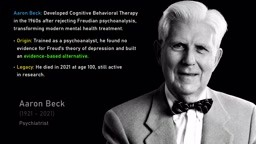
The central figures in this transformation include Albert Bandura, Albert Ellis, and Aaron Beck. Aaron Beck (known as Tim Beck) is particularly legendary — he lived to nearly 100, and his talks in old age remained sharp and insightful.
Beck himself trained as a psychoanalyst before becoming disillusioned and ultimately moving in the opposite direction. His contributions run along two important threads. First, back in the 1960s, he studied psychiatric diagnosis and revealed its profound unreliability — psychiatrists had great difficulty agreeing on "what was actually wrong with a patient." This critique helped drive the creation of the DSM-3.
Second, he abandoned the notion that treating symptoms was a waste of time, and joined forces with psychologists to explore how to help people overcome self-destructive patterns of response. Interpersonal therapy developed from this foundation — it focuses more on how breakdowns in your relationships with others damage emotional stability, and how repairing those relationships can help restore it.
The DSM (Diagnostic and Statistical Manual of Mental Disorders) is the diagnostic classification system published by the American Psychiatric Association and widely used in clinical and research settings worldwide. The DSM-1 (1952) and DSM-2 (1968) were heavily influenced by psychoanalysis: diagnostic categories were vague and highly dependent on clinical judgment, and different doctors could reach very different diagnoses for the same patient. Aaron Beck's research in the 1960s systematically documented this low "interrater reliability" in diagnosis, providing empirical grounds for reform. The DSM-3, published in 1980, was a paradigm revolution: it abandoned etiological assumptions and instead adopted observable, operationalized symptom criteria, dramatically improving diagnostic consistency and reproducibility. This shift mirrored the rise of CBT — both reflected a broader movement in mental health toward the measurable and the verifiable, and both helped shrink the institutional space available to psychoanalysis.
The Truth About Efficacy: The Evidence Isn't as Strong as You'd Think

On the question of actual effectiveness, Scull maintains the clear-eyed perspective of a historian. Unlike most countries with socialized medicine, the United States has a tradition of out-of-pocket healthcare spending, making people more willing to pay for clinical psychologists. And these therapies are most successful in addressing "problems of everyday life" — difficulties that, while not severe, are genuinely distressing.
But once you move into the territory of serious mental illness, the evidence becomes thin. For CBT applied to schizophrenia, for instance, "the evidence is quite poor"; even for less severe conditions, the evidence is murkier than proponents are willing to admit. Cochrane Reviews, which systematically assess the strength of evidence for various treatments, conclude that CBT's evidence is at best "low to moderate certainty."
That said, Scull acknowledges that for mild depression, CBT may work as well as medication — and without the side effects. The UK's National Institute for Health and Care Excellence (NICE) has used this reasoning to determine which therapies the NHS will fund.
Lex Fridman adds a fair observation: CBT contains some intuitively accessible elements — noticing and adjusting thought patterns, identifying triggers that pull you into negative spirals, making healthier behavioral choices and building better habits. The idea that this process of "getting your life in order" could have a positive effect on some people is intuitively plausible. But the deeper you go into serious mental illness, the less certain the conclusions become.
Scull agrees: it's not a cure-all, but for some people it genuinely improves things significantly. We do develop poor ways of responding to external cues, and habits are extremely hard to break — CBT requires a lot of homework and practice to reconfigure how you interact with the world. It doesn't work for everyone, but for a certain subset of people, the results are positive.
Cochrane Reviews are widely regarded as among the highest-quality sources of evidence in evidence-based medicine, published by the independent nonprofit Cochrane Collaboration. Their methodological core involves systematically searching for and synthesizing all qualifying randomized controlled trials, then assessing each study's risk of bias using uniform criteria, ultimately assigning a "certainty" rating (high, moderate, low, or very low). The reason CBT's rating is only "low to moderate" is not necessarily that effectiveness data is nonexistent, but rather that existing trials typically suffer from methodological flaws: small sample sizes, short follow-up periods, and poorly designed control groups (using "waitlists" rather than active interventions as comparators). This reminds us that there is an important gap between "supported by evidence" and "well-supported by evidence" — a distinction that deserves particular care in the field of psychotherapy.
Related articles

Why Does the Tesla Roadster Need to Fly? A Deep Dive into Musk's Wild Demo
Tesla's Roadster launch showed wall-climbing, upside-down driving, and flying stunts—but The Vergecast notes the demo car may lack a battery, the Rocket version is invite-only and not street-legal, and the website terms don't guarantee delivery. After nine years of delays, why does this car still need to exist?

AI Is Not a Replacement: Human-AI Collaboration Through the Lens of Factory Root Cause Analysis
Starting from factory root cause analysis, this article explains how AI accelerates evidence chain construction rather than replacing human experts, exploring the pragmatic implementation logic and business value of 'AI supporting people rather than replacing them.'

AI Agent Decision Auditing: Building an Evidence Chain in Regulated Workflows
Starting from a Reddit discussion, this article analyzes three core issues in AI agent decision auditing within regulated workflows: what fields audit records should contain, how to handle feedback latency for erroneous decisions, and how to continuously calibrate LLM judge consistency with human judgment.