CC-Switch: An Open-Source Desktop Tool to Manage Six Major AI Coding Assistants in One Interface
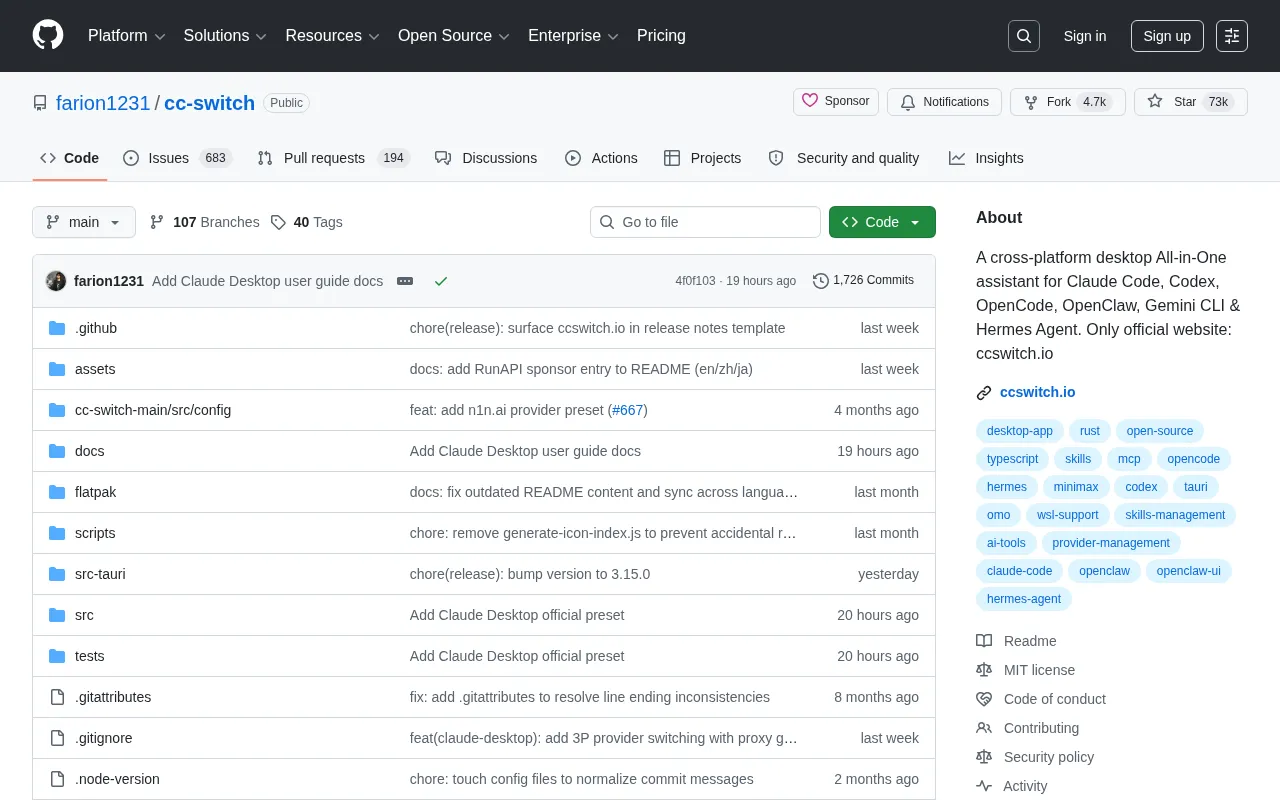
CC-Switch unifies six major AI coding assistants into one cross-platform desktop app for seamless switching.
CC-Switch is a cross-platform desktop application built with Rust that integrates six major AI coding assistants — Claude Code, Codex, OpenCode, OpenClaw, Gemini CLI, and Hermes Agent — into a unified interface, solving the efficiency pain point of constantly switching between multiple AI tools. With over 67,000 GitHub Stars, its popularity highlights the emerging trend of "meta-tools" in the AI tool ecosystem.
Overview
In today's flourishing landscape of AI coding assistants, developers face an increasingly practical challenge: how to efficiently manage and switch between multiple AI coding tools. CC-Switch was built to solve exactly this pain point. It's a cross-platform desktop application that integrates six major AI coding assistants — Claude Code, Codex, OpenCode, OpenClawAd, Gemini CLI, and Hermes Agent — into a single unified interface, freeing developers from the hassle of constantly switching between tools.
The project has earned over 67,000 Stars on GitHub with more than 4,300 Forks. Built with Rust, it demonstrates both exceptional community interest and serious technical merit.
Why Developers Need an All-in-One AI Coding Assistant Manager
The Real-World Challenge of Managing Multiple Tools
The AI coding landscape is evolving rapidly. Anthropic's Claude Code is renowned for its powerful code comprehension, OpenAI's Codex excels at code generation, Google's Gemini CLI offers a unique multimodal programming experience, and open-source alternatives like OpenCode, OpenClaw, and Hermes Agent each bring their own strengths.
In fact, the AI coding assistant market is experiencing an unprecedented "Cambrian explosion." Since GitHub Copilot first brought AI-assisted programming into the mainstream in 2021, major AI companies have raced to launch their own coding assistant products. These tools are built on fundamentally different technical approaches: some leverage large language model (LLM) code completion capabilities, others adopt an Agent architecture for autonomous programming, and still others use RAG (Retrieval-Augmented Generation) to deeply understand project context. This diversity of technical approaches means no single tool performs optimally in every scenario, forcing developers to cherry-pick tools for different tasks.
Many developers don't rely on just one tool in their daily work — different tasks may call for different AI assistants. For example, complex code refactoring might be better suited to Claude Code, while rapid prototyping might be Codex's forte. However, constantly switching between multiple terminal windows and applications not only disrupts workflow but also adds configuration management complexity.
CC-Switch's Approach
CC-Switch adopts a "unified entry point, switch on demand" design philosophy. Users can configure and invoke all their AI coding assistants from a single desktop application, without needing to separately install and manage the runtime environments for each CLI tool. This All-in-One approach dramatically lowers the barrier to using multiple tools in tandem.
Core Technical Highlights of CC-Switch
High-Performance Architecture Built with Rust
CC-Switch chose Rust as its core development language — a technical decision worth noting. Rust is renowned for its memory safety, zero-cost abstractions, and excellent concurrency performance, making it ideal for building desktop applications that need to efficiently manage multiple subprocesses and network connections. Compared to solutions like Electron, Rust-based desktop applications typically have lower memory footprint and faster startup times — critical qualities for a development tool that needs to run in the background.
Rust was initiated by Mozilla Research in 2010 and released version 1.0 in 2015. It has risen rapidly in the systems programming space in recent years. Its core innovation is the "Ownership System," which uses a compile-time Borrow Checker to guarantee memory safety without relying on garbage collection, fundamentally eliminating common system-level bugs like null pointers and data races. In the desktop application development space, the Tauri framework in the Rust ecosystem has become a strong alternative to Electron — Tauri applications typically have installation packages 1/10 to 1/20 the size of Electron apps, with significantly reduced memory usage. For an application like CC-Switch that needs to simultaneously manage multiple AI assistant subprocesses and maintain multiple API connections, Rust's async runtime (such as Tokio) enables highly efficient concurrent scheduling with minimal resource overhead.
Full Cross-Platform Support
As a cross-platform application, CC-Switch supports macOS, Windows, and Linux — the three major operating systems — ensuring a consistent experience regardless of which system developers use. This is particularly important for team collaboration scenarios, where team members on different operating systems can share the same tool configurations and workflows.
Deep Integration with Six Major AI Coding Assistants
CC-Switch currently supports six AI coding assistants covering the most mainstream options on the market:
- Claude Code: Made by Anthropic, excels at complex code comprehension and long-context processing. Its core advantage is an ultra-long context window (supporting up to 200K tokens), enabling it to understand an entire codebase's structure and logical relationships at once — particularly well-suited for large-scale code refactoring and cross-file dependency analysis.
- Codex: OpenAI's programming-specific model with powerful code generation capabilities. Its training data includes vast amounts of open-source code repositories, delivering outstanding accuracy in code generation and multi-language support. It's especially adept at generating runnable code snippets directly from natural language descriptions.
- OpenCode: An open-source AI coding solution that provides developers with a self-hostable, customizable AI programming experience — ideal for enterprises and individual developers with strict data privacy requirements.
- OpenClaw: A community-driven AI programming tool that continuously iterates through the power of the open-source community, typically responding faster to developer feature requests and bug reports.
- Gemini CLI: Google's command-line AI assistant with multimodal input support. Its unique strength is that developers can directly feed UI design mockups, architecture diagrams, and other images as input, allowing the AI to understand visual information and generate corresponding code — bridging the entire pipeline from design to implementation.
- Hermes Agent: An intelligent agent-based coding assistant that uses an Agent architecture where the AI can not only generate code but also autonomously perform file operations, run tests, debug errors, and carry out a series of programming tasks. It represents the evolution of AI programming from "assistance" to "autonomy."
This broad compatibility means developers can flexibly choose the most suitable tool for each specific task without being locked into a single ecosystem.
Community Momentum and the Future of AI Tool Management
Over 67,000 GitHub Stars places this project at the top tier among developer tools, reflecting strong resonance within the developer community for the concept of "unified AI tool management." The 4,300+ Forks also indicate that many developers are actively participating in secondary development and customization.
From a broader perspective, CC-Switch's popularity reveals an important trend in the AI programming tool ecosystem: as the number of AI assistants grows, meta-tools — tools that manage and orchestrate other AI tools — are emerging as a new product category. Just as package managers serve programming languages, CC-Switch is attempting to become the "unified management layer" for AI coding assistants.
The concept of meta-tools originates from the "metaprogramming" paradigm in computer science — writing programs that operate on other programs. Throughout software engineering history, this "tools that manage tools" pattern has been validated repeatedly: Docker Compose orchestrates multiple containers, Terraform unifies multi-cloud resource management, and nvm and pyenv manage multiple language runtime versions. Now, as AI coding assistants proliferate, a similar need for an abstraction layer naturally emerges. Industry analysts have also noted that the "AI Orchestration Layer" will become a critical component of enterprise AI infrastructure. CC-Switch's emergence is a concrete manifestation of this trend at the individual developer tool level, foreshadowing the potential rise of more middleware products focused on AI tool coordination, routing, and policy management.
Installation and Usage Recommendations
For developers who are currently using or planning to use multiple AI coding assistants, CC-Switch offers a solution worth trying. Its official website is ccswitch.io, and it's recommended to download installation packages from official channels to ensure security.
It's important to note that API keys and account configurations for each AI assistant still need to be prepared by the user — CC-Switch primarily serves as a unified scheduler and interface integrator. When using CC-Switch to manage multiple AI assistants, secure API key management is a critical concern. Each AI provider's API key is essentially an identity credential; if leaked, it could lead to unauthorized API calls and hefty bills. Industry best practices include: using OS-level keychains (such as macOS Keychain or Windows Credential Manager) to store sensitive information rather than plaintext configuration files; setting up independent API keys for each tool with usage limits configured; and regularly rotating keys to minimize leak risks. Developers should carefully review the key storage mechanisms and data transmission methods of any third-party tool used to manage API keys.
For developers who only use a single AI assistant, CC-Switch's value may be limited. But for "multi-platform" developers who need to flexibly switch between multiple tools, it can significantly boost daily coding efficiency.
Key Takeaways
- CC-Switch integrates six AI coding assistants — Claude Code, Codex, OpenCode, OpenClaw, Gemini CLI, and Hermes Agent — into a single cross-platform desktop application
- Built with Rust, leveraging the ownership system and async runtime for high-performance concurrent management, the project has earned over 67,000 Stars on GitHub
- Solves the efficiency pain point of developers constantly switching between multiple AI coding tools by providing a unified configuration management and invocation entry point
- The project's popularity reveals the emerging trend of "meta-tools" in the AI tool ecosystem, similar to the role Docker Compose, Terraform, and similar tools play in their respective domains
- Cross-platform support ensures a consistent experience for macOS, Windows, and Linux users
- When using the tool, pay attention to API key security management — use system-level keychains for storage and rotate keys regularly
Related articles
Deep Dive into AI Agent Skill Design: …
Deep Dive into AI Agent Skill Design: Engineering Practices from Anthropic and Perplexity
A deep dive into Skill design philosophy from Anthropic's Claude Code team and Perplexity's Agent team, covering the Tax Test, Gotchas Flywheel, progressive disclosure, and Eval-First practices for building high-quality AI Agent skill systems.
Deep Dive into OpenAI's Official GPT-5…
Deep Dive into OpenAI's Official GPT-5.6 Prompting Guide: The Shift from Manual to Automatic
A deep dive into OpenAI's official GPT-5.6 Sol prompting guide: conciseness-first, outcome-oriented design, autonomy boundaries, tool routing, and reasoning intensity tuning.
 Deep Dives
Deep Dive into How OpenClaw (Open-Source Crayfish) AI Agent Works
Deep analysis of OpenClaw AI Agent internals: System Prompt, tool calling, SubAgents, Skill system, memory, and Context Engineering explained.