Cerebras CEO Predicts: Personal AI Assistants Will Enter Every Home
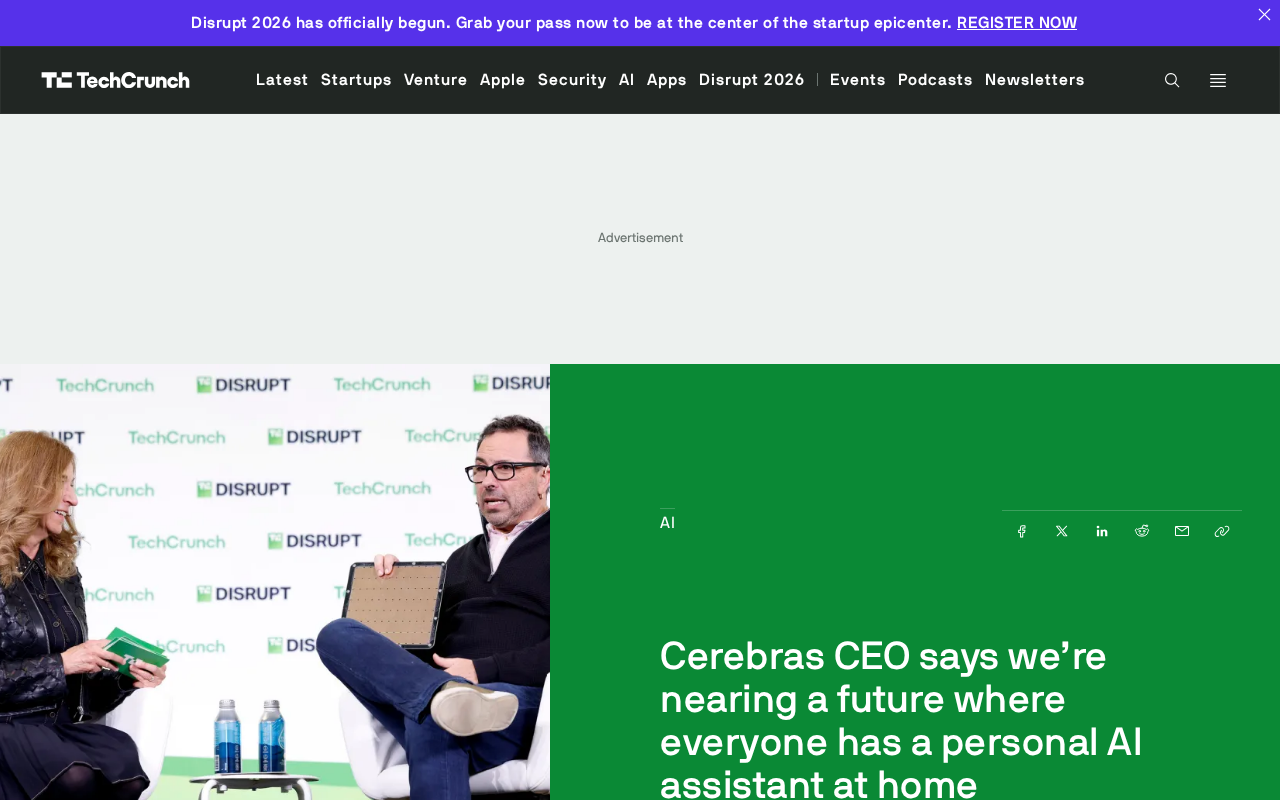
Cerebras CEO predicts personal AI assistants will become as ubiquitous as home appliances, using a hybrid local + cloud architecture.
Cerebras CEO Andrew Feldman recently predicted that personal AI assistants are evolving toward the ubiquity of household appliances. He envisions a "local + cloud" hybrid model: high-frequency, low-latency, privacy-sensitive tasks run locally, while complex reasoning and model updates go to the cloud. Falling inference costs, improving chip efficiency, and model miniaturization techniques are the key enablers. Yet challenges remain in hardware costs, software scheduling, developer ecosystems, and user habits.
Cerebras CEO Andrew Feldman recently made a striking prediction: personal AI assistants are evolving toward the kind of ubiquity enjoyed by household appliances. In his vision, these assistants won't rely entirely on the cloud, nor will they run entirely on local devices—instead, they'll operate in a hybrid "local + cloud" model.
From Data Center to Living Room: The Path to AI Assistant Adoption
Over the past few years, large model deployments have been almost exclusively concentrated in cloud data centers. Users obtain inference results through API calls, while endpoint devices handle only input and output. The advantage of this model is centralized compute power and the ability to build very large models, but the costs are equally obvious—latency, network dependency, privacy risks, and the ongoing expenses of continuous API calls.
The path Feldman describes is different. He believes personal AI assistants will run some capabilities directly on home devices while delegating others to the cloud. This split isn't a compromise—it's a pragmatic choice: high-frequency, low-latency, privacy-sensitive tasks stay local; tasks requiring large-scale compute or the latest model capabilities go to the cloud.
Cerebras itself is known for wafer-scale chips and large-scale inference acceleration, so Feldman's judgment clearly bears the imprint of his company's technology roadmap. But setting aside vendor positioning, "edge-cloud collaboration" is indeed a mainstream direction in current AI infrastructure discussions.
Edge-Cloud Collaboration refers to an architectural model that divides computing tasks between endpoint devices and cloud servers. Unlike traditional pure-cloud inference, edge-cloud collaboration dynamically allocates compute based on task characteristics: privacy-sensitive and latency-sensitive tasks are prioritized for local execution, while compute-intensive tasks or those requiring the latest model capabilities are uploaded to the cloud. This architecture has already taken shape in smartphones—for example, voice wake-word detection is handled locally, while complex semantic understanding is delegated to the cloud. In the AI assistant scenario, the challenge of edge-cloud collaboration lies in making users unaware of where task switching occurs, and in keeping capabilities consistent across both ends when model versions are updated.
Why Now? Changes in Inference Costs and the Chip Landscape
For personal AI assistants to move from concept to everyday commodity, one unavoidable prerequisite is that inference costs must be low enough and responses fast enough.
Feldman's core argument is that the hardware efficiency of AI inference is improving rapidly. When the cost of a single inference drops low enough, packing some model capabilities into home devices is no longer economically disadvantageous. This stands in sharp contrast to the "everything goes to the cloud" logic of just a few years ago.
Another variable is the models themselves. Techniques like miniaturization, quantization, and distillation allow capable models to run on consumer-grade hardware. This means home devices don't need to be miniature data centers to handle a considerable portion of everyday AI tasks.
Cerebras's accumulated expertise in inference speed makes its CEO particularly optimistic about the prospect of "real-time interactive AI assistants." Real-time responsiveness is precisely the key to the personal assistant experience—nobody wants to talk to an "assistant" that takes three seconds to respond.
Model Quantization is a technique that converts weights and activations in a neural network from high precision (such as 32-bit floating point) to lower precision (such as 8-bit or 4-bit integers). Quantization can significantly reduce model size, lower memory usage, and decrease computational power consumption, making it possible for large models to run on consumer-grade hardware. Knowledge Distillation involves having a smaller "student model" mimic the output distribution of a larger "teacher model," thereby substantially reducing parameter count while maintaining relatively high performance. Model Miniaturization typically combines quantization, distillation, pruning, and architecture search techniques. Together, these technologies drive the feasibility of "small models running on-device," and they form an important technical prerequisite for Feldman's judgment that home devices can handle some AI tasks.
What the Local-Cloud Division of Labor Means
If Feldman's prediction holds, AI assistants in the home will bring several cascading changes.
Privacy-sensitive tasks can be handled in a local closed loop, without sending data to remote servers. This is especially critical for voice, video, and health data in home scenarios. At the same time, local processing ensures that basic functions remain available during network outages—a point that is essential to the positioning of being "as reliable as a home appliance."
The cloud still handles the heavy lifting. Complex reasoning, model updates, and cross-device synchronization are better suited to centralized processing. What users perceive is a seamlessly connected assistant, not two disconnected systems.
This architecture imposes new requirements on chipmakers, device manufacturers, and cloud service providers alike. Whoever can find the most rational task allocation between edge and cloud is more likely to define the next generation of personal computing entry points.
Inference Cost refers to the hardware and time overhead required for an AI model to complete one forward pass (i.e., generate one output), typically measured in dollars per million tokens or tokens processed per second. Inference cost directly determines whether AI services can achieve widespread adoption. In recent years, specialized inference chips (such as Cerebras's wafer-scale engine and Groq's LPU) and model optimization techniques have driven inference costs down rapidly. When the cost of a single inference becomes negligible, placing some inference tasks on local devices is no longer an economic burden but a choice that improves experience and privacy protection. This is also the core support for the "home appliance-ization of AI assistants" in terms of compute economics.
How Far Are We from "Every Home Has One"
Feldman's phrasing is "we are approaching," not "it has arrived." The gap in between lies mainly not in the concept, but in engineering and ecosystem.
At the hardware level, the compute, power consumption, and heat dissipation of home devices all need to be balanced within consumer-grade costs. At the software level, edge-cloud scheduling, model version management, and data consistency are all problems that have yet to be fully solved. At the ecosystem level, developers need a unified set of interfaces to build applications for this hybrid architecture.
More important is user habit. Treating an AI assistant as a home appliance means it must be reliable enough and unobtrusive enough. Any product that requires users to manually configure or frequently troubleshoot will struggle to reach "appliance-level" adoption.
Feldman's prediction is essentially a bet on the maturity of AI infrastructure. When inference becomes cheap enough and fast enough, personal AI assistants moving from the cloud into the home will no longer be marketing rhetoric, but an inevitable outcome driven by compute economics.
One-line Summary
Cerebras CEO predicts personal AI assistants will become as ubiquitous as home appliances, using a hybrid local + cloud architecture.
Paragraph Summary
Cerebras CEO Andrew Feldman recently predicted that personal AI assistants are evolving toward the kind of ubiquity enjoyed by household appliances. He believes these assistants will not rely entirely on the cloud or run entirely locally, but instead adopt a "local + cloud" hybrid model: high-frequency, low-latency, privacy-sensitive tasks are handled locally, while complex reasoning and model updates go to the cloud. The key drivers of this trend are rapidly falling inference costs, improving chip efficiency, and miniaturization techniques such as quantization and distillation that allow consumer-grade hardware to handle a considerable portion of AI tasks. This edge-cloud division of labor can protect privacy, reduce latency, and maintain basic functionality during network outages. However, the journey from concept to ubiquity still faces multiple engineering challenges, including hardware costs, software scheduling, developer ecosystems, and user habits.
Related articles

Lifting: A New Framework for Quantum State Discrimination in Mid-Circuit Measurements
Lifting is a quantum state discrimination framework for mid-circuit measurements, using repetition encoding, neural decoding, and in-situ calibration to improve MCM reliability on superconducting quantum processors.

ProTok: A Unified Protein Tokenizer via Multi-Codebook Quantization
ProTok introduces a unified protein tokenizer using modular multi-codebook quantization and modality dropout to map sequence, structure, and function into one discrete vocabulary. It ranks 1.4 on average in StructTokenBench, reaches 0.939 lDDT on CATH, and generates 52% designable backbones.

Membership Inference Attacks on Tabular Data: An SoK Reexamination of Privacy Evaluation
An SoK paper systematically examines membership inference attacks in tabular machine learning, revealing how class granularity and majority class proportion affect vulnerability, and noting that single-out records remain highly exposed under common defenses. It calls for rethinking the privacy evaluation paradigm.