Channels SDK: Seamlessly Connect AI Agents to Slack, Teams, and Any Platform

Channels SDK provides middleware to deploy any AI Agent across Slack, Teams, and other platforms with a single integration.
Channels SDK is a middleware solution that abstracts the complexity of connecting AI Agents to communication platforms like Slack and Microsoft Teams. By decoupling channel integration from Agent logic, it enables developers to build once and distribute across multiple platforms, addressing the critical 'last mile' problem of AI Agent deployment in enterprise environments.
An Underestimated Pain Point in Agent Deployment
As AI Agent technology matures, more and more developers are building powerful intelligent assistants. An AI Agent is an AI system capable of autonomously perceiving its environment, making decisions, and executing actions. Unlike traditional single-turn Q&A chatbots, Agents possess multi-step reasoning, tool-calling, and persistent memory capabilities. Since 2023, with the leap in reasoning abilities of large language models like GPT-4 and Claude, Agents have rapidly transitioned from academic concepts to engineering practice.
However, a commonly overlooked reality is: where exactly should these Agents run?
The vast majority of enterprise users won't open a dedicated new web interface to chat with AI—their workflows are already deeply embedded in instant messaging tools like Slack and Microsoft Teams. Research on enterprise software adoption consistently shows that a tool's value is proportional to how deeply it integrates into users' existing workflows. Slack has over 32 million daily active users globally, and Microsoft Teams has over 300 million monthly active users. This means if an Agent can't appear on these platforms, it effectively shuts out the vast majority of potential users. If an Agent can't show up in the communication channels users use daily, its actual adoption rate and value will be significantly diminished.
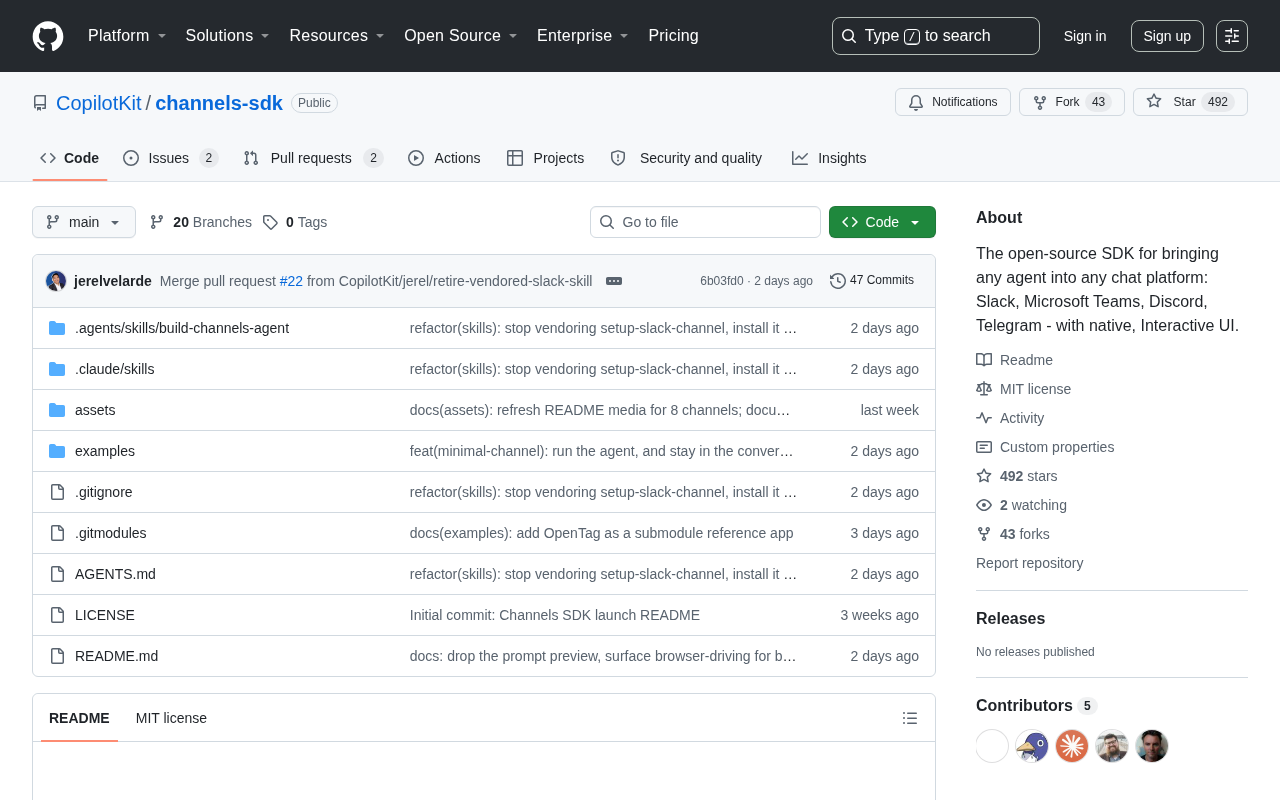
The recently featured Channels SDK, which debuted as a Show HN on Hacker News, targets precisely this pain point. Its tagline is straightforward—"Bring Any Agent to Any Channel."
What Problem Does Channels SDK Solve?
From "Building Agents" to "Distributing Agents"
Over the past two years, the developer community's attention has primarily focused on building smarter Agents: better reasoning frameworks, stronger tool-calling capabilities, and more sophisticated memory management. But as Agents themselves approach maturity, distribution and integration become the new bottleneck.
For each channel integration, developers typically face entirely different technical details:
- Slack has its own Events API, Bolt framework, OAuth authorization flow, and message format;
- Microsoft Teams relies on Bot Framework, with authentication and deployment logic completely different from Slack;
- Other channels (such as Discord, WhatsApp, web embeds, etc.) each have their own set of specifications.
Specifically, Slack's Events API is based on HTTP callbacks, requiring developers to handle URL verification, event subscriptions, retry logic, and more. While its Bolt framework simplifies some of this work, you still need to understand Slack-specific Block Kit message formats, Interactive Components interaction models, and complex OAuth 2.0 three-legged authorization flows (including the distinction between Bot Tokens and User Tokens). Microsoft Teams, on the other hand, is built on Azure Bot Framework, uses the Activity protocol for message passing, relies on Azure Active Directory for authentication, and requires app registration in Teams Admin Center along with compliance review for deployment. The two platforms share almost nothing in common regarding message formats (Slack uses Block Kit JSON, Teams uses Adaptive Cards), file handling, threading models, and more—which is why the engineering effort for cross-platform integration far exceeds what it appears on the surface.
Writing adapter code separately for each platform involves not only massive duplication of effort but also high maintenance costs. The core value proposition of Channels SDK is abstracting these heterogeneous channels into a unified interface, allowing developers to focus solely on the Agent's business logic without repeatedly reinventing the integration wheel.
The Framework-Agnostic "Any Agent" Approach
The "Any Agent" in the SDK's name means it doesn't bind to any specific Agent framework. Whether your Agent is built on LangChain, LlamaIndex, a custom framework, or directly calls LLM APIs, it can theoretically connect to target channels through the SDK's adaptation layer.
The current mainstream Agent development framework ecosystem is quite fragmented: LangChain defines Agent workflows through its LCEL (LangChain Expression Language), emphasizing chain-based calls and tool orchestration; LlamaIndex focuses on Retrieval-Augmented Generation (RAG), connecting private data with LLMs; AutoGen is Microsoft's multi-Agent collaboration framework; CrewAI adopts a role-playing multi-Agent system design. Additionally, many teams choose to build Agents directly on OpenAI's Assistants API or Anthropic's Tool Use interface, bypassing third-party frameworks entirely. This fragmentation means any channel integration solution that binds to a specific framework will lose a large number of potential users.
This design philosophy of "decoupling the channel layer from the Agent layer" essentially consolidates common capabilities—message reception, format conversion, identity authentication, and session management—into a middle layer, keeping the upper Agent layer platform-agnostic.
Technical Architecture of Channels SDK
Middleware, Not a Framework
From a product positioning perspective, Channels SDK is more like a middleware than yet another Agent development framework. It fills the gap between "Agent logic" and "the platform where end users reside."
The concept of middleware has a long history in software architecture, dating back to IBM mainframes in the 1960s, and later widely adopted in enterprise Java (such as JMS message middleware) and web development (such as Express.js middleware). Its core value lies in separating cross-cutting concerns—like logging, authentication, and protocol translation—from business logic. In the AI domain, similar middleware approaches already exist: API gateways (like Kong, Apigee) abstract backend service complexity, and message queues (like Kafka, RabbitMQ) decouple inter-system communication. Channels SDK essentially applies this classic architectural pattern to Agent-to-Channel communication scenarios, unifying the encapsulation of heterogeneous WebSocket connections, webhook callbacks, and authentication token management across platforms.
A simple layered model helps illustrate this:
- Upper layer: Agent's reasoning and business logic (the developer's core focus)
- Middle layer: Channels SDK handles message routing, protocol conversion, and multi-channel adaptation
- Lower layer: Specific communication platforms like Slack, Teams, etc.
This layering gives Agents the ability to "develop once, distribute across multiple channels"—similar to the cross-platform framework approach in frontend development.
Adaptation Value for Enterprise Scenarios
For enterprises, the significance of such tools is particularly evident. Enterprise IT environments often have strict requirements for data compliance, identity authentication (SSO/OAuth), and audit logs. If each channel integration requires handling these enterprise-grade requirements separately, the engineering burden becomes overwhelming. A unified SDK has the opportunity to centrally manage these cross-cutting concerns, lowering the barrier for enterprises to deploy AI Agents.
A Sober Assessment: Opportunities and Challenges Coexist
Inherent Limitations of Abstraction Layers
Any unified abstraction faces the "Lowest Common Denominator" problem. This is a classic dilemma for all cross-platform abstraction layers—take React Native as an example: while it achieves code reuse between iOS and Android, utilizing deep platform-native features still requires writing platform-specific code (Native Modules).
In the communication platform domain, Slack's unique Workflow Builder integration, AI participation in Huddle voice calls, Canvas document collaboration, and other features are completely different from Teams' Adaptive Cards dynamic forms, Power Automate flow triggers, Loop component embedding, and similar capabilities. If an abstraction layer only supports plain text message sending and receiving, it achieves cross-platform unity but loses the most valuable rich interaction capabilities of each platform.
Slack and Teams each have unique capabilities in interactive controls, card messages, and approval workflows. An overly unified abstraction layer may fail to fully expose each platform's advanced features. The industry's typical solution is a "unified core + platform extensions" dual-layer design—basic message handling is abstracted uniformly while preserving escape hatches for each platform to access native APIs. How to strike the right balance between "unified simplicity" and "preserving platform-specific features" is a long-term design challenge for this type of SDK.
Ecosystem Competition and Differentiation Space
You may not have noticed, but platforms like Slack and Microsoft themselves are aggressively pushing native AI integration capabilities. In 2024, Slack launched deep integration with Salesforce Agentforce, allowing enterprises to directly invoke Salesforce's AI Agents for CRM tasks within Slack, while also opening an AI Agent API that gives third-party Agents first-class citizen status in the user interface. Microsoft has deeply embedded Copilot into Teams, offering native AI capabilities like meeting summaries and task extraction through the Microsoft 365 Copilot ecosystem, and allowing enterprises to build custom Agents for direct Teams deployment via Copilot Studio.
These platform-native solutions have advantages in deeper system integration, smoother user experiences, and lower permission friction, but their downside is single-platform lock-in. The differentiation space for third-party SDKs lies in the fact that enterprises often use multiple communication tools simultaneously (e.g., engineering teams on Slack, sales teams on Teams), requiring unified management capabilities for a single Agent to serve multiple channels simultaneously. Third-party SDKs need to prove their unique value in cross-platform unity and Agent-agnosticism to find survival space beyond the platforms' official solutions.
Judging from its current traction on Hacker News, this project is still in a very early stage, and community reception remains to be seen. But the problem it points to—the last mile of Agent distribution—is undoubtedly a real and increasingly important direction.
Conclusion: Agent Distribution Is a Critical Piece of AI Deployment
Channels SDK represents a signal that AI Agent development has entered a new phase: when building intelligent agents themselves is no longer the biggest obstacle, how to truly integrate Agents into users' existing workflows becomes the key to realizing their value.
For developers building enterprise-grade Agents, paying attention to this type of channel integration middleware is worthwhile. It may not be the sexiest technology, but it's an important piece in pushing AI capabilities from demos to real production environments. Of course, ultimate success still depends on the soundness of its abstraction design, the depth of its support for each platform's features, and whether it can establish differentiated advantages in the gaps between tech giants' native ecosystems.
Related articles

Why Does the Tesla Roadster Need to Fly? A Deep Dive into Musk's Wild Demo
Tesla's Roadster launch showed wall-climbing, upside-down driving, and flying stunts—but The Vergecast notes the demo car may lack a battery, the Rocket version is invite-only and not street-legal, and the website terms don't guarantee delivery. After nine years of delays, why does this car still need to exist?

AI Is Not a Replacement: Human-AI Collaboration Through the Lens of Factory Root Cause Analysis
Starting from factory root cause analysis, this article explains how AI accelerates evidence chain construction rather than replacing human experts, exploring the pragmatic implementation logic and business value of 'AI supporting people rather than replacing them.'

AI Agent Decision Auditing: Building an Evidence Chain in Regulated Workflows
Starting from a Reddit discussion, this article analyzes three core issues in AI agent decision auditing within regulated workflows: what fields audit records should contain, how to handle feedback latency for erroneous decisions, and how to continuously calibrate LLM judge consistency with human judgment.