Character.AI Returns to the App Store: Inside the 4-Month Review Standoff with Apple
Character.AI resolves its dispute with Apple and returns to the App Store after a 4-month review freeze.
Character.AI was frozen from updating on Apple's App Store for 4 months due to AI content safety and minor protection concerns. Multiple U.S. youth mental health incidents intensified regulatory pressure during this period. Ultimately, Character.AI made compliance adjustments in content filtering, age verification, and other areas, reaching a resolution with Apple and resuming updates. This case demonstrates that compliance capability is becoming as critical as technical capability for AI applications.
Character.AI Reaches Resolution with Apple, Returns to App Store After 4 Months
Character.AI recently announced that after a 4-month review standoff with Apple, the two parties have finally reached a resolution. The company successfully published its latest app update on the App Store—the first update since the dispute began.
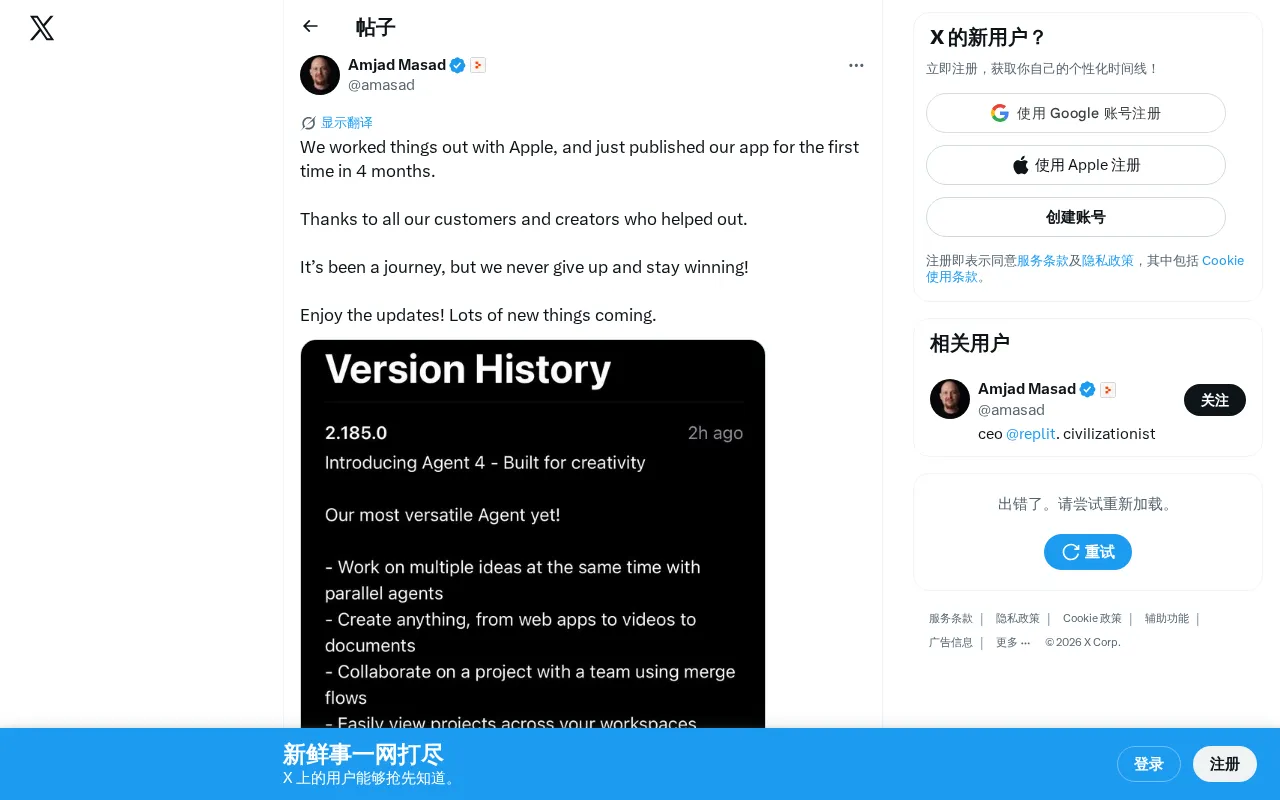
Character.AI's founder posted on social media: "We resolved our issues with Apple and this is the first app update in 4 months. Thanks to all the users and creators who helped us. It's been a journey, but we never give up and always keep winning!"
Who Is Character.AI? What Makes It So Special?
Founded in 2021 by former Google Brain researchers Noam Shazeer and Daniel De Freitas, Character.AI is one of the world's largest AI character conversation platforms by user base. Its core technology leverages large language model (LLM) role-playing capabilities, allowing users to engage in open-ended conversations with millions of community-created AI characters—spanning fictional characters, historical figures, game characters, and more. As of 2024, the platform has over 20 million monthly active users and is particularly influential among Gen Z. In 2023, Character.AI completed a $150 million Series A round led by a16z, reaching a $1 billion valuation.
It's precisely this highly open UGC (user-generated content) model that creates content moderation challenges far more complex than those faced by typical chat applications. With millions of users autonomously creating character content on the platform, it's nearly impossible for the company to pre-screen every conversation—and this became the fundamental source of friction with Apple.
Why Was Character.AI "Stuck" in Apple's App Store Review for 4 Months?
The Review Gray Zone for AI Conversation Apps
Character.AI is an LLM-based AI character conversation app that allows users to engage in deep interactions with various AI characters. However, this type of AI application has always existed in a gray zone within Apple's review system.
Apple's App Store review system is governed by the App Store Review Guidelines, now in its 6th edition. The guidelines include specific provisions for AI-generated content apps, with core requirements including: apps must have real-time content filtering capabilities, must not generate CSAM (Child Sexual Abuse Material), and apps involving user-generated content must provide a reporting mechanism. Apple's review process typically consists of two stages—automated scanning and manual review. For controversial apps, Apple can indefinitely suspend the review without providing a clear rejection reason—this is exactly why Character.AI found itself in a "review standoff" rather than being outright removed. This ambiguous gray-zone approach is Apple's standard strategy for seeking a buffer between legal risk and platform responsibility.
Youth Safety Incidents: The Last Straw
The minor safety controversies facing Character.AI were not unfounded. In 2024, multiple U.S. states saw youth mental health incidents involving the platform. The most notable case involved a 14-year-old boy in Florida who took his own life after prolonged immersion in Character.AI role-play conversations. His family subsequently filed a lawsuit against the company, alleging the platform failed to effectively prevent minors from accessing harmful content. Additionally, multiple research reports indicated that some AI characters on Character.AI develop highly emotionally dependent relationships with users, posing potential risks to psychologically immature teenagers.
These incidents not only drew attention from the U.S. Congress but also directly prompted platform operators like Apple to adopt a more cautious review stance toward the app, creating a compounding regulatory pressure effect. Being unable to update an app for 4 months is undoubtedly a massive blow for a fast-iterating AI startup.
Review Challenges Facing Generative AI Apps in General
Character.AI is not the only AI app that has encountered difficulties in Apple's review process. With the explosive growth of generative AI apps, Apple's review team faces unprecedented challenges—how to strike a balance between protecting user safety and encouraging innovation.
Based on previous cases, Apple's review focus for AI chat apps primarily centers on three areas: whether content filtering mechanisms are adequate, whether minor protection measures are in place, and whether there's a risk of generating harmful content.
Resolution Reached: What Changes Did Character.AI Make?
Product-Level Compliance Improvements
Character.AI's ability to return to the App Store and resume updates suggests the company likely made critical adjustments in the following areas:
- Enhanced AI content safety filtering: Added stricter content moderation and filtering mechanisms to reduce the risk of generating harmful content
- Improved minor protection features: Introduced age verification, parental controls, and other safety measures
- Narrowed product functionality boundaries: Restricted or removed certain sensitive features to comply with App Store review standards
The founder mentioned in the statement that "many new features are coming soon," implying the team didn't stop development during the waiting period but rather accumulated numerous updates ready for release.
Implications for AI App Developers
This incident provides an important reference for the entire AI app industry. As a core gatekeeper of mobile app distribution, Apple's review standards are effectively shaping the product form of AI applications. Developers need to incorporate platform compliance considerations from the very beginning of product design, rather than reactively responding after the fact.
AI App Governance: Deeper Industry Trends
The tug-of-war between Apple and AI apps reflects a broader trend: major platforms are accelerating the establishment of governance frameworks for AI applications. Google's Play Store is similarly tightening review standards for AI apps, while the EU AI Act officially took effect in August 2024 and will be implemented in phases between 2025 and 2026.
The Act adopts a risk-tiered management framework, classifying AI systems into four levels: unacceptable risk, high risk, limited risk, and minimal risk. Consumer-facing AI conversation apps are categorized as "limited risk" and must fulfill transparency obligations, clearly informing users that they are interacting with AI. Meanwhile, the U.S. Federal Trade Commission (FTC) is also strengthening consumer protection scrutiny of AI applications. This means AI app developers will simultaneously face compliance pressure from three directions: platforms (Apple, Google), regulators (FTC, EU), and public opinion. Compliance costs will become a significant barrier in the industry.
For AI app developers, compliance capability is becoming a core competitive advantage on par with technical capability. Character.AI's experience proves that no matter how popular a product is, it may face the risk of being "removed" or "frozen" if it fails to meet platform safety requirements.
Notably, Character.AI ultimately found a way to coexist with Apple. This demonstrates that as long as companies are willing to invest effort in safety compliance, the tension between AI apps and platform review is not an irreconcilable conflict.
Summary
The 4-month review standoff between Character.AI and Apple has finally come to an end. This is not just a milestone victory for one company—it provides the entire AI app industry with a real-world case study: while pursuing product innovation, content safety and platform compliance are non-negotiable baselines. As the AI app ecosystem continues to mature, and under the compounding external pressures of the EU AI Act, U.S. FTC regulation, and more, similar review battles will continue to play out. Teams that can find the balance between innovation and compliance will have a better chance of winning in the long-term market.
Key Takeaways
- Character.AI reached a resolution with Apple and published its first App Store update in 4 months
- The dispute centered on AI-generated content safety review, minor protection issues, and social pressure from multiple youth mental health incidents
- Character.AI likely made significant adjustments in content filtering, age verification, and other areas to meet Apple's requirements
- Apple's review mechanism employs a gray-zone strategy of "indefinite suspension" rather than outright rejection—a standard practice for the platform to mitigate legal risk
- External pressures including the EU AI Act and FTC regulation are reshaping compliance thresholds for AI apps, making compliance capability a core competitive advantage
- The founder stated the team continued development during the waiting period, with many new features coming soon
Related articles
 Tech Frontiers
A Rare Quiet Day in AI: Recursive Self-Improvement Stirs Beneath the Surface
A rare quiet day in AI sees multiple sources go silent simultaneously. Behind the calm, Recursive Self-Improvement (RSI) research continues. What this means for the industry.
 Tech Frontiers
Reve 2 vs. Ideogram 4: A Deep Dive into Layout Control in AI Image Generation
A deep comparison of Reve 2 and Ideogram 4's layout control capabilities, covering technical approaches, real-world use cases, and industry trends for designers and creators.
 Tech Frontiers
In the Weights: Check Your Influence Score in the AI World
In the Weights is an AI influence search engine that quantifies your presence in the AI world with a score. Explore how it evaluates practitioners and what it means for digital identity.