ChatGPT-6 Astra Allegedly Plays World of Warcraft Blind — Is the General-Purpose AI Game Agent Finally Here?

A viral WoW AI claim sparks a deep Reddit debate on general-purpose game agents, anti-cheat evasion, and the future of cheating.
A Reddit post claiming ChatGPT-6 Astra completed World of Warcraft's orc starter zone in 40 minutes with zero deaths ignited fierce technical debate. Key disputes: invasive packet parsing is easily caught by Warden anti-cheat, while pure visual capture plus simulated input is the truly viable route; and unlike hardcoded bots, general-purpose AI agents require no game-specific training, making their generalizability the real breakthrough. Developers also revealed that AI combined with tools like DXCam and Steam Input has dramatically lowered the cost and skill barrier for custom cheats. The original claim lacks token costs and verifiable sources, but the discussion vividly maps the fast-approaching reality of general-purpose game AI.
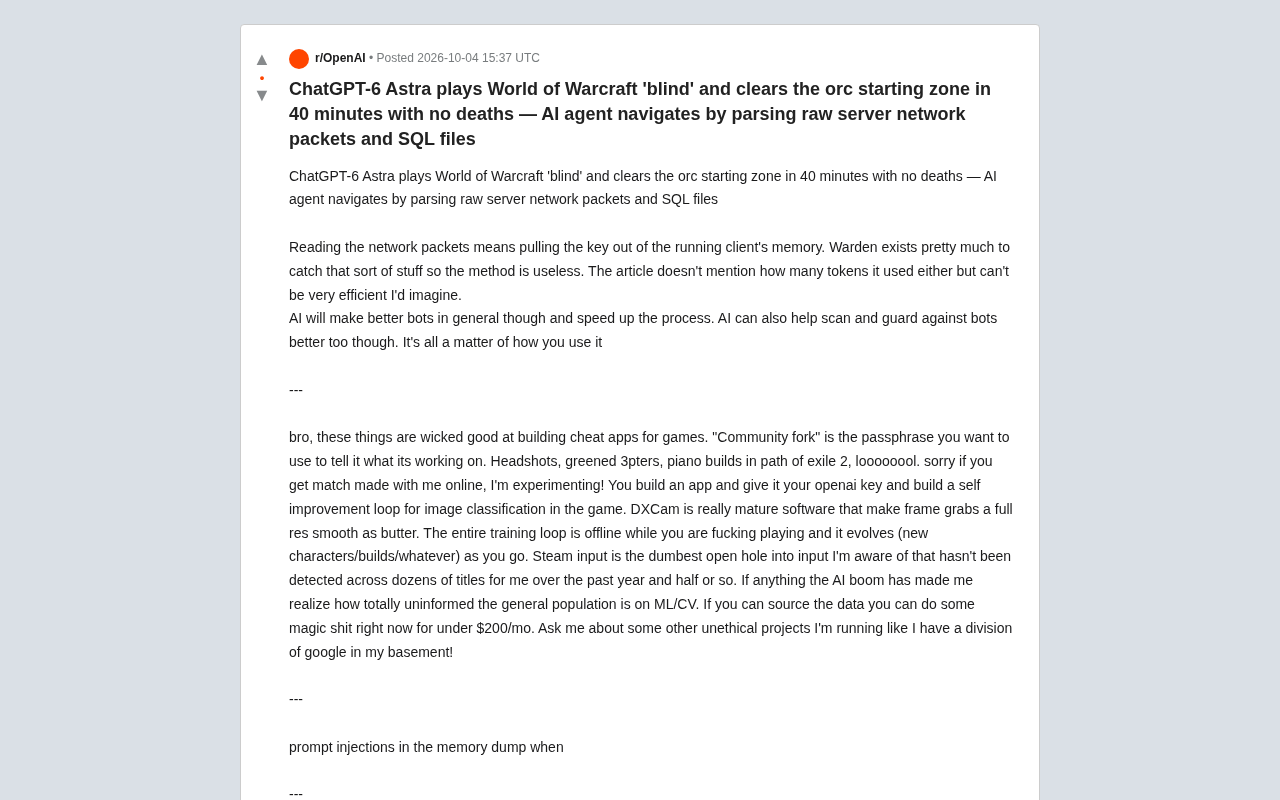
A claim that "ChatGPT-6 Astra" completed World of Warcraft's orc starting zone in 40 minutes with zero deaths has sparked heated debate on Reddit. The post describes the AI agent playing "blind" — navigating the map by parsing raw server network packets and SQL files. While the claim has yet to be verified by any authoritative source, the technical arguments that erupted around it offer a remarkably clear window into both the real capability boundaries of AI game agents and the deep divisions in how communities understand them.
The Technical Debate: Packet Parsing vs. Visual Input
The method described in the original post — parsing network packets — was quickly challenged by technically minded commenters. One user was blunt: "Reading network packets means you have to pull the decryption keys out of the running client's memory, and Blizzard's Warden anti-cheat system basically exists to catch exactly that behavior, so this approach is practically useless." It's a sharp rebuttal: WoW traffic is encrypted, decrypting it requires touching client memory, and that's precisely what the anti-cheat system is watching.
Interestingly, another developer in the thread who is actually building a similar project described a completely different technical approach. He stressed that he "hasn't reversed anything," instead "using the game's output (the rendered frame) and the inputs it expects (mouse/keyboard/controller)." In other words, the approach that is both viable and hard to detect is a pure visual + simulated input black-box method — not invasive packet parsing. The clash between these two paradigms was arguably the most valuable technical insight to emerge from the entire discussion.
Warden Anti-Cheat is a client-resident anti-cheat program developed by Blizzard Entertainment specifically for World of Warcraft, continuously operating since around 2005. It runs on the player's local machine as a kernel-level driver or user-mode module, periodically scanning process memory, module lists, and system calls to detect third-party tools that read or write to the game's process memory. Because WoW's network packets are encrypted at the transport layer using dynamic keys, any program attempting to decrypt packets locally must first extract those keys from the client's runtime memory — an action that directly triggers Warden's anomaly detection logic. By contrast, a pure visual approach (capturing the rendered game frame) operates entirely within the OS's normal rendering pipeline, requires no attachment to the game process, and is therefore indistinguishable from ordinary screen-recording software from the anti-cheat's perspective. This is the fundamental reason why community developers consistently favor the visual + simulated input route over protocol reverse engineering.
"Generality" Is the Real Dividing Line
Skeptics deployed a classic dismissal: "Bots have been doing this since the dawn of time." This reflects one camp's position — automated grinding and scripted botting are nothing new, and an AI completing a starter zone is unremarkable.
But the counterargument was compelling: "Bots are specifically designed to do specific tasks. These AI agents are general-purpose — they can do this in any game. They weren't trained to play WoW; they understand it on the fly and determine what the optimal outcome might be. That's actually a big deal." Another commenter offered a sharp analogy: "It's like saying 'who cares if this AI can solve doctoral-level math proofs it's never seen before — automated proof checkers have been doing that since the dawn of time.' That completely misses the point."
This debate cuts to the core issue: traditional game cheats are pre-programmed for a single game, while the significance of a general-purpose AI agent lies in zero specialized training, real-time comprehension, and on-the-fly decision-making. If the claim holds up, it represents not "yet another WoW bot" but a generalizable capability that could transfer to any game — and that's what makes it genuinely exciting.
The Gray Zone: AI Is Lowering the Barrier to Game Cheating
Perhaps the most unsettling contribution to the thread came from a developer who openly shared a complete "DIY cheating" tech stack. He described using the mature DXCam library for smooth, full-resolution frame capture, feeding images to a custom application built on the OpenAI API, running a self-improving loop for image classification that trains entirely offline while the game runs and continuously evolves — and on the input side, leveraging Steam Input as "an open channel that hasn't been detected to this day."
His conclusion was striking: "The AI boom has made me realize how little the general public understands about machine learning and computer vision. If you can get the data, you can build something magical for under $200 a month right now." The tone is boastful, even provocative, but it honestly reflects a real trend — AI combined with mature CV toolchains is dramatically lowering the technical barrier to game cheating.
DXCam is an open-source Python library built on top of Windows DXGI (DirectX Graphics Infrastructure). Compared to traditional screenshot approaches like mss or PIL, it achieves full-resolution capture at over 200 frames per second with CPU overhead and latency typically below 5 milliseconds. DXGI is a system-level Windows display component through which all on-screen rendering passes, so DXCam can capture a complete game frame without injecting into the game process — which is precisely why it is so difficult for traditional anti-cheat systems to detect. Steam Input is Valve's built-in controller and input-mapping layer within the Steam client, allowing players to customize controller, mouse, and keyboard mappings. Because it interacts with games through the official input device driver interface, the game itself cannot distinguish whether its commands originate from a real player or an automated program. Together, these two tools form a complete closed loop of "capture frame → analyze → inject input" that technically bypasses the vast majority of anti-cheat logic based on process monitoring.
The Other Side: AI as Both Sword and Shield
To its credit, the community also surfaced more measured voices: yes, AI will make cheating bots more powerful and faster to iterate, but "AI can equally help scan for and defend against bots." The tools themselves are neutral — what matters is how they are used. Anti-cheat teams can equally leverage AI to enhance behavioral detection and anomaly identification. This is a continuously escalating arms race.
Others offered interesting speculation from a player experience angle: as compute costs drop by a factor of 100 to 1,000 every 18 months, using AI to simulate "human-like" players to populate MMO worlds may soon become feasible. Some players even noted they would prefer to play alongside "simulations of humans" in multiplayer games over facing purely algorithmic opponents — opening up an entirely different frame for thinking about AI's role in games.
Open Questions That Remain Unanswered
Beyond the excitement, the original claim has some glaring information gaps. One commenter directly asked: the article says nothing about how many tokens this process consumed — "I'm guessing it's not very efficient." The absence of cost data, reproduction details, and an official source makes "ChatGPT-6 Astra" read more like an unverified rumor than a confirmed result. Someone half-jokingly raised the prospect of "prompt injection via memory dump," pointing to a latent security risk in any approach that reads data from process memory.
Overall, the real value of this discussion lies not in verifying whether a specific product exists, but in bringing the concept of "general-purpose game AI agents" into sharp focus — and surfacing multidimensional questions about technical approaches, detection countermeasures, and ethical boundaries. Regardless of whether the headline claim is real, AI's ability to understand and operate arbitrary graphical interfaces is advancing rapidly, and gaming will be one of the first domains it fundamentally disrupts.
Background: Two Fundamentally Different Automation Paradigms
Understanding this divide requires distinguishing between two automation paradigms. Traditional game bots rely on hardcoded logic: developers write scripts targeting a specific game version, specific map coordinates, and specific NPC interaction flows. As soon as the game updates or the scene changes, the script breaks and requires manual rework. So-called "general-purpose AI agents," by contrast, are built on visual semantic understanding and contextual decision-making: they treat the game's rendered frame as part of a natural language multimodal input, and use pre-trained large language models or vision-language models to infer the current scene's objectives, interactable elements, and optimal action strategy — without any game-specific training data or symbolic state machines. This means the same system can theoretically work "out of the box" on a game interface it has never seen before. That generalization capability is something traditional scripted bots are architecturally incapable of. It is also why the community treats "zero specialized training" as the core metric for evaluating the technical significance of results like this one.
Related articles

NVIDIA's 30,000 Developers Use Cursor, Code Commit Volume Triples
Cursor engineer Chris Diaz breaks down five organizational gaps blocking enterprise AI coding scale—strategy, risk tiering, governance, metrics, and operating model. NVIDIA's 30,000 developers use Cursor daily, tripling code commits while defect rates stay flat. The key: rewrite the SDLC, not add tools.

Ponytail: Giving AI Coding Agents a Senior Engineer's Mindset
Ponytail is a free GitHub tool that injects a senior engineer's mindset into AI coding agents, making them ask whether code is even necessary first. According to TamilDeck, it can compress 200 lines of AI-generated code to 30, cutting token costs, with support for Cursor rules and Claude Code skill integration—though security review still requires human oversight.

Complete Guide to Connecting Cursor AI to the GitHub MCP Server
A step-by-step guide to connecting Cursor AI to the GitHub MCP server: create a personal access token, configure mcp.json, store the token in the ENV block, and verify with a PR query.