ChatGPT Chat and Work Integration Tested as Gemini 4 Carbon Tops the Charts: An In-Depth AI Briefing

OpenAI merges Chat and Work entry points, Google's Gemini 4 Carbon tops the charts with security and agents, and coding agents shift toward model orchestration.
This episode of the AI Daily Briefing shows two main threads accelerating. On the product side, ChatGPT's web interface showed a gray-scale merged Chat and Work interface, and OpenAI confirmed plans to integrate them within the year. On the model side, Google released Gemini 4 Carbon within two weeks, topping the Artificial Analysis Intelligence Index with 59 points; the High version debuted at number one on the Arena text board. DeepMind also open-sourced Embedding Gemma R. In coding agents, GitHub launched Copilot Fusion, halving costs while approaching flagship performance. Also covered: NVIDIA's unified diffusion and voice models, Anthropic's legal toolkit, several security and privacy incidents, and supply chain pressure from Changxin HBM3E's low yield.
Product Integration and Model Competition: Two Fronts Accelerating at Once
According to a roundup from Bilibili's AI Daily Briefing Episode 196, two main threads in the AI world are worth watching: leading vendors are accelerating the integration of their product entry points, while the focus of the model race is shifting from general capabilities to vertical battlegrounds such as cybersecurity and long-horizon agents.
ChatGPT's Chat and Work Move Toward Merger
Some users noticed that ChatGPT's web interface briefly showed a merged Chat and Work interface, where the model selector allowed direct selection of the Work model, consuming the corresponding quota when invoked. The interface soon disappeared, suspected to be a gray-scale test. Pibo responded that the team does indeed plan to integrate Chat and Work within the year, but that no official launch has happened yet.
The significance of this move isn't the interface redesign itself. The separation of Chat and Work was essentially OpenAI's product division between consumer-grade conversation and enterprise-grade tasks. Merging means two things: first, the underlying model capabilities are converging, so the same set of models can support both lightweight conversation and workflows; second, OpenAI hopes to guide individual users into work scenarios with lower cognitive cost, then convert them naturally to Business subscriptions. The "quota consumption" prompt in the gray-scale test also hints that the billing systems of the two entry points are being connected.
Gemini 4 Carbon: Breakthroughs in Both Cybersecurity and Long-Horizon Agents
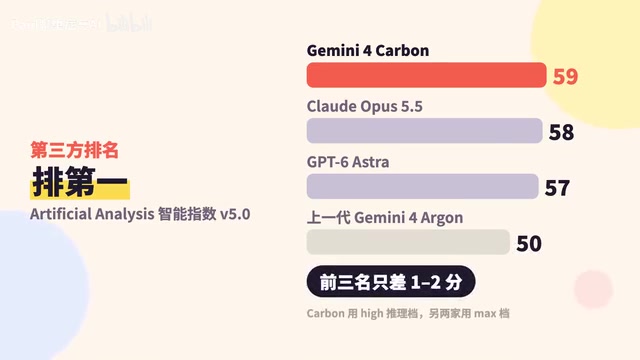
Google released its frontier model Gemini 4 Carbon, just two weeks after Argon. The new model focuses on cybersecurity and long-horizon agent capabilities, ranking first on the Artificial Analysis Intelligence Index with a score of 59. Starting this week, cybersecurity defenders can use the model through the Fairwind program. Pricing matches Argon: $2 per million input tokens, $10 per million output tokens, with a 95% discount on cached input, doubling after the promotional period.
The High version of Carbon debuted on the Arena leaderboard at number one on the text board with a score of 1528, while also ranking second on the agent board and fourth on the web development board. The agent board is based on real-task evaluations; Carbon's net improvement was 16.2%, 5.2 percentage points higher than Gemini 4 Argon, and its ranking was 5 places higher.
One detail worth noting is Carbon's distribution strategy. Despite focusing on cybersecurity, it was opened to defenders in the very week of release—a "defenders first" path that is uncommon in commercial model launches, suggesting Google is using security scenarios as a proving ground for capability validation. That said, leaker Lyra revealed that Gemini Omni 1.2 Flash has already been deployed and is expected to be released soon, with specific features and launch timing not yet announced.
The Artificial Analysis Intelligence Index is a third-party aggregated model evaluation metric that weights and normalizes scores from multiple public benchmarks (reasoning, knowledge, coding, math, etc.) into a composite score for cross-vendor comparison of flagship models. It doesn't evaluate a single capability but gives a rough ranking of "overall combat power," which is why media often cite it as a source for model rankings.
The Arena leaderboard (LMArena, formerly Chatbot Arena) uses crowdsourced blind testing: users vote on answers from two anonymous models, and a Bradley-Terry-style statistical model converts the votes into Elo-like scores. It measures human preference rather than objective correctness, so models with appealing styles tend to fare better. The text, agent, and web development boards mentioned in the article are sub-boards split by task type on Arena, and their scores cannot be directly compared across boards.
Multimodal Embeddings and Open Source
Google DeepMind open-sourced the multimodal embedding model Embedding Gemma R, which can encode text, images, audio, and video into the same vector space, with 744 million parameters. It is claimed to outperform much larger models with 12 times the parameter count, and to have pushed the frontier of the performance-to-resource trade-off across four benchmark categories, with a technical report released simultaneously.
For developers building retrieval-augmented and multimodal applications, the value of such small-parameter embedding models may exceed that of flagship generative models, because embedding cost directly determines vector database scale and retrieval latency.
Multimodal embedding models and generative multimodal models are two different technical routes. Generative models output text or images, while embedding models map inputs of any modality into a fixed-dimensional dense vector, so that semantically similar content is closer in vector space. Recall in retrieval-augmented generation (RAG), cross-modal image search, deduplication clustering, and recommendation recall all rely on such vectors.
Encoding text, images, audio, and video into the same vector space means you can query video clips directly with text, or search audio with images, without building separate aligned databases for each modality. The cost is that information density varies greatly across modalities, and training usually requires contrastive learning to pull paired samples closer and push unpaired ones apart. A small parameter count (around 700 million) is critical for deployment: embeddings must be computed one by one for millions to billions of records, so the smaller the model and the higher the throughput, the more controllable the vector database scale and retrieval latency.
Coding Agents: From Single Models to Model Orchestration
GitHub launched Copilot Fusion within Copilot, which can select and coordinate models from Anthropic and OpenAI to optimize performance and cost. On the Coding Agent Index test, Fusion scored 2 points lower than Opus 5.5 used by Cloud Code, while costing only half as much per task.
At the Universe 2026 conference, GitHub also released multiple AI coding updates focused on building agent workflows from requirements to code delivery: the new Copilot APP integrates multi-project management, Copilot Fusion automatically selects and combines models to approach Opus 5.5 performance while cutting task costs by about half, plus cross-device drawing sync, continuously optimizable automated workflows, and Copilot Code Review Max.
GitHub's 2026 Octoverse report shows that over 40% of PRs are drafted by agents; in the past 12 months developers pushed code 17.9 billion times, more than 2024 and 2025 combined, with 1.3 billion PRs merged over the same period.
Local and Remote Task Distribution
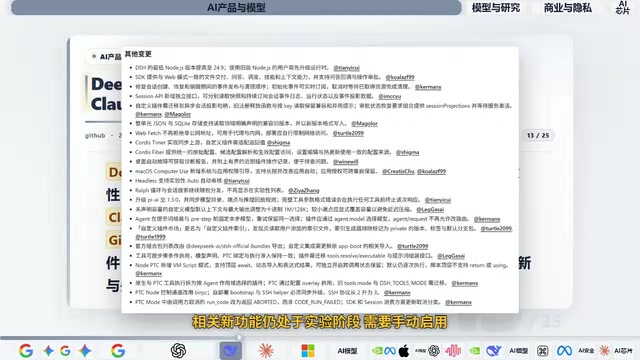
DSH updated to v0.2.2-alpha.2, adding an experimental plugin that can hand off independent tasks to local Codex or Cloud command-line tools; the new version also supports independent Gate work counts and drawing, making it easier to view code diffs and PR status; a developer statistics plugin lets you view context cache and model time consumption step by step. The related features are still experimental and require manual activation, and the version also supports third-party plugin updates and failure rollback.
Tencent's AI Agent tool WorkBody launched a remote control feature. Previously, on mobile you could only view the execution process and results of AI tasks; now you can connect to a computer via the mobile app to view the desktop in real time and take over operations with gestures such as tapping and dragging. Currently, remote control only supports Mac, with Windows not yet available.
The MiniMax Code team open-sourced its internal engineering skills and workflows, Mcode Stack, providing installable skill files and checklists covering task decomposition, context auditing, long command and drawing management, as well as code review and experiment evaluation.
These items point to the same trend: the competitive focus of coding agents is shifting from "how strong the model is" to "how tasks are distributed, how context is managed, and how costs are accounted for."
Model orchestration refers to a router or scheduler in an agent system dynamically choosing which vendor's model and which tier to invoke based on task type, difficulty, and cost budget, then chaining the results together. Common strategies include: routing simple tasks to small models and escalating complex reasoning to large models; preferring one vendor's model for coding tasks and another for long-document summarization; and automatically downgrading or switching models to retry on failure.
Its prerequisite is that different vendors' APIs are sufficiently similar in message formats and tool-calling protocols to be abstracted into a unified interface. The value lies in turning "model selection" from hard-coding into a runtime decision, thereby lowering the average unit price while approaching flagship model performance—which is why Copilot Fusion can cut costs in half while scoring only 2 points lower on the leaderboard. The difficulty is that routing decisions themselves can go wrong, and cross-vendor calls introduce latency and stability risks.
Models and Research: Unified Diffusion and Local Execution
NVIDIA's Nimitron team released the unified diffusion language model NLD-Ni, where the same model can both understand visual content and complete generation tasks, with the company claiming state-of-the-art results in both areas; the model and code have been open-sourced, and the training used On Policy techniques.
After the Stratta update, DeepSync v4.1 Flash can run locally on Mac, currently supporting text mode, requiring an M1 or newer Apple chip and macOS 15 or newer, with at least 64GB of unified memory recommended and 260–280GB of high-speed SSD space reserved. In testing, an M5 Max device using specific quantization settings generated about 15–16 tokens per second for short answers.
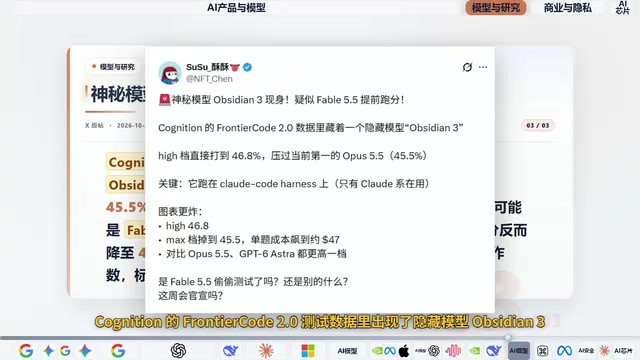
In Cognition's Frontier Code 2.0 test data, a hidden model called Obsidian 3 appeared, scoring 46.8% on High-Down, higher than Opus 5.5's 45.5%, with its true identity still undetermined. Since the test used the Cloud Code framework, some speculate it might be Fable 5.5.
Voice, Law, and Privacy: Capability Expansion Brings Governance Challenges
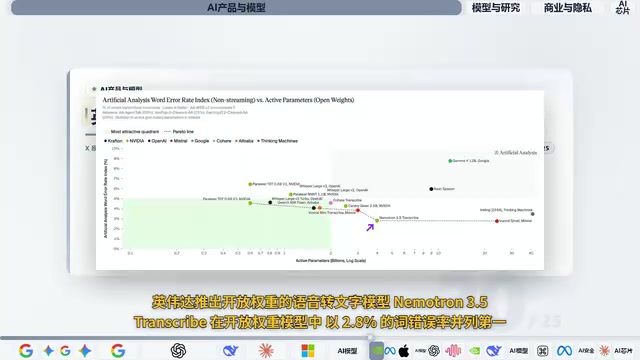
NVIDIA launched the open-weight speech-to-text model Nemotron 3.5 Transcribe, which ties for first among open-weight models with a 2.8% word error rate; it is used for non-streaming transcription, with 30 billion total parameters and 4 billion activated per run.
Anthropic launched a legal-specific Artifacts toolkit for Cloud for Legal, allowing lawyers to directly use or customize interactive workbenches for bulk contract review, legal citation verification, regulatory tracking, and cross-jurisdictional legal comparative analysis, with results traceable to original sources and shareable across teams. Anthropic says it has integrated more than 60 legal professional connectors and is collaborating with organizations such as Harvey and PwC to develop tools.
Governance news is equally dense. AI coding platform Command Code revoked all API keys, stating that it detected and blocked a large-scale traffic-hijacking attack targeting Anthropic and OpenAI models that day; users need to log in to Studio again to generate new keys, and the company says no users have been found to be affected and is investigating with Cloudflare, Anthropic, and OpenAI. Facing strong backlash from publishers, Meta may once again delay new commercial terms, from the originally planned October 30 to after November 20. Discord will allow search engines such as Google to index discoverable public server messages and generate AI discussion summaries, enabled by default in most regions, which users can turn off in Settings under Data & Privacy.
Some developers found that when Cloud Code completes the same task by calling Cloud Opus from different entry points, the 5-hour quota may be consumed at different rates: in one test, the same token usage of about $13 deducted 8% and 5% of the quota respectively, and in another the gap reached 2.9 times; the issue is suspected to be related to client entry-point identifiers, and the relevant GitHub Issue remains open.
Chips and Supply Chain
Changxin Memory plans to mass-produce the AI memory chip HBM3E within two months, with current yield only 20% to 30%, lower than SK Hynix's 70%. Changxin has sent samples to several domestic AI chip manufacturers for testing, with performance closer to the previous generation HBM3. Low yield drives up costs, and HBM3E products are expected to be priced higher than similar overseas products. Previously, manufacturers such as Huawei have raised prices by 20% to 50% due to rising memory costs.
Memory supply is becoming a real bottleneck for AI compute expansion. When HBM yield ramps slower than expected, cost pressure propagates along the chain from chips to servers all the way to model training and inference—more than any single model's leaderboard ranking, this affects the industry's pace.
HBM (High Bandwidth Memory) is memory that vertically stacks multiple DRAM dies, interconnects them through through-silicon vias (TSVs), and packages them together with the GPU/accelerator via a silicon interposer. It offers several times the bandwidth and lower power consumption than traditional GDDR and is a key component of AI training and inference cards; capacity and bandwidth often directly determine how large a model a single card can run.
Yield refers to the proportion of good chips on a wafer. The difficulty with HBM is that the more layers stacked and the denser the TSVs, the more a defect in any one layer drags down the entire stack, so yield ramps extremely slowly. A 20%–30% yield means most output is scrapped, significantly raising unit costs; meanwhile, yield-leading manufacturers can amortize costs through scale and prioritize supply. This is why HBM capacity is often seen as a hard constraint on AI compute expansion, and its scarcity affects the industry's rhythm more than any single model's leaderboard ranking.
One-line Summary
OpenAI integrates Chat and Work entry points, Google's Gemini 4 Carbon tops the charts with a focus on security and agents, and coding agents shift toward model orchestration.
Paragraph Summary
This episode of the AI Daily Briefing shows two main threads accelerating simultaneously. On the product side, ChatGPT's web interface showed a gray-scale merged Chat and Work interface, and OpenAI confirmed plans to integrate them within the year, aiming to connect billing and model foundations across consumer and enterprise subscriptions. On the model side, Google released Gemini 4 Carbon within two weeks, focusing on cybersecurity and long-horizon agents, topping the Artificial Analysis Intelligence Index with 59 points; the High version debuted at number one on the Arena text board. DeepMind also open-sourced the 744-million-parameter multimodal embedding model Embedding Gemma R. In coding agents, GitHub launched Copilot Fusion to orchestrate Anthropic and OpenAI models, halving costs while approaching flagship performance; DSH, WorkBody, and MiniMax focused on local task distribution, remote takeover, and open-source workflows, respectively. Also covered: NVIDIA's unified diffusion and voice models, Anthropic's legal toolkit, several security and privacy governance incidents, and supply chain pressure from Changxin HBM3E's yield of only 20%–30%.
Related articles

Microsoft Fabric Database Agent in Action: From Reactive Firefighting to Intelligent Detective
A deep dive into the Microsoft Fabric Database Agent: how to enable it, supported monitoring scenarios, a blocking-issue demo, and the roadmap from reactive to autonomous operations.

Zendesk Uses ChatGPT Enterprise to Build a Sales Agent with 1,000 Daily Active Users
Zendesk opened ChatGPT Enterprise to all employees, who built about 600 apps themselves, including a sales expansion agent with about 1,000 daily active users. This article analyzes how it turns internal data into sales opportunities and its "don't wait" implementation strategy.
Google Releases Gemini 4 Carbon: Its Strongest Model Yet, Debuting with a Cybersecurity Focus
Google releases Gemini 4 Carbon, calling it its strongest model, with a cybersecurity focus. It tops the third-party composite ranking at 59 points but leads by only one or two. This article analyzes its security test results, staged rollout, token pricing, and the divergence between self-reported and third-party tests on hallucinations.