ChatGPT Explains Better Than Professors? The Real Experience and Limits of AI-Assisted Learning

Exploring why students find ChatGPT better than professors, and where AI-assisted learning hits its limits.
A Reddit post about ChatGPT explaining concepts better than professors reveals AI's growing role in education. This article analyzes why AI excels as a patient, personalized tutor, while examining critical limitations including hallucinations, the illusion of fluency, and dependency risks. It also explores how AI is redefining teaching roles and democratizing educational resources.
A Student's Honest Reflection
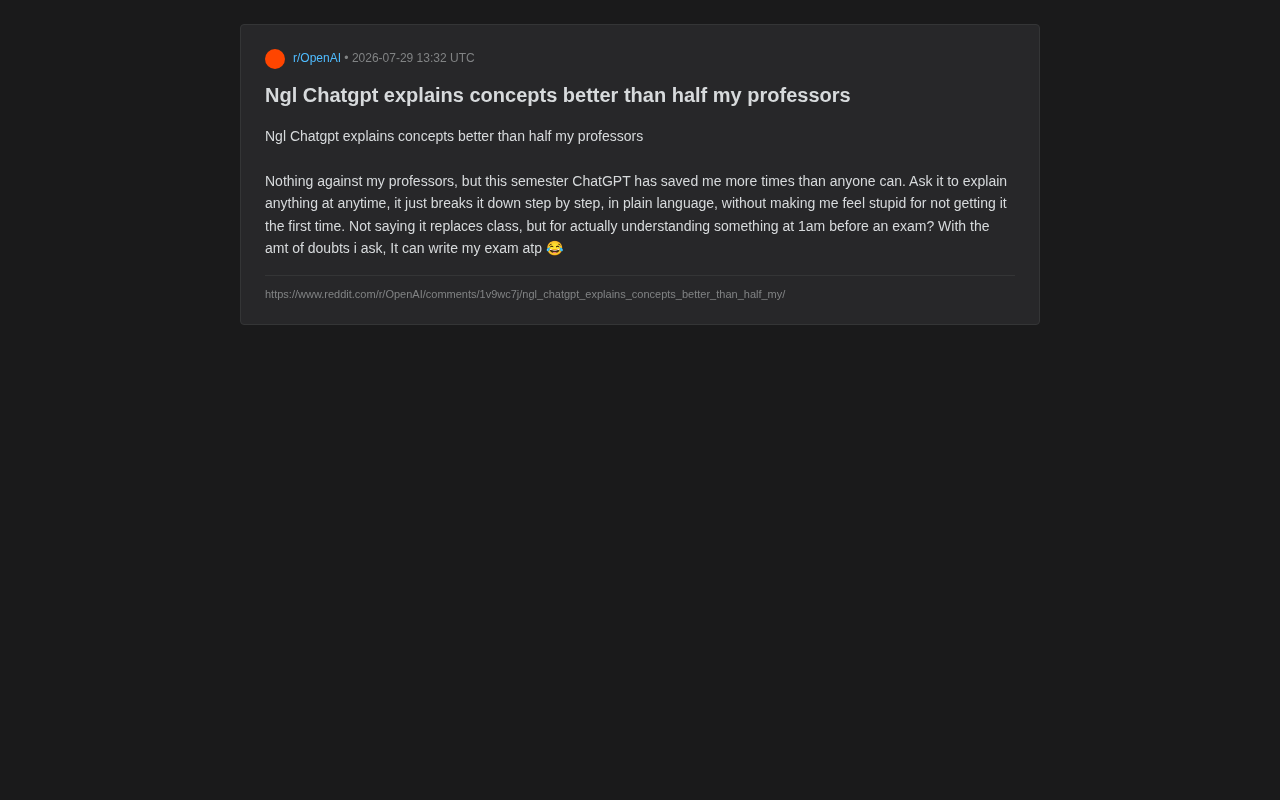
Recently, a student shared their semester experience on Reddit, sparking widespread resonance: "Ngl, ChatGPT explains concepts better than half my professors."
The user emphasized they had nothing against their professors, but that ChatGPT truly helped them through many tough spots this semester. "You can ask it anything, anytime, and it'll break it down step by step in plain language — without making you feel stupid for not getting it the first time." They added that while AI can't replace the classroom, "when it comes to actually understanding a concept at 1 AM before an exam," ChatGPT is irreplaceable.
Behind this candid post lies a growing role for AI in education — that of a personalized, patient tutor.
Why Do Students Feel ChatGPT Explains Better Than Professors?
This post resonated so widely for good reason. It touches on several long-standing pain points in traditional teaching.
Infinite Patience and Zero Psychological Pressure
The key phrase the student mentioned was "without making you feel stupid." In real classrooms, students often avoid asking questions for fear of exposing their ignorance. With AI, that social pressure vanishes entirely. You can ask the same question ten times over, and AI will maintain the same tone and patience.
The impact of this "zero-judgment" learning environment on learning psychology shouldn't be underestimated. Educational psychology research shows that Learning Anxiety significantly reduces working memory capacity, preventing students from processing content they're otherwise capable of understanding. When social pressure is removed, all cognitive resources can be devoted to comprehension itself, naturally boosting learning efficiency. Many learning difficulties stem not from intellectual limitations but from the psychological barrier of being afraid to admit "I don't understand."
On-Demand Breakdowns with Full Control Over Learning Pace
Traditional classroom pacing is designed for the class average and struggles to accommodate individual comprehension speeds. ChatGPT can break down a complex concept into steps of any granularity based on your specific confusion, or even re-explain using a different analogy until you get it.
This "Socratic" step-by-step guidance is exactly the core value of an excellent tutor. The Socratic Method, originating from ancient Greek philosopher Socrates, centers on guiding learners to discover answers through continuous questioning and dialogue rather than directly delivering conclusions. Education researchers consider this method effective at promoting deep understanding and metacognitive development. Now, every student can access this kind of personalized tutoring 24/7, for free.
Where Are the Boundaries of AI-Assisted Learning?
Despite this student's positive experience, we need to view AI's role in learning rationally. The original poster themselves acknowledged: "I'm not saying it can replace the classroom." This statement hits the key point.
AI Excels at Explaining Concepts, but Isn't Always Correct
The core capability of Large Language Models (LLMs) is reorganizing and expressing existing knowledge in clear, accessible ways. They work by training on massive text datasets, learning to predict the most likely next word given a context, thereby generating fluent, coherent natural language output. For mature, well-established foundational concepts (like mathematical theorems, physics principles, or programming syntax), their explanations are often clear and accurate, because this knowledge has been expressed consistently and abundantly in training data.
However, AI still suffers from the "hallucination" problem — it may confidently provide incorrect answers, especially when dealing with cutting-edge research, niche domains, or scenarios requiring precise data. Hallucination refers to the model generating content that appears reasonable and grammatically correct but is factually wrong. This stems from LLMs being fundamentally probabilistic text generators — they don't truly "understand" facts and cannot distinguish between recalling training data and "fabricating" content. Students who treat every AI response as truth may actually be misled.
The Gap Between Understanding and True Mastery
"Getting a concept at 1 AM" and "truly mastering it with flexible application" are two different things. The "Illusion of Fluency" in cognitive science points out that when information is presented very clearly and accessibly, learners tend to overestimate their level of mastery. AI-generated explanations possess exactly this high fluency, potentially making students believe they've truly learned something when they haven't. Deep internalization of learning still requires active practice, independent thinking, and repeated application — things AI cannot do for you.
If students develop a dependency habit of "asking AI the moment a question arises," it may weaken their independent problem-solving abilities. The original poster's half-joking comment about "at this rate, it could take my exams for me" is precisely a warning sign worth heeding.
Deeper Implications of AI for Education
This seemingly casual Reddit post actually reflects structural changes happening in the education industry.
The Professor's Role Is Being Redefined
When the function of "knowledge explanation" can be efficiently handled by AI, teachers' core value will increasingly shift toward aspects AI cannot easily replace: sparking curiosity, guiding critical thinking, providing emotional support, organizing collaborative learning, and offering judgment and guidance based on real-world experience.
This aligns with the "Flipped Classroom" educational philosophy — students self-study foundational knowledge before class through videos or reading materials, while class time is devoted to deep discussion, Q&A, and collaborative projects. AI makes this model more feasible because students now have an always-online "teaching assistant" for pre-class self-study.
In other words, AI won't replace good teachers, but it may phase out teaching approaches that remain at the level of merely "reading from the textbook."
Democratization of Educational Resources
In the past, high-quality one-on-one tutoring was a scarce and expensive resource. Now, a student in a remote area and a student at a prestigious university, facing the same difficult problem at 1 AM, can receive nearly the same quality of instant assistance.
This AI-driven democratization of educational resources continues the trend started by MOOCs (Massive Open Online Courses, like Coursera and edX) and platforms like Khan Academy, but represents a qualitative leap — from one-way video watching to two-way personalized dialogue. Past online education was still a "one-to-many" broadcast model, while AI tutoring truly achieves "one-to-one" interactive teaching. Its long-term significance may be severely underestimated.
Conclusion: Use AI Tools Well, Don't Depend on Them
This student's post represents the real situation of countless students today. ChatGPT has quietly become an indispensable part of many people's learning toolkits.
The real key is treating AI as an amplifier rather than a substitute — using it to quickly understand, clear obstacles, and expand thinking, while maintaining habits of independent thought, hands-on practice, and critical verification. When students learn to harness AI rather than be led by it, this educational transformation will truly unlock its greatest value.
Key Takeaways
Related articles

llama.cpp GUI Launcher for Linux: Hands-On Review of Two Installation Methods
Hands-on review of the llama.cpp GUI Launcher for Linux, comparing manual compilation vs. Snap installation, covering startup commands, known bugs, and differences from Ollama and LM Studio.

Training-Free Object Localization with DINOv2: One-Shot Open-World Detection and Segmentation
Explore a training-free object localization approach using DINOv2 patch embeddings — no fine-tuning needed. Achieve open-world one-shot detection and segmentation with touching instance separation.

How to Spend $100/Month on AI Subscriptions: Single Pro Plan vs. Combo Approach — A Deep Comparison
Should you spend $100/month on ChatGPT Pro alone or combine ChatGPT Plus, Cursor Pro, and SuperGrok? A deep comparison of single vs. combo AI subscription strategies for developers and knowledge workers.