ChatGPT Helped Me Claim €400 in Flight Delay Compensation: The Full AI-Assisted Dispute Process

A traveler used ChatGPT to cite EU261 law, secure airport hotel accommodation, and claim €400 in compensation.
A Reddit user shared how ChatGPT helped them fight back when an airline refused to provide overnight accommodation after a missed connection. By citing EU261/2004 regulations and verifying hotel availability online, they secured a free hotel stay and successfully claimed €400 in delay compensation. The case also reveals significant accuracy differences between free and paid ChatGPT versions in legal scenarios.
A Flight Delay That Almost Meant Sleeping at the Airport
For frequent flyers, flight delays and missed connections are all too familiar nightmares. But a recent real-life experience shared by a Reddit user reveals the unexpected value AI tools can bring when dealing with these kinds of emergencies.
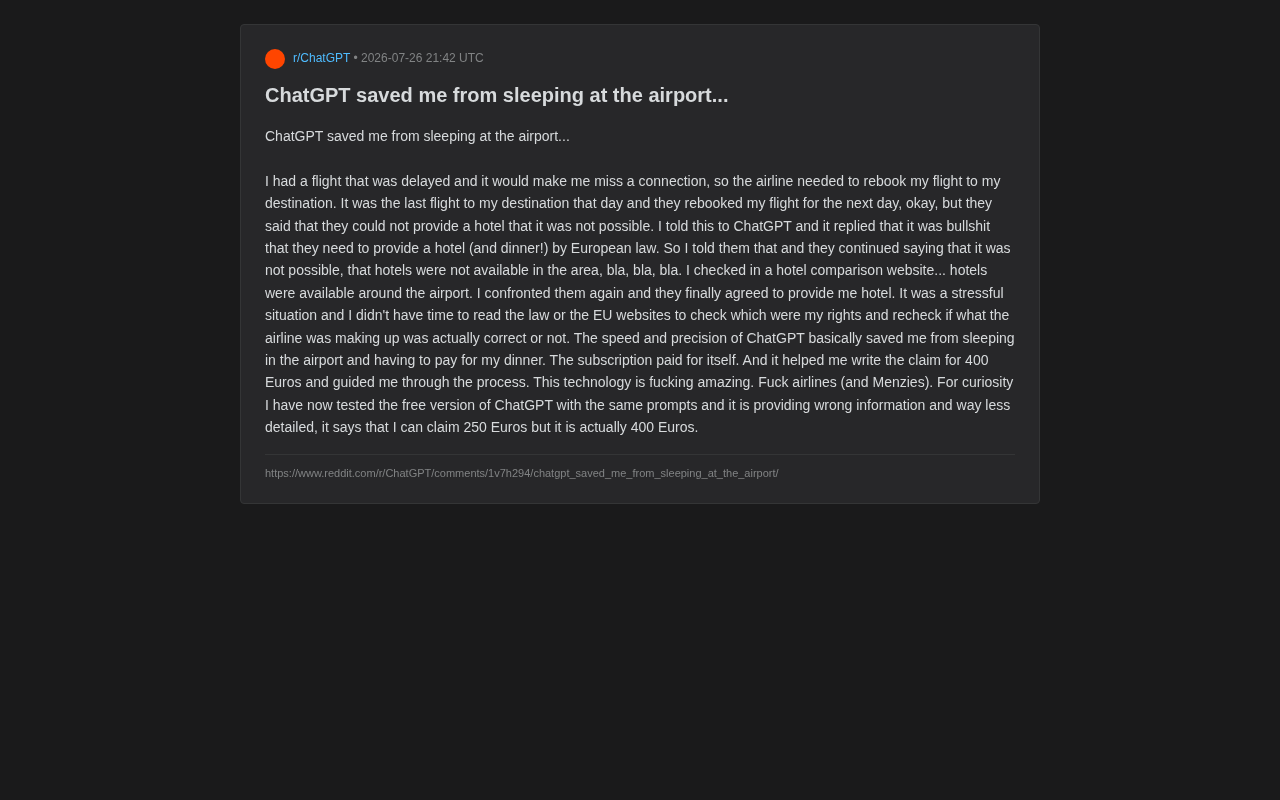
The story is straightforward: this user's flight was delayed, causing them to miss their connection—and it was the last flight of the day to their destination. The airline rebooked them on the next morning's flight, which was acceptable enough. The problem was what came next. The airline explicitly stated: no accommodation could be provided, and arranging a hotel was impossible, claiming that "there are no available hotels near the airport."
Faced with this situation, most passengers would simply accept their fate—either paying out of pocket for a hotel or enduring the night on airport benches. But this user did something different—they described the entire situation to ChatGPT.
How ChatGPT Became a Pocket Legal Advisor
ChatGPT's response was blunt: the airline's claim was "bullshit." According to EU Regulation 261/2004 (EU261), when a flight delay causes a missed connection requiring an overnight rebooking, the airline is obligated to provide hotel accommodation for the passenger, and even meals.
EU261/2004 is an EU regulation enacted in 2004 for the protection of air passenger rights. Its full title is "Establishing Common Rules on Compensation and Assistance to Passengers in the Event of Denied Boarding, Cancellation, or Long Delay of Flights." The regulation applies to all flights departing from EU airports, as well as flights to the EU operated by EU-registered carriers. It not only specifies standardized compensation amounts but also clearly defines the airline's "duty of care" during flight disruptions—including providing meals, communication means, accommodation, and transportation between the airport and hotel. Notably, according to European Consumer Centre surveys, a large number of eligible passengers never exercise these rights, primarily because they simply don't know they exist—and airlines rarely volunteer this information.
Armed with this critical information, the user re-engaged with the airline. Although they initially continued deflecting with the "no hotels available" excuse, the user quickly checked hotel comparison websites and discovered that there were plenty of available rooms near the airport. When confronted with this evidence, the airline finally relented and agreed to provide accommodation.
The most noteworthy aspect of this process is the time factor. The user admitted that in such a stressful, anxiety-filled situation at the airport, there was simply no time to read through EU regulations or official websites line by line, let alone verify whether the airline's claims were true. The speed and precision ChatGPT provided perfectly bridged this information gap—it gave an ordinary traveler the equivalent of professional legal knowledge in just a few minutes.
Full-Process Assistance from Dispute to Compensation Claim
The AI's help didn't stop at securing accommodation. Afterward, ChatGPT also helped the user draft a €400 compensation claim for the flight delay and guided them step by step through the entire claims process.
Under EU261, compensation for flight delays or cancellations is typically tiered by flight distance:
- Routes under 1,500 km: €250
- Routes between 1,500–3,500 km: €400
- Routes over 3,500 km: up to €600
It's worth adding that these compensation amounts are fixed and standardized, regardless of the actual ticket price paid. This means that even if you bought a €50 budget ticket, you're still entitled to €250–€600 in compensation as long as you meet the criteria. Furthermore, this compensation is independent of and parallel to the duty of care services (accommodation, meals, etc.) the airline provides—in other words, even if the airline has already arranged a hotel, passengers can still claim this additional amount.
The user ultimately confirmed they were entitled to €400, not the lower tier. They remarked: "The subscription paid for itself."
The Critical Gap Between Free and Paid ChatGPT
This case also contains a detail worth noting for all AI users. Out of curiosity, the user later tested the exact same prompt with the free version of ChatGPT, and the results were alarming:
The free version not only provided noticeably less detailed information but actually gave an incorrect compensation amount—it claimed the user could only claim €250, when the correct amount was €400.
The core difference between ChatGPT's free and paid versions (Plus/Pro) lies in the underlying large language model's reasoning capabilities and knowledge precision. The free version typically runs a lighter model variant or imposes stricter computational resource limits on advanced models, making it prone to "hallucinations" or simplification bias when handling complex logical reasoning, precise numerical calculations, and multi-step legal analysis. The paid version provides access to the full GPT-4o or even more advanced reasoning models like o1/o3, which offer significantly improved training data coverage, contextual understanding depth, and reliability in multi-step reasoning chains. In this case, accurately identifying the "1,500–3,500 km" distance bracket and matching it to the corresponding compensation amount required the model to simultaneously understand the regulatory text structure and specific route information—exactly the type of scenario where lighter models tend to fail.
This comparison reveals a real-world problem: in scenarios requiring high precision around legal matters and monetary amounts, differences in AI model capability can directly translate into real financial losses. Had the user relied on the free version and fully trusted its output, they likely would have received €150 less.
AI Output Still Requires Cross-Verification
Although this experience is a textbook success story for AI application, it also contains an important usage lesson. You might not have noticed, but the user didn't blindly trust every word from ChatGPT—when the AI flagged the airline's "no hotels available" claim as problematic, they proactively verified room availability on comparison websites, obtaining powerful evidence for their confrontation.
This is the ideal model for AI-assisted decision-making: AI provides direction and a knowledge framework, while humans handle critical fact verification. Especially in high-stakes domains like consumer rights, law, and healthcare, treating AI output as a "starting point" rather than an "endpoint" is the safer approach. Current large language models are fundamentally probability-based text generation systems—they may be entirely correct in the big picture but can make subtle errors in specific details like dates, amounts, or clause numbers. Developing a habit of "trust but verify" is the key skill for extracting maximum value from AI tools.
AI Is Reshaping Ordinary People's Ability to Assert Their Rights
This seemingly ordinary airport story actually reflects a deeper trend: AI tools are closing the power gap created by information asymmetry.
Information Asymmetry is a classic concept in economics, systematically articulated by Nobel laureate George Akerlof and others. In consumer dispute scenarios, companies typically possess complete knowledge of rule systems, internal policy interpretations, and legal boundaries, while consumers remain chronically disadvantaged in terms of information. The aviation industry is a prime example—according to relevant statistics, approximately 70% of passengers eligible for EU261 compensation never file a claim, mainly because they don't understand their rights or are deterred by airlines' professional jargon and procedural barriers. This asymmetry exists not only in aviation but is equally prevalent in everyday scenarios like insurance claims, rental disputes, and labor arbitration.
In the past, institutions like airlines held a natural advantage in dealings with individual consumers—they knew the rules, mastered the rhetoric, while passengers often had only a vague understanding of their legal rights. When one side can casually fabricate claims like "regulations don't allow us to provide accommodation," passengers lacking specialized knowledge can hardly push back.
Now, a portable AI assistant can retrieve relevant regulations in seconds, assess the truthfulness of the other party's claims, and even draft formal complaint letters. The widespread availability of this capability is essentially democratizing specialized knowledge, allowing every ordinary person to arm themselves when needed. From a broader perspective, this represents a subtle shift in power structures—when professional knowledge is no longer monopolized by the few, when anyone can carry a "quasi-legal advisor" in their pocket, the balance of power between institutions and individuals is being quietly reset.
Of course, we should remain clear-eyed: AI makes mistakes, and reliability varies enormously between different versions and models. But this case demonstrates well enough that—when used appropriately—AI is no longer just a chat toy, but a practical tool capable of delivering real value in real-world predicaments.
Next time you face a flight delay or get brushed off by an institution with "that's just our policy," try asking AI first—it might save you a night's hotel bill, or even help you recover compensation that was rightfully yours all along.
Related articles

DIY Air Purifier: Building a Silent CR Box with PC Fans and an Aluminum Frame
Learn how to build a quiet Corsi-Rosenthal air purifier using PC case fans and an aluminum frame, covering fan selection, PWM speed control, and cost analysis.

Universality of Gradient Descent Training: Does Neural Network Architecture Choice Really Matter?
Exploring the universal approximation capability of gradient descent training, analyzing the relationship between neural network architecture choice and learnability, from UAT to NTK theory.

From AI to Large Models: Understanding the Conceptual Landscape and Technological Evolution of Artificial Intelligence
Understand how AI, machine learning, deep learning, large models, and generative AI relate to each other. From Deep Blue to ChatGPT, learn how Transformer architecture gave rise to LLMs.