ChatGPT Plus Quota Draining Fast: Users Say 5-Hour Limit Lasts Only 10 Minutes
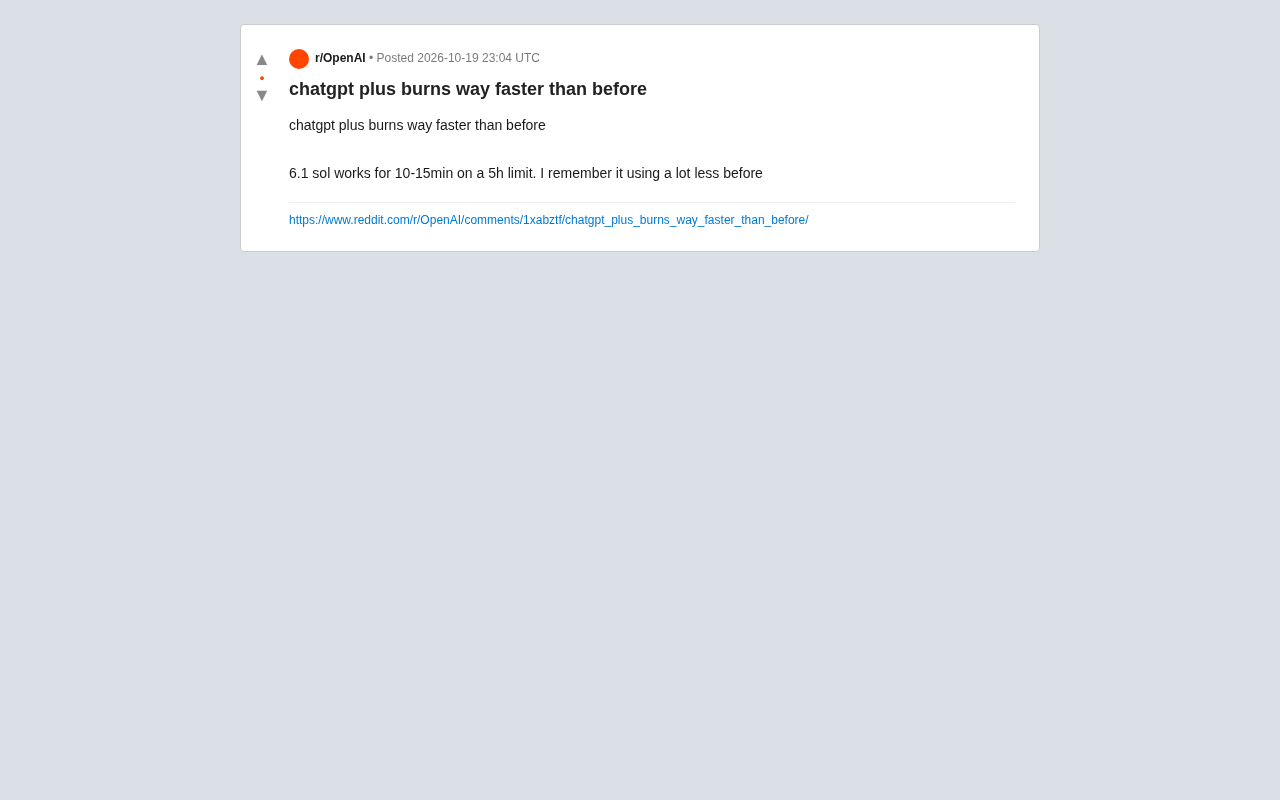
Reddit users say ChatGPT Plus quota is draining faster, with the 5-hour limit lasting only 10-15 minutes for a model.
Recently, Reddit users reported that ChatGPT Plus's 5-hour rolling limit is being consumed noticeably faster, with a model exhausting the quota in just 10 to 15 minutes, resonating with subscribers. The article analyzes that faster quota consumption may stem from rising model inference costs, context and memory accumulation, and silent adjustments by the platform to quota conversion rules. However, this feedback is only a single user's subjective perception, lacking official statements or third-party measurement corroboration. The article suggests heavy users control usage by splitting sessions, choosing models by task, reducing tool calls, and tracking consumption patterns, and calls for more users to cross-validate.
A recent post on Reddit has struck a chord: a user reports that ChatGPT Plus usage is being consumed noticeably faster than before, with the same 5-hour limit now lasting only 10–15 minutes for a single model. The post itself doesn't include complex test data, but the "feels faster" sentiment is becoming a shared topic among subscribers.
Specifics of the User Feedback
The poster's description is quite direct: under the rolling 5-hour limit, a model labeled "6.1 sol" burned through the entire quota in just 10 to 15 minutes. He added, "I remember using way less before," suggesting the change wasn't gradual but became noticeable after some point in time.
The difficulty with this kind of feedback is the lack of a reproducible measurement method. ChatGPT Plus quotas aren't presented as a single number but are calculated based on factors like model, context length, and tool calls. Users find it hard to precisely compare "before" and "now" and can only judge by their daily usage rhythm. For this reason, a single post isn't enough to draw a conclusion, but it provides a signal worth tracking.
ChatGPT Plus usage limits are based on a rolling time window rather than a fixed daily quota that resets. The so-called "5-hour limit" means the system continuously tracks quota consumed over the past 5 hours; once cumulative usage hits the cap, users must wait for the earliest consumption to slide out of the window before continuing. This mechanism means that high-frequency continuous use will hit the limit faster than intermittent use, and it also makes the perceived difference in "whether the quota is draining faster" vary more between users.
Additionally, ChatGPT billing isn't a simple count of "message count" but calculates weighted token consumption for each request. Model unit price, input/output length, and whether tools are called all affect the weight, so what users see as "how much is left" is essentially a converted balance, not the raw number of calls.
Why Quota Consumption May Be Faster
From a product mechanism perspective, faster subscription quota consumption typically comes from several sources.
Rising Model and Inference Costs
More complex models and longer reasoning chains increase the billing weight per conversation. If the platform adjusts the consumption multiplier for different models in the background, what users feel on the interface is "the quota drops faster for the same few questions."
Accumulation of Context and Memory
Conversation history, memory features, and additional tools cause each request to carry more context. The longer the context, the higher the processing cost. Many users are accustomed to asking follow-up questions continuously in the same session, which amplifies consumption—and this isn't intuitive on the interface.
Every inference of a large language model requires re-feeding the complete conversation context into the model for processing, and its computational load increases with context length. When the context approaches the model's maximum window, the platform often needs to truncate, summarize, or enable more expensive processing methods, all of which drive up the equivalent cost per request. Moreover, after enabling the "memory" feature, the system injects additional user profile information into requests, further increasing input length. Therefore, continuous follow-up questions in the same long session have significantly higher marginal consumption than creating a new session.
Adjustments to Quota Policy
The platform may adjust the available quota per unit time without changing the "5 hours" wording. Externally it's the same limit window, but internally the conversion rules have changed. Such adjustments typically aren't announced separately and can only be discovered through user perception.
Quota rules for subscription-based AI products are typically authorized by terms of service for unilateral adjustment by the platform, and user agreements generally include clauses stating "usage limits may change at any time." When compute resources are tight or costs rise, the platform may balance load by adjusting model multipliers, reducing available quota per unit time, or introducing dynamic limits, while the external interface still shows the same limit window. This "silent adjustment" is not uncommon in the SaaS industry, but it directly changes the user experience and is one reason why this Reddit feedback is difficult to either disprove or confirm.
Limitations of a Single Source
It should be noted that this information currently comes from a single Reddit user's subjective feedback, with no official statement or third-party measurement data to corroborate it. The "6.1 sol" mentioned in the post also lacks context, making it impossible to confirm which model or feature it refers to.
Therefore, a more prudent judgment is: this could be a real change in experience, or it could be compounded by changes in personal usage habits. Treat it as a sample of the "quota draining faster" phenomenon, not a conclusion. If you have similar feelings, you can record the consumption for similar tasks over a period of time and then compare.
Practical Advice for Heavy Users
When official rules are opaque, controlling consumption is more practical than investigating causes.
- Split sessions: Put unrelated questions into new sessions to avoid unlimited context accumulation.
- Choose models by task: Use lightweight models for simple tasks and save high-consumption models for scenarios that truly need them.
- Watch out for tool calls: Additional capabilities like web browsing and code execution are billed extra—don't enable them unless necessary.
- Track consumption patterns: Recording quota changes for similar tasks over several consecutive days is more reliable than a single perception.
Quota rules are something the platform can adjust unilaterally; what users can do is make their usage more controllable. As for whether this feedback is an isolated case or a widespread phenomenon, more users' actual records are needed for cross-validation.
One-line Summary
Reddit users say ChatGPT Plus quota is draining faster, with the 5-hour limit lasting only 10-15 minutes for a model.
Paragraph Summary
Recently, Reddit users reported that ChatGPT Plus's 5-hour rolling limit is being consumed noticeably faster, with a model exhausting the quota in just 10 to 15 minutes, resonating with subscribers. The article analyzes that faster quota consumption may stem from rising model inference costs, context and memory accumulation, and silent adjustments by the platform to quota conversion rules. However, this feedback is only a single user's subjective perception, lacking official statements or third-party measurement corroboration, and cannot be confirmed. The article suggests heavy users control usage by splitting sessions, choosing models by task, reducing tool calls, and tracking consumption patterns, and calls for more users to cross-validate.
Related articles

A Single Prompt Triggers a Global PHP Security Storm: Is AI a Savior or a Hidden Risk?
A single AI prompt triggered a global PHP security crisis affecting Wikipedia and the Internet Archive. This article reviews the incident, analyzes the OpenAI-Amazon controversy, and explores the security paradox of lowered vulnerability discovery barriers in the AI era and developer response strategies.

When AI Is Taken Away: How Reliance on Shortcuts Undermines Your Problem-Solving Resilience
A study of 1,222 people found that after using AI to answer questions, once AI was removed, people gave up on more problems than a control group that never used AI. The article analyzes the impact of AI reliance on learning resilience and metacognition, and explores design implications for AI learning tools.

Carta and NewView Partner to Let Startup Employees Cash Out Equity Early
Carta and NewView Capital partner to simplify startup tender offers, helping employees sell equity early. Analysis of the mechanism, liquidity pain points, and impact.