ChatGPT Trusted Contact Feature Explained: How AI Crisis Intervention Protects User Mental Health
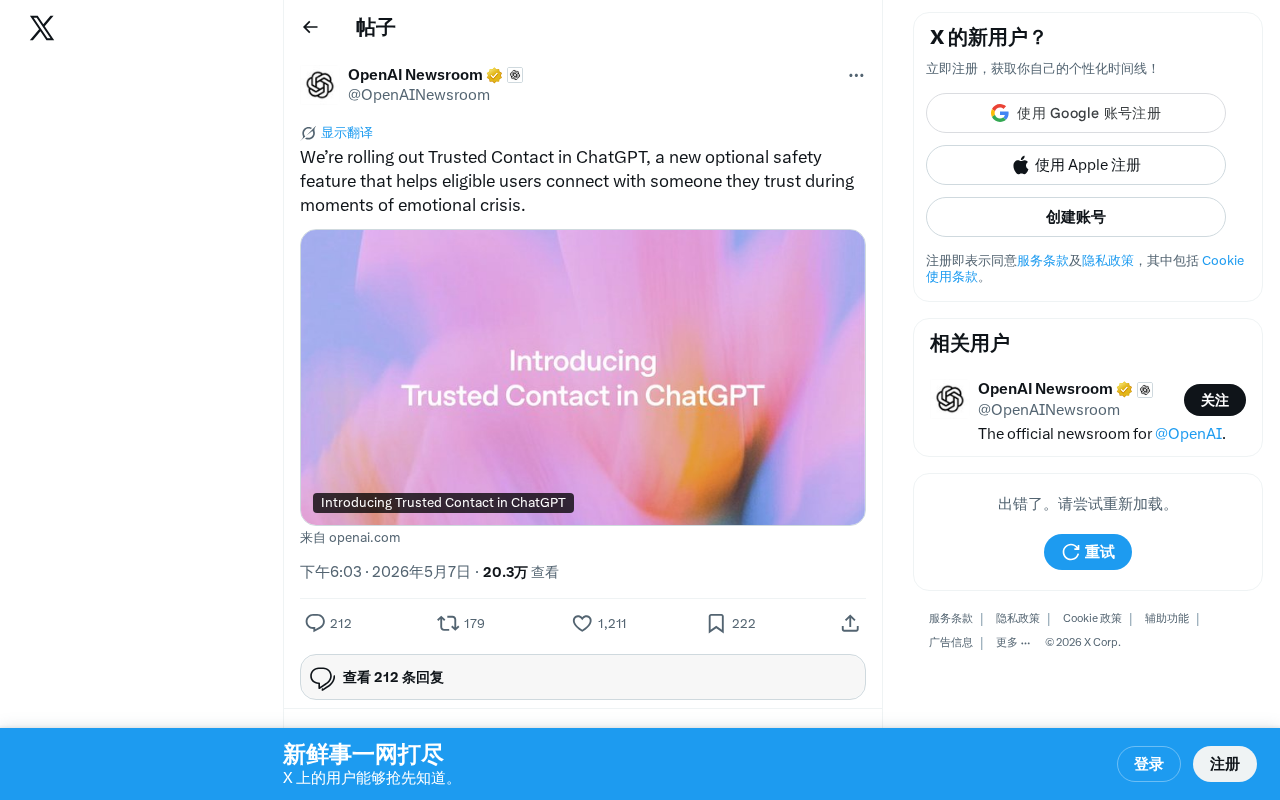
ChatGPT launches Trusted Contact feature to help users reach trusted people during emotional crises.
OpenAI has launched an optional safety feature called Trusted Contact for ChatGPT, allowing users to pre-set trusted contacts. When AI detects emotional crisis signals in conversations, it proactively offers contact options to help users access real interpersonal support. This feature reflects AI products' transformation from productivity tools to user well-being guardians, and represents a forward-looking response to industry mental health incidents and regulatory pressure.
Feature Overview: What Is ChatGPT's Trusted Contact?
OpenAI recently announced the launch of a new safety feature called Trusted Contact in ChatGPT. This is an optional safety feature designed to help eligible users quickly reach out to someone they trust when experiencing an emotional crisis. This initiative marks an important step forward for AI products in protecting user mental health.
Feature Positioning: A Humanized Extension of AI Safety
Why Does ChatGPT Need a Trusted Contact Feature?
As ChatGPT's user base continues to grow, more and more people are using it as a daily outlet for venting and emotional communication. Many users express anxiety, depression, or even more serious mental health crisis signals during their conversations with AI. Previously, when ChatGPT detected that a user might be in a crisis state, it could typically only provide generic resources like mental health hotline numbers.
This crisis recognition capability stems from large language models (LLMs) being deeply trained on massive amounts of human conversation data. Modern LLMs can identify negative emotional signals in user expressions through semantic analysis, Sentiment Analysis, and contextual understanding—detecting keywords and semantic patterns such as despair, helplessness, and self-harm intent. This capability is known as "Affective Computing" and forms the technical foundation of AI safety mechanisms. However, LLM emotional recognition is far from perfect—it relies on statistical patterns rather than genuine emotional understanding, creating a risk of misjudgment. This is precisely why Trusted Contact is designed to return the final decision-making power to users rather than having AI automatically trigger intervention actions.
The launch of the Trusted Contact feature upgrades this passive information provision into proactive social connection—allowing users to reach someone they trust in the real world with a single tap during their most vulnerable moments, rather than merely facing a cold list of phone numbers.
How Trusted Contact Works
Based on publicly available information, Trusted Contact's core operating mechanism includes the following key components:
- Completely Optional: Users decide for themselves whether to enable the feature—there is no mandatory setup
- Eligibility Restrictions (Eligible Users): Not all users can access it; OpenAI likely sets qualification criteria based on factors such as age and region
- Pre-set Contacts: Users can designate one or more trusted contacts in advance, and the system assists in establishing connections during crisis moments
- Crisis Trigger Mechanism: When conversation content indicates a user may be in emotional crisis, the system offers the option to contact their trusted contact at an appropriate time
On the technical implementation level, ChatGPT's crisis recognition involves a multi-layered architecture. At the model level, OpenAI uses RLHF (Reinforcement Learning from Human Feedback) and specialized safety fine-tuning to enable the model to recognize high-risk content patterns such as Suicidal Ideation and Self-harm. At the system level, independent Content Classifiers may also be layered in as a double safeguard, performing real-time scanning of conversation flows. Such systems need to strike a balance between "sensitivity" and "specificity"—being too sensitive leads to numerous false positives that disrupt normal user experience, while being too conservative may miss genuine crises. This technical challenge also explains why OpenAI chose to limit the feature to "eligible users," allowing them to continuously optimize recognition accuracy within a controlled scope.
In simple terms, users pre-link trusted friends or family members, and when ChatGPT detects serious emotional crisis signals in a conversation, it proactively displays contact options to help users access real interpersonal support at critical moments.
Industry Significance: The Expanding Boundaries of AI Product Responsibility
From Productivity Tool to User Guardian: A Role Transformation
The launch of this feature reflects an important trend in the AI industry: AI products are gradually transitioning from pure productivity tools to assuming the role of user well-being guardians. When hundreds of millions of users engage in deep conversations with AI every day, AI companies inevitably need to confront the serious issue of user mental health.
Previously, role-playing AI platforms like Character.AI had faced severe criticism and even legal action over mental health issues involving teenage users. In 2024, a 14-year-old American boy died by suicide after prolonged deep emotional interaction with an AI character, and his family subsequently filed a lawsuit against Character.AI, alleging the platform failed to provide adequate safety protection mechanisms. This incident triggered Congressional hearings on AI platform teen protection issues and prompted multiple states to advance specialized legislation targeting AI products. Character.AI was subsequently forced to roll out a series of safety updates, including mandatory crisis intervention pop-ups and parental monitoring features. This series of events constitutes the direct industry context behind OpenAI's launch of the Trusted Contact feature, and also marks the formal transition of the AI mental health responsibility topic from academic discussion into the regulatory and legal arena. OpenAI's proactive release of the Trusted Contact feature is both a response to industry lessons learned and a forward-looking move ahead of increasing regulatory pressure.
Balancing Technical Capability with Ethical Considerations
Notably, the design of this feature reflects OpenAI's careful balance between technical capability and ethical considerations:
- Respecting User Autonomy: The feature is completely optional, avoiding controversies over excessive intervention
- Connecting Real Social Relationships: Rather than attempting to have AI play the role of a therapist, it guides users back to real interpersonal support networks
- Setting Entry Thresholds: Through eligibility restrictions, it likely prioritizes protecting high-risk groups such as minors
This design philosophy has solid psychological theory behind it. Social Support Theory indicates that during psychological crises, emotional support from close relationships is more effective at reducing suicide risk than any professional intervention. The World Health Organization (WHO) suicide prevention guidelines also clearly state that the "Gatekeeper" model—training ordinary people to identify and connect with individuals in crisis—is one of the prevention strategies with the strongest evidence base. AI plays the role of a "digital gatekeeper" here.
Related articles
 Tech Frontiers
A Rare Quiet Day in AI: Recursive Self-Improvement Stirs Beneath the Surface
A rare quiet day in AI sees multiple sources go silent simultaneously. Behind the calm, Recursive Self-Improvement (RSI) research continues. What this means for the industry.
 Tech Frontiers
Reve 2 vs. Ideogram 4: A Deep Dive into Layout Control in AI Image Generation
A deep comparison of Reve 2 and Ideogram 4's layout control capabilities, covering technical approaches, real-world use cases, and industry trends for designers and creators.
 Tech Frontiers
In the Weights: Check Your Influence Score in the AI World
In the Weights is an AI influence search engine that quantifies your presence in the AI world with a score. Explore how it evaluates practitioners and what it means for digital identity.