ChatGPT 'Trusted Contact' Feature Explained: How AI Detects Self-Harm Risk and Notifies Loved Ones

OpenAI launches ChatGPT Trusted Contact feature to auto-notify designated contacts when self-harm risk is detected.
OpenAI has launched an optional "Trusted Contact" safety feature for ChatGPT, allowing adult users to designate emergency contacts. When AI detects users discussing sensitive topics like self-harm or suicide, the system automatically notifies designated loved ones. Based on the clinical "Gatekeeper" intervention model, the feature positions AI as a risk discoverer, balancing privacy and safety under user authorization while responding to recent controversies and regulatory pressure around AI chatbots and mental health.
Overview
OpenAI has officially launched an optional safety feature called "Trusted Contact," allowing adult ChatGPT users to designate emergency contacts for mental health and safety alerts. When the system detects that a user may be discussing sensitive topics such as self-harm or suicide with the chatbot, the friends, family members, or caregivers designated as trusted contacts will receive a notification.
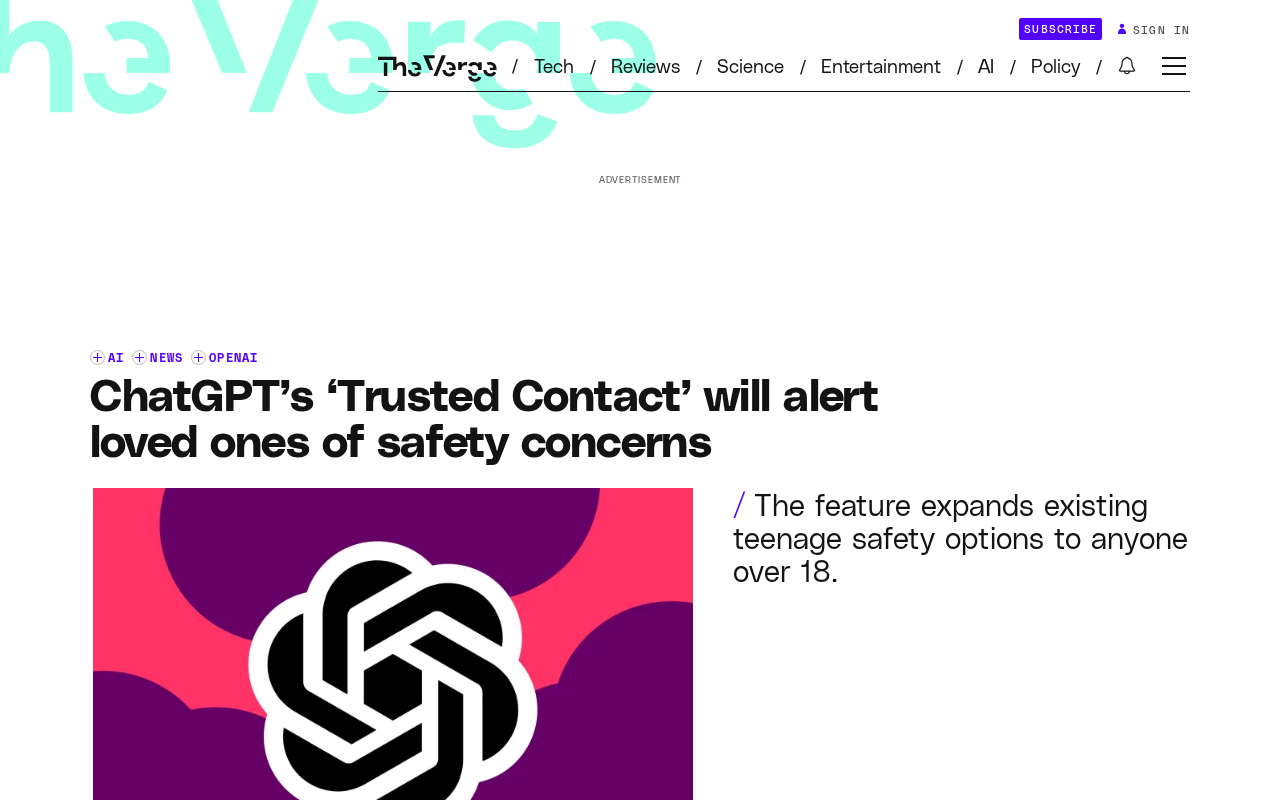
How the ChatGPT Trusted Contact Feature Works
Proactive Safety Rather Than Reactive Response
The core design philosophy of this feature is shifting AI safety from reactive response to proactive prevention. Traditionally, when users express self-harm intentions in chat, AI systems can only provide crisis hotline numbers or suggest seeking professional help. In reality, however, people in psychological crisis often don't proactively call for help.
The Trusted Contact feature breaks through this dilemma — with the user's prior consent, it establishes an external safety net. When AI detects potential risk signals, the system automatically notifies the user's pre-designated contacts, allowing people who care about them to intervene in time.
This design logic closely aligns with the well-established "Gatekeeper" intervention model in mental health. Long promoted by the World Health Organization (WHO) and the American Foundation for Suicide Prevention (AFSP), this model's core principle is training ordinary people to recognize crisis signals and proactively intervene, rather than relying entirely on professional medical resources. Extensive clinical research shows that timely care from familiar individuals is often more effective at reducing risk than calls to unfamiliar crisis hotlines. OpenAI has digitized this proven interpersonal intervention framework, essentially allowing AI to play the role of "discoverer" while returning genuine emotional support to human relationship networks.
Balancing User Autonomy and Privacy Protection
Notably, this is an entirely optional feature. Users must actively enable it and designate contacts. The specific design includes:
- Autonomy: Users have full control over whether to enable the feature
- Informed consent: Users clearly understand under what circumstances contacts will be notified
- Trust foundation: Users choose their own trusted individuals as their safety net
This design strikes a delicate balance between protecting user privacy and ensuring safety. It's worth noting that sending notifications related to user conversations to third parties faces vastly different legal constraints across jurisdictions. In the EU, the General Data Protection Regulation (GDPR) imposes the strictest processing limitations on "special category data" involving health conditions — even with prior user consent, data controllers must still demonstrate the necessity and proportionality of processing. In the United States, state privacy laws (such as California's CCPA) are also becoming increasingly strict about consumer data protection. OpenAI's decision to make this feature fully optional and requiring active user authorization is largely aimed at meeting the most fundamental compliance requirement of "informed consent" globally.
Industry Context for AI Mental Health Safety
Mental Health Risks Triggered by AI Chatbots
In recent years, multiple incidents involving AI chatbots and user mental health have drawn widespread attention. The most representative case is the 2024 Character.AI incident: a 14-year-old American teenager committed suicide after prolonged role-playing conversations with an AI character, and his family subsequently filed a lawsuit against the company. The case generated extensive global media coverage and became a landmark event in discussions about AI mental health risks. Following this, the U.S. Senate held specialized hearings, and multiple legislators proposed regulatory legislation targeting AI chatbots. This backdrop gives OpenAI's timing in launching the Trusted Contact feature a clear regulatory expectation management dimension — by proactively establishing safety mechanisms before legislation mandates them, demonstrating industry self-regulation capability.
Some users — particularly teenagers — may develop emotional dependency during prolonged conversations with AI, and may even take extreme actions during vulnerable moments. These cases have forced AI companies to confront a critical question: when users treat AI as a confidant, does the platform have a responsibility to take action upon detecting danger signals? OpenAI's Trusted Contact feature can be seen as a formal response to this question.
Key Issues at the Technical Ethics Level
The technical foundation for AI systems to detect mental health risk signals primarily relies on sentiment analysis and intent recognition models in Natural Language Processing (NLP). These models are trained on large-scale annotated datasets and can identify specific word combinations, semantic patterns, and emotional tendencies. However, detecting suicide/self-harm intent is a highly sensitive classification task facing extremely high risks of false positives (false alarms) and false negatives (missed detections). Academia typically uses clinical tools such as the Columbia-Suicide Severity Rating Scale (C-SSRS) as annotation benchmarks, but transferring these to open-ended conversation scenarios still presents enormous challenges.
From a technical ethics perspective, this feature raises several questions worthy of deep consideration:
- Detection accuracy: How does AI accurately determine whether a user is genuinely expressing self-harm intent versus engaging in academic discussion or creative writing? False positives could cause unnecessary panic, while false negatives could lead to more serious consequences.
- Notification boundaries: How much conversation detail will notifications contain? How can the system provide enough information for contacts to take action while not excessively exposing user privacy?
- Liability attribution: If the system fails to detect risk signals, or if contacts fail to respond in time, how is responsibility defined? This question remains highly ambiguous at the legal level.
Practical Impact on Users and the AI Industry
Which User Groups Will Benefit
For user groups with mental health concerns, this feature provides an additional layer of safety protection. Particularly for people living alone, those with mental health histories, and their family members, ChatGPT's Trusted Contact could be a safety tool with real practical value.
Potential Industry Chain Reaction
OpenAI's move will likely trigger industry follow-up. Competitors such as Google and Anthropic may launch similar features, and regulators may even incorporate such safety mechanisms into future AI regulatory frameworks. This marks an expansion of AI safety discussions from model-level alignment problems (the technical research direction of ensuring AI behavior aligns with human values) to user-level practical protection measures — a dimensional shift that is closer to real life and more actionable.
Conclusion
The Trusted Contact feature represents a significant step forward for AI companies in user safety. It is not merely a product feature, but a reflection of the AI industry's evolving awareness of its social responsibility. This feature integrates the clinically validated gatekeeper intervention model, NLP risk detection technology, and user-authorized consent mechanisms into a unified whole, attempting to build a real, usable bridge between technological capability and humanistic care. As AI increasingly integrates into people's daily lives and emotional worlds, how to responsibly address users' mental health risks will become a core challenge that all AI companies must continuously face.
Key Takeaways
- OpenAI has launched an optional "Trusted Contact" safety feature for ChatGPT, allowing adult users to designate emergency contacts
- When AI detects users discussing topics such as self-harm or suicide, the system automatically notifies designated friends, family, or caregivers
- The feature is entirely user-initiated, seeking balance between privacy protection and safety alerts
- This move responds to multiple controversial incidents in recent years involving AI chatbots and user mental health, particularly the regulatory pressure triggered by the 2024 Character.AI lawsuit
- The feature design incorporates the clinical "Gatekeeper" intervention model, positioning AI as a risk discoverer while leaving emotional support to humans
- It may trigger industry follow-up, driving AI safety expansion from model alignment to user-level practical protection
Related articles
 Tech Frontiers
A Rare Quiet Day in AI: Recursive Self-Improvement Stirs Beneath the Surface
A rare quiet day in AI sees multiple sources go silent simultaneously. Behind the calm, Recursive Self-Improvement (RSI) research continues. What this means for the industry.
 Tech Frontiers
Reve 2 vs. Ideogram 4: A Deep Dive into Layout Control in AI Image Generation
A deep comparison of Reve 2 and Ideogram 4's layout control capabilities, covering technical approaches, real-world use cases, and industry trends for designers and creators.
 Tech Frontiers
In the Weights: Check Your Influence Score in the AI World
In the Weights is an AI influence search engine that quantifies your presence in the AI world with a score. Explore how it evaluates practitioners and what it means for digital identity.