ChatGPT Wallet Launches: AI Agents Pay for You Without Ever Touching Your Card Number

OpenAI launches ChatGPT Wallet: payment tokens let AI agents shop without exposing card numbers, with biometric approval.
OpenAI launched ChatGPT Wallet on Product Hunt, letting its dots agent complete purchases while payment tokens keep real card numbers from both agent and merchant. Built with American Express, Mastercard, and Visa, it points to a card-network-level protocol for agent payments. Users review item details, total, and card, then approve via Face ID or fingerprint—keeping the agent in execution, not authorization. It hit #6 on Product Hunt with 89 votes, but token validity, revocation, and cross-merchant interoperability remain unclear.
OpenAI has made a move in the payments space. ChatGPT Wallet, launched on Product Hunt, lets OpenAI's "dots" agent complete purchases on the user's behalf—and neither the agent nor the merchant ever sees the user's card number. The product was built with the participation of all three major card networks—American Express, Mastercard, and Visa—and entered Product Hunt at #6 for the day with 89 votes.
What Problem Does It Actually Solve?
Having an AI agent "help you buy things" sounds like just handing the click actions to a model, but the real difficulty lies in payment authorization. In the traditional flow, any online transaction requires card number, expiration date, CVV, and other information to circulate on the merchant side. Once you hand that to an autonomously operating agent, the risk exposure multiplies.
ChatGPT Wallet's approach is to introduce payment tokens. The card network issues a token to the agent to complete the transaction; the real card number neither appears in the agent's context nor reaches the merchant's systems. In other words, the agent gets a "one-time pass," not the key to your wallet.
Payment Token is a technology introduced by card networks to replace real card numbers. In traditional transactions, merchants need to store or transmit sensitive information such as card numbers and expiration dates; a single leak creates card-fraud risk. Tokenization replaces the card number with a randomly generated string that can only be used for a specific merchant, specific device, or specific scenario—even if intercepted, it cannot be used elsewhere. Visa's Visa Token Service (VTS) and Mastercard's MDES are examples of this infrastructure, and Apple Pay and Google Pay both rely on token mechanisms. ChatGPT Wallet extends this concept to AI agents: the card network issues a token to the agent rather than a card number, thereby isolating leak risk at the architectural level and giving agent payments auditable, revocable properties.
Three Gates: See Clearly First, Then Approve
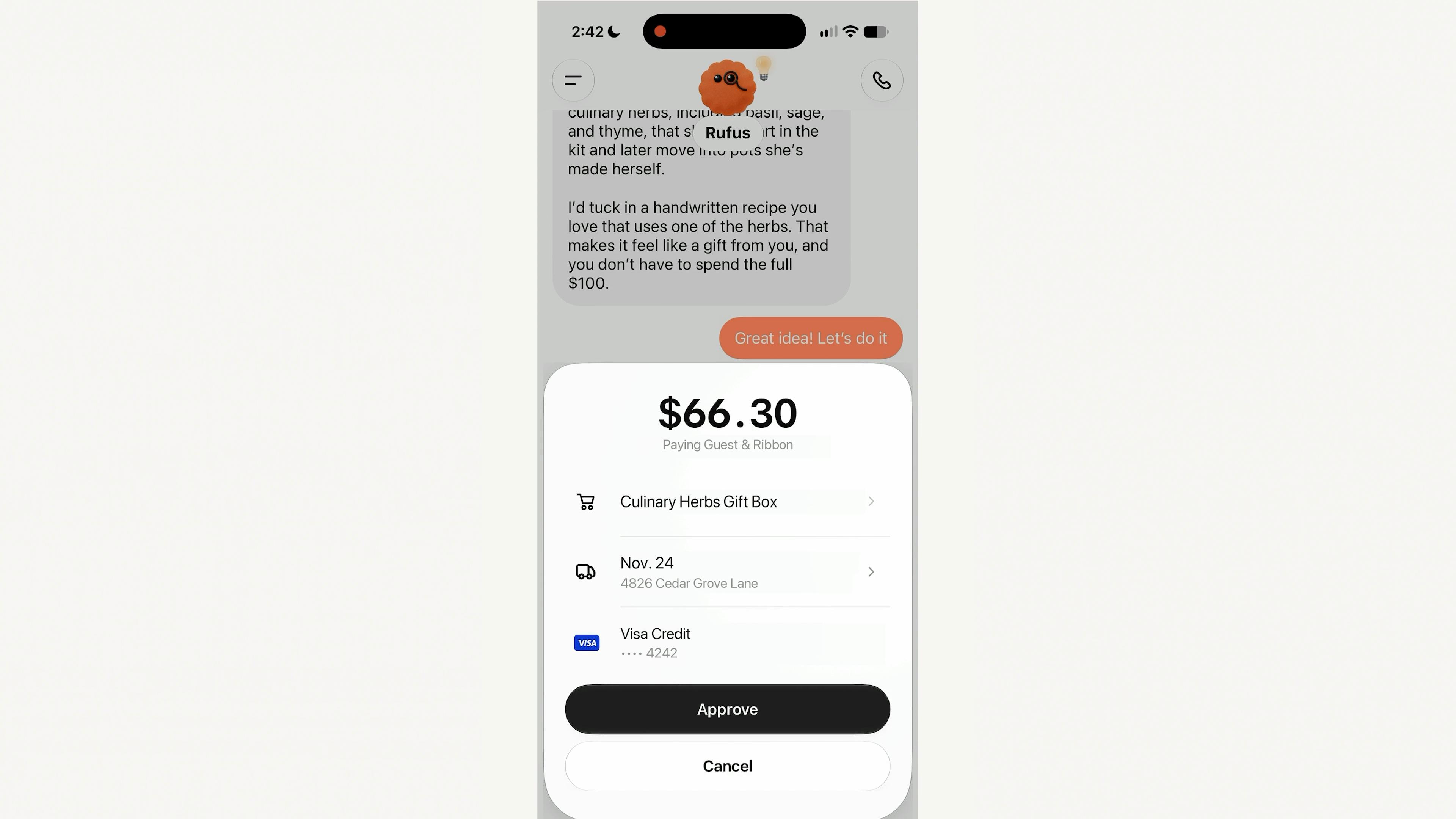
The product description makes clear where human confirmation sits: before each purchase, the user must review three things—item details, order total, and the card used for this transaction—then approve with Face ID or fingerprint.
This design limits the AI agent's role to "execution" rather than "decision authorization." The agent can compare prices, add items to cart, and complete the checkout flow, but the final press must be made by a human. Biometrics here serve both as a security gate and as a division of responsibility: there is a record of who approved the transaction.
One detail: the simultaneous participation of all three card networks means this is not a custom feature from a single bank, but an attempt to establish a general protocol for agent payments at the card-network level. Visa and Mastercard have both been exploring standards for AI agent payments, and American Express's participation makes the coverage of this solution more complete.
Biometric payment authorization (such as Face ID or fingerprint) is not simply a password replacement. In payment scenarios, biometrics are typically bound to the device's Secure Enclave and used to unlock a private key or token credential stored locally on the device—not to send the biometric itself to a server. This means the authorization action happens on the user's device, and the card network or merchant only receives a cryptographic proof of "verified." For AI agent payments, the key point of this model is that the agent cannot forge biometric signals, and each user authorization generates a non-repudiable signature record. This provides a technical basis for subsequent liability determination—when a transaction is disputed, it can be precisely determined whether the user personally approved it or the agent initiated it automatically.
What It Means for Ordinary Users
In the short term, the value of this feature lies in handing "repetitive shopping" to the agent. Restocking, renewals, and list-based purchasing—low decision cost but tedious operation—are the most natural landing spots for agent payments. Users don't need to entrust their card numbers to a third-party app, nor worry about the agent being induced into overspending—because the total and item list are displayed before approval.
Longer term, the signal value of this exceeds the feature itself. For AI agents to truly participate in economic activity, payments are unavoidable infrastructure, and the core tension of payments is always "convenience" versus "control." ChatGPT Wallet's answer: give convenience to the agent, keep control with the human, and use token technology as the isolation layer.
What Still Needs Watching
There is only 1 comment on the Product Hunt page, and public discussion is still limited. Several key questions have no clear answers yet: How are token validity periods and revocation mechanisms designed? Can the agent repeatedly initiate purchase requests before user approval? Are tokens interoperable across merchants and currencies? These details determine whether it's a usable small feature or foundational capability that can support an agent economy.
From a product positioning standpoint, ChatGPT Wallet is another step in OpenAI's push to move ChatGPT from a "conversation tool" to an "execution tool." When the agent can look up information, write code, book travel, and now make payments, it's only one last stretch away from a complete closed loop of "handling things for you." Whether that stretch is walked steadily depends on how card networks, merchants, and users mesh in real transactions.
One-line Summary
OpenAI launches ChatGPT Wallet, using payment tokens so AI agents can shop for you without exposing card numbers, with biometric approval.
Paragraph Summary
OpenAI launched ChatGPT Wallet on Product Hunt, allowing its dots agent to complete purchases on users' behalf while using payment token mechanisms to ensure neither the agent nor the merchant can access real card numbers. The product was built with the participation of all three major card networks—American Express, Mastercard, and Visa—pointing to a general protocol for agent payments at the card-network level. Before each purchase, users review item details, order total, and the card used, and approve via Face ID or fingerprint, limiting the AI agent's role to execution rather than decision authorization. The product received 89 votes on Product Hunt, ranking #6 for the day, but public discussion is still sparse, and key details such as token validity periods, revocation mechanisms, and cross-merchant interoperability remain unclear. Essentially, this is another step in OpenAI's push to move ChatGPT from a conversation tool to an execution tool, and an attempt at payment infrastructure for AI agents participating in economic activity.
Related articles

Gemini 4 Neon Leak: A Potential Strong Contender Against Opus 5.5
A Hacker News thread suggests Gemini 4 Neon looks like an Opus 5.5 competitor. This article unpacks the product positioning behind this community signal, shifts in the top-model competitive landscape, and what it means for developers' model selection strategy.

Claude Fable 5.2's Self-Authored Short Film 'Fable' Sparks Discussion
A short film 'Fable,' credited to Claude Fable 5.2 for script, visuals, and directing, appears on Hacker News. This article analyzes the significance of full-pipeline AI creation, community reactions, and what it means for content creators.

Anthropic IPO Pricing: A Signal of AI Giants Going Public
Anthropic's IPO pricing draws attention. This article analyzes its potential impact on AI industry valuation, commercialization paths, and the competitive landscape, and highlights public-market expectations and challenges for AI companies.