Chert: Build FaceTime Video AI Agents in Just a Few Lines of Code

Chert lets developers build FaceTime video AI agents in just a few lines of code.
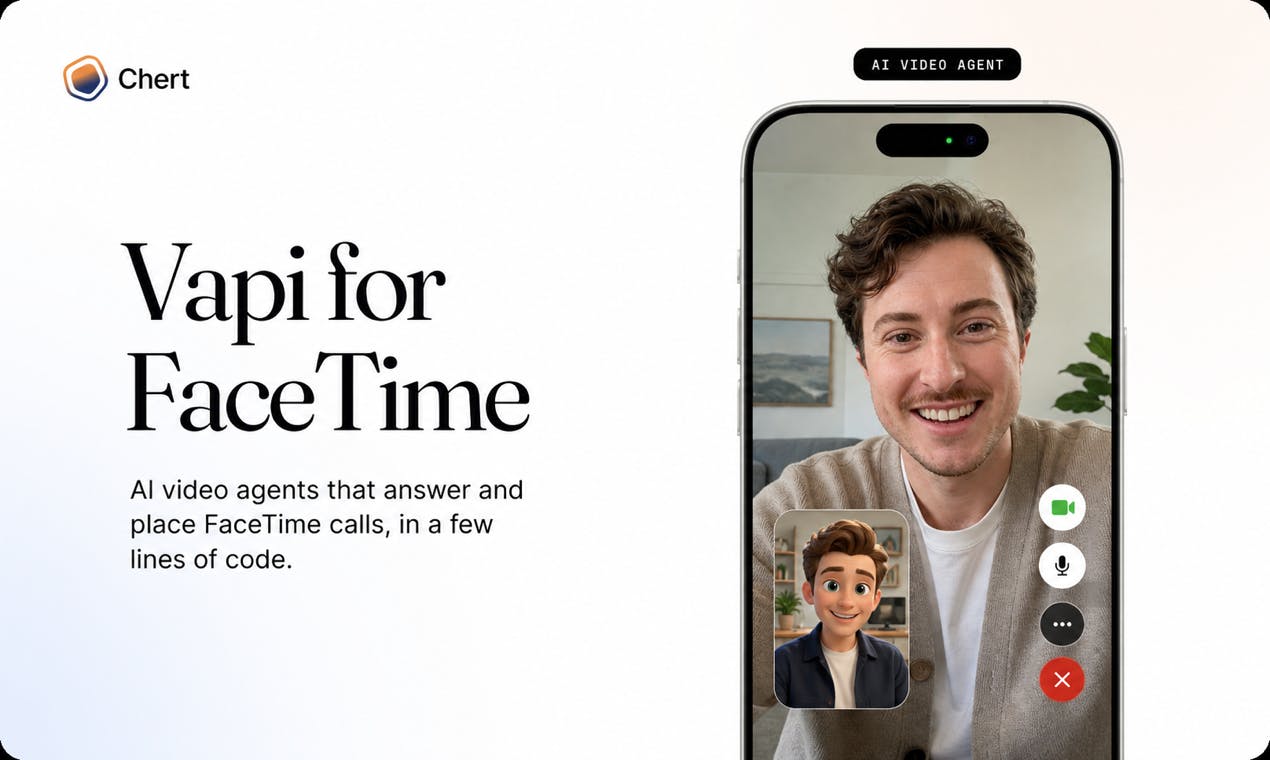
Chert is a developer platform positioning itself as "Vapi for FaceTime," enabling AI agents that can answer and make FaceTime video calls. With a few lines of code, developers can build agents that see, hear, and speak — ideal for remote tech support, field service, telehealth intake, and guided onboarding. The product leverages Apple's FaceTime ecosystem for zero-friction user access and encapsulates complex real-time video, multimodal AI, and voice processing into simple APIs.
When AI Agents Enter FaceTime Video Calls
In an era dominated by voice AI, a developer tool called Chert has chosen a differentiated path — bringing AI agents into video call scenarios. Its positioning tagline is refreshingly direct: "Vapi for FaceTime." For developers familiar with the AI voice space, Vapi is a well-known platform for building voice AI agents, while Chert aims to replicate that "deploy in just a few lines of code" developer experience in the video dimension.
Vapi is one of the most representative developer platforms in the voice AI agent space. Founded in 2023, it has raised tens of millions of dollars in funding. Its core value lies in chaining together speech recognition (ASR), large language model (LLM) inference, and text-to-speech (TTS) into a seamless real-time pipeline — developers can deploy an AI agent capable of making and receiving phone calls simply through API configuration. Competitors in the same space include Retell AI, Bland AI, and others. The rise of these platforms stems from an industry consensus: enterprises have enormous automation demand for scenarios like phone customer service and appointment outreach, but the engineering complexity of building real-time voice systems from scratch is extremely high, involving WebRTC protocols, streaming inference, interruption detection, latency optimization, and many other technical challenges. Vapi's success validated the "platform-as-a-service" model in the AI agent space, and also provides a clear commercial reference for Chert's replication in the video dimension.
The product recently launched on Product Hunt, earning 112 upvotes and 15 comments, ranking #5 for the day and appearing in the API, Developer Tools, and Artificial Intelligence categories. Based on these numbers, it has generated considerable attention in the developer community.
Core Capability: Video Agents That Can "See" and "Speak"
Chert's core value lies in giving AI agents the ability to answer and make FaceTime video calls. Unlike traditional text-only or voice-only interactions, video calls mean the agent can not only "hear" and "speak" but also "see" — users can point their camera directly at an object, a malfunction, or a document, and the AI can understand and provide feedback in real time.
FaceTime is Apple's video calling service built into iOS, iPadOS, and macOS, with over 1 billion active users globally. At WWDC 2021, Apple introduced FaceTime Links, allowing users to generate call links and share them with non-Apple device users to join via browser. Starting in 2023, Apple further opened up CallKit and related frameworks, enabling third-party apps to deeply integrate with the system-level calling experience. Chert's choice of FaceTime as its entry point likely leverages these open capabilities — using the CallKit framework to make AI agents appear as "contacts" in users' calling interfaces, delivering a native-like inbound and outbound calling experience. The advantage of this strategy is zero installation friction: users don't need to download a new app and can interact with AI directly within the existing FaceTime interface, dramatically reducing user acquisition costs in B2C scenarios.
The official site offers a compelling one-liner: "Try it live: FaceTime an agent right now and show it something." This statement captures the essential advantage of video interaction — sometimes showing is more efficient than describing.
Low-Barrier Development Experience in Just a Few Lines of Code
For developers, Chert's most attractive feature is its "few lines of code" low-barrier promise. This continues the prevailing trend among AI infrastructure tools in recent years: encapsulating complex real-time audio/video processing, AI model invocation, and multimodal understanding into clean APIs, letting developers focus on business logic rather than underlying implementation.
The tech stack for video AI agents is significantly more complex than pure voice systems, typically requiring integration of several layers: First, the real-time audio/video transport layer, involving WebRTC protocol stacks, adaptive bitrate control, and low-latency codecs (such as H.264/VP9). Second, the visual understanding layer, which requires feeding video frames in real time into multimodal large models (such as GPT-4o, Gemini Pro Vision, or Claude's vision capabilities) for scene recognition, object detection, and OCR. Third, the voice interaction layer, including voice activity detection (VAD), streaming speech recognition, and natural speech synthesis. Finally, the orchestration layer, responsible for coordinating the timing relationships among the above modules, ensuring that the AI's visual understanding results are reflected in voice responses within milliseconds. End-to-end latency across the entire pipeline must be controlled to under 2 seconds to achieve a natural conversational experience, placing extremely high demands on engineering optimization. Chert encapsulates all this complexity within its platform, freeing developers from worrying about implementation details.
Comparing this with Vapi's success in the voice AI space, it's clear that this "platform-based" approach reduces the cost of building AI agents, enabling small teams and even individual developers to quickly build functional product prototypes.
Use Cases: From Remote Support to Telehealth
Chert's official site lists several typical use cases, each tightly aligned with the core logic of "showing beats explaining":
- Remote Support: Users can point their camera directly at a malfunctioning device, and the AI agent identifies the issue in real time and guides them through the fix — no need for users to laboriously describe the problem in text.
- Field Service: Field technicians encountering complex equipment on-site can video-call the AI for instant guidance.
- Telehealth Intake: Before a formal consultation, an AI agent can conduct preliminary screening and information collection via video.
- Guided Onboarding: New users can receive hands-on visual guidance via video when using a product.
Among these, telehealth is one of the most commercially valuable yet challenging application scenarios. In the United States, telehealth applications must comply with the strict requirements of HIPAA (Health Insurance Portability and Accountability Act), including data transmission encryption, access control, audit logs, and Business Associate Agreements (BAA). After the COVID-19 pandemic, the U.S. telehealth market grew rapidly to over $80 billion, but healthcare institutions face a pain point: initial intake consultations consume significant healthcare staff time, and the accuracy of patient symptom descriptions varies widely. If video AI agents can complete standardized information collection before formal consultations — for example, having patients show rashes, wounds, or medication packaging — it would significantly improve pre-visit efficiency. However, this also means the system must ensure that PHI (Protected Health Information) is not leaked or misused during data storage and model inference.
The common thread across these scenarios is: visual information transmission can significantly improve communication efficiency. When a problem can be understood "at a glance," having AI directly "see" it is clearly more efficient than having users "describe" it.
Product Positioning and Industry Observations
Chert's emergence reflects a clear evolutionary direction in the AI agent space: from voice to multimodal video. Over the past two years, voice AI agents (like Vapi, Retell, etc.) have become relatively mature, capable of handling phone customer service, appointments, outbound calls, and other tasks. Chert targets video — a higher-dimensional form of interaction.
Notably, it chose FaceTime as its entry point. As a video calling tool with extremely high adoption in the Apple ecosystem, FaceTime naturally commands a massive user base, requiring no additional app installation to initiate video calls. This choice lowers the barrier for end users and makes agent deployment closer to real-world scenarios.
Potential Challenges and Risks
Of course, video AI agents also face higher technical barriers than voice. Real-time video stream processing, visual understanding accuracy, latency control, and bandwidth costs are all challenges that need to be overcome.
Specifically, the core engineering challenges of real-time video AI can be summarized by three key metrics: latency, accuracy, and cost. For latency, humans tolerate natural conversation pauses of about 800 milliseconds, with delays beyond 2 seconds creating a noticeably unnatural feel; the time budget across the entire chain — from video frame capture, compression, transmission, AI inference, result generation, to voice output — is extremely tight. For accuracy, vision large models still suffer from hallucination issues when understanding complex real-world scenes, such as misreading dashboard numbers or incorrectly identifying device models. For cost, multimodal models like GPT-4o consume far more tokens processing images than pure text; if multiple frames per second are processed, the API cost of a single call could reach several dollars or more. Therefore, intelligent frame sampling strategies (extracting frames for model processing only when the scene changes) and edge computing preprocessing have become key technical directions for cost reduction and efficiency improvement.
Additionally, deep integration with platforms like FaceTime requires careful handling of compliance and privacy boundaries, especially in sensitive scenarios like telehealth. Apple has always maintained strict control over its ecosystem, and whether Chert can continue to operate within Apple's policy framework is a variable worth watching.
Summary
Chert represents a microcosm of AI agents evolving from "can hear and speak" to "can see and act." Using Vapi's success in the voice space as a blueprint, it brings the low-code, platform-based development experience to video call scenarios, enabling developers to quickly build video AI agents for remote support, field service, telehealth, and other use cases.
For businesses where "showing is more effective than explaining," video AI agents may well be the next direction worth paying attention to. Whether Chert can establish itself in this emerging space will depend on further validation of its technical stability, ecosystem integration capabilities, and real-world deployment results.
Related articles

Why Does the Tesla Roadster Need to Fly? A Deep Dive into Musk's Wild Demo
Tesla's Roadster launch showed wall-climbing, upside-down driving, and flying stunts—but The Vergecast notes the demo car may lack a battery, the Rocket version is invite-only and not street-legal, and the website terms don't guarantee delivery. After nine years of delays, why does this car still need to exist?

AI Is Not a Replacement: Human-AI Collaboration Through the Lens of Factory Root Cause Analysis
Starting from factory root cause analysis, this article explains how AI accelerates evidence chain construction rather than replacing human experts, exploring the pragmatic implementation logic and business value of 'AI supporting people rather than replacing them.'

AI Agent Decision Auditing: Building an Evidence Chain in Regulated Workflows
Starting from a Reddit discussion, this article analyzes three core issues in AI agent decision auditing within regulated workflows: what fields audit records should contain, how to handle feedback latency for erroneous decisions, and how to continuously calibrate LLM judge consistency with human judgment.