Chris Olah Invited to Papal Encyclical Launch: A Historic Dialogue Between AI Safety and Religious Ethics

Chris Olah speaks at the papal encyclical launch, marking a new era in AI-religion ethics dialogue.
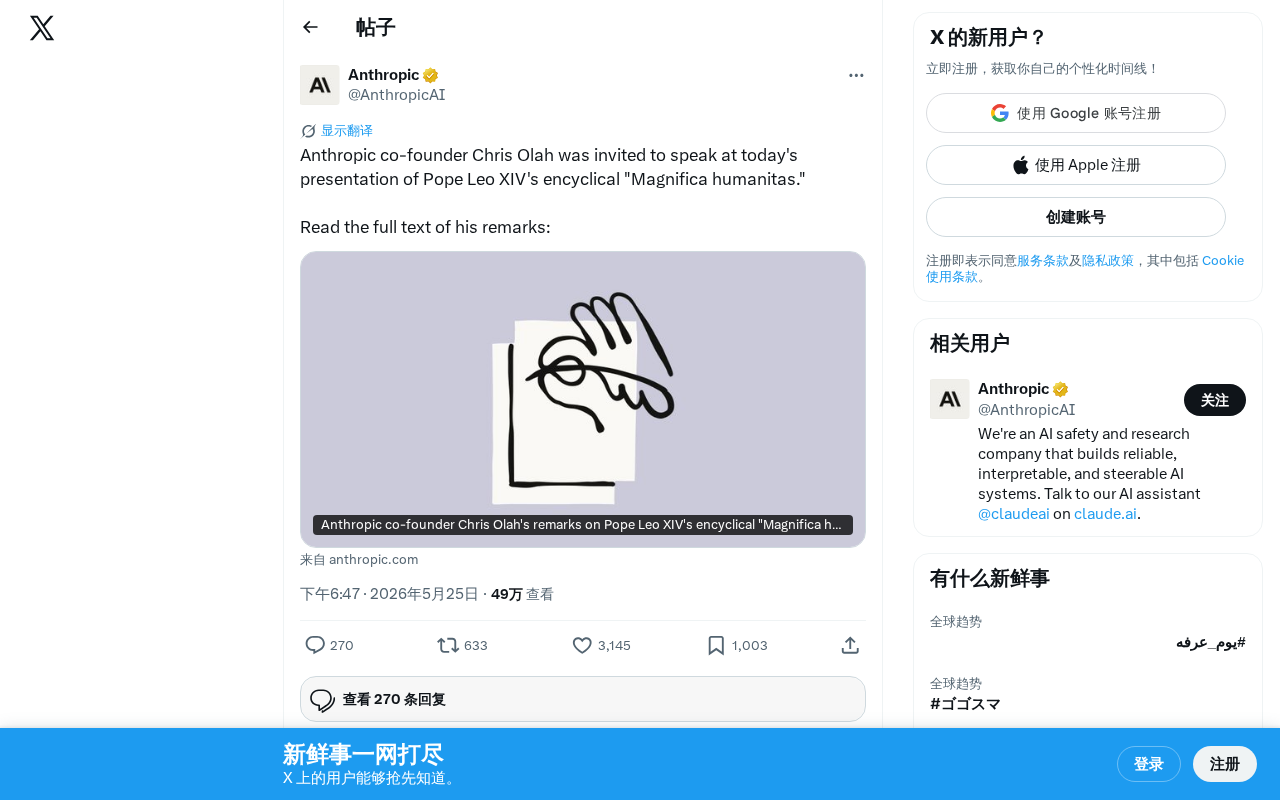
Anthropic co-founder Chris Olah was invited to speak at the launch of Pope Leo XIV's encyclical *Magnifica humanitas*. As a pioneer in neural network interpretability research, Olah's work closely aligns with the religious world's concerns about AI transparency and ethics. The event reflects that AI ethics discussions are transcending the technology sphere, religious institutions are actively engaging in AI governance dialogue, and institutionalized communication channels between technology and humanistic traditions are taking shape.
How Chris Olah Came to Speak at the Papal Encyclical Launch
Anthropic co-founder Chris Olah was invited to deliver a speech at the launch of Pope Leo XIV's encyclical Magnifica humanitas (The Greatness of Humanity). This event marks a new milestone in the deepening dialogue between AI industry leaders and the religious world on artificial intelligence ethics.
AI and the Vatican: Why the Religious World Is Paying Attention to Artificial Intelligence
The Papal Encyclical's Stance on AI
A papal encyclical (Encyclical Letter) carries the highest level of authority within the Catholic doctrinal system and is one of the most significant types of documents issued by the Holy See. Since the Middle Ages, successive popes have used encyclicals to express the Church's official position on major social, political, and scientific issues. Their influence extends far beyond the Catholic faithful, often sparking global ethical debates. Notable historical encyclicals include Pope Leo XIII's Rerum Novarum (1891), which laid the foundation for modern Catholic social teaching, and Pope Francis's Laudato Si' (2015), which profoundly shaped the moral framework around the global climate change discussion. Pope Leo XIV's choice of "Magnifica humanitas" (The Greatness of Humanity) as the title for this encyclical focuses on the core question of how to uphold human dignity and value in the age of artificial intelligence. This continues the tradition of the papacy engaging with the defining issues of each era and signifies that the Vatican has formally incorporated artificial intelligence into its moral theology discourse.
The decision by Pope Leo XIV to invite AI technical experts to speak at the encyclical's launch reflects the Vatican's intense focus on AI development and its desire to establish channels for dialogue with the technology community.
Chris Olah: From Neural Network Interpretability to AI Ethics Dialogue
Chris Olah is renowned in the AI field for his pioneering work on neural network interpretability. As a co-founder of Anthropic, he has long been dedicated to understanding the internal workings of AI systems and advancing the research direction of mechanistic interpretability.
Mechanistic interpretability is one of the most cutting-edge research directions in AI safety today. Its goal is to use reverse engineering to understand the specific computational mechanisms inside neural networks—namely, what a model has actually "learned" and "how it makes decisions." Unlike traditional black-box AI systems, mechanistic interpretability research seeks to translate neural network weights and activation patterns into human-understandable concepts and circuit structures. The series of studies Chris Olah published during his time at Google Brain (such as the Zoom In and Circuits series of papers) are considered foundational work in the field. He discovered that neural networks contain identifiable functional modules resembling "curve detectors" and "high-low frequency detectors." The significance of this research direction lies in the fact that only by truly understanding the internal mechanisms of AI systems can we effectively assess their safety and alignment—a concern that deeply resonates with the religious world's emphasis on AI transparency and ethics. This is precisely what makes Chris Olah an ideal figure for bridging the technology community and humanistic traditions.
The Resonance Between Anthropic's AI Safety Philosophy and Religious Ethics
Anthropic has consistently positioned itself as an "AI safety company," with a core mission of building reliable, interpretable, and controllable AI systems. The company's exploration of methodologies like Constitutional AI is essentially about establishing a values framework for AI systems. Constitutional AI is a training methodology proposed by Anthropic in 2022. Its core idea is to preset a clear set of value principles (a "constitution") for the AI system, allowing the model to proactively follow these principles through self-critique and iteration, rather than relying entirely on human annotator feedback. The philosophical implications of this approach are profound: it attempts to translate abstract ethical principles into actionable technical specifications—essentially a practice of "values engineering." This bears a structural similarity to the religious tradition of encoding moral imperatives into doctrines and commandments—both are attempting to answer the fundamental question of "how to make a powerful agent adhere to human-endorsed notions of good." It is this deep methodological resonance that makes Anthropic's research path uniquely open to dialogue in the eyes of religious ethicists.
Chris Olah's invitation to speak at such a high-profile religious venue reflects several important trends:
- AI ethics discussions are transcending the technology sphere, becoming an issue of concern for all of humanity
- Religious institutions are actively participating in AI governance dialogue, rather than standing on the sidelines
- Dialogue between the technology community and humanistic traditions is developing into institutionalized channels
From the Vatican to the World: Cross-Domain Collaboration in AI Governance
The Necessity of Diverse Voices in AI Development
The development of artificial intelligence is not merely a technical issue—it is a philosophical and ethical question concerning the future of humanity. As guardians of human values and moral traditions spanning thousands of years, religious institutions hold a unique perspective and voice in AI ethics discussions.
The Vatican's involvement in AI ethics discussions did not begin with this encyclical; rather, it follows a clear historical trajectory. In February 2020, the Pontifical Academy of Sciences, together with tech giants such as Microsoft and IBM, co-signed the Rome Call for AI Ethics, introducing the concept of "Algorethics" and emphasizing that AI systems should be transparent, inclusive, accountable, fair, and reliable. In 2023, Pope Francis delivered a speech on AI at the G7 summit, becoming the first pope to attend the forum. The Vatican has also established dedicated academic institutions for studying AI ethics and built partnerships with top universities around the world. This series of actions demonstrates that the Vatican views AI governance as a vital part of its social mission and is systematically building the capacity and channels for dialogue with the technology community. The release of this encyclical and the invitation of AI industry representatives to participate is a natural extension of this strategic effort, marking the dialogue's entry into a deeper phase.
Implications for the AI Industry
This event serves as a reminder to the entire industry that the development of AI requires the participation of diverse voices. Technological progress cannot be divorced from humanistic concern, and humanistic traditions also need to understand technological realities. When the world's most influential religious institution proactively engages in dialogue with AI safety researchers, it signals that a cross-sector consensus on responsible AI development is taking shape.
The Dialogue Between Technology and the Humanities Will Shape AI's Future
The rapid advancement of AI technology is reshaping every facet of human society. When an AI researcher stands at the Vatican's podium to discuss the greatness of humanity and the future of AI with the world's largest religious organization, that in itself is a landmark event of our era. The ongoing dialogue between technology and the humanities will, to a great extent, determine the direction of AI development and the shared destiny of humankind.
Key Takeaways
- Anthropic co-founder Chris Olah was invited to speak at the launch of Pope Leo XIV's encyclical Magnifica humanitas
- This marks a new high point in the dialogue between the AI industry and the religious world on artificial intelligence ethics
- Chris Olah is renowned for his research on neural network interpretability, a direction that closely aligns with the religious world's concerns about AI transparency
- The event reflects that AI ethics discussions are transcending the technology sphere to become a shared concern for all humanity
- Religious institutions are actively participating in AI governance dialogue, seeking to establish institutionalized communication channels with the technology community
Related articles
 Tech Frontiers
A Rare Quiet Day in AI: Recursive Self-Improvement Stirs Beneath the Surface
A rare quiet day in AI sees multiple sources go silent simultaneously. Behind the calm, Recursive Self-Improvement (RSI) research continues. What this means for the industry.
 Tech Frontiers
Reve 2 vs. Ideogram 4: A Deep Dive into Layout Control in AI Image Generation
A deep comparison of Reve 2 and Ideogram 4's layout control capabilities, covering technical approaches, real-world use cases, and industry trends for designers and creators.
 Tech Frontiers
In the Weights: Check Your Influence Score in the AI World
In the Weights is an AI influence search engine that quantifies your presence in the AI world with a score. Explore how it evaluates practitioners and what it means for digital identity.