Citi Generative AI Developer Final Interview Guide: Key Topics and Preparation Strategies

A comprehensive final interview prep guide for Citi's Junior Generative AI Application Developer role.
This article breaks down what to expect in Citi's Junior Generative AI Application Developer final interview, covering technical areas like RAG, LLM integration, prompt engineering, and system design, as well as financial industry considerations around compliance and data security. It also provides a prioritized short-term preparation strategy to help candidates prepare efficiently.
A Real Job-Seeker's Dilemma
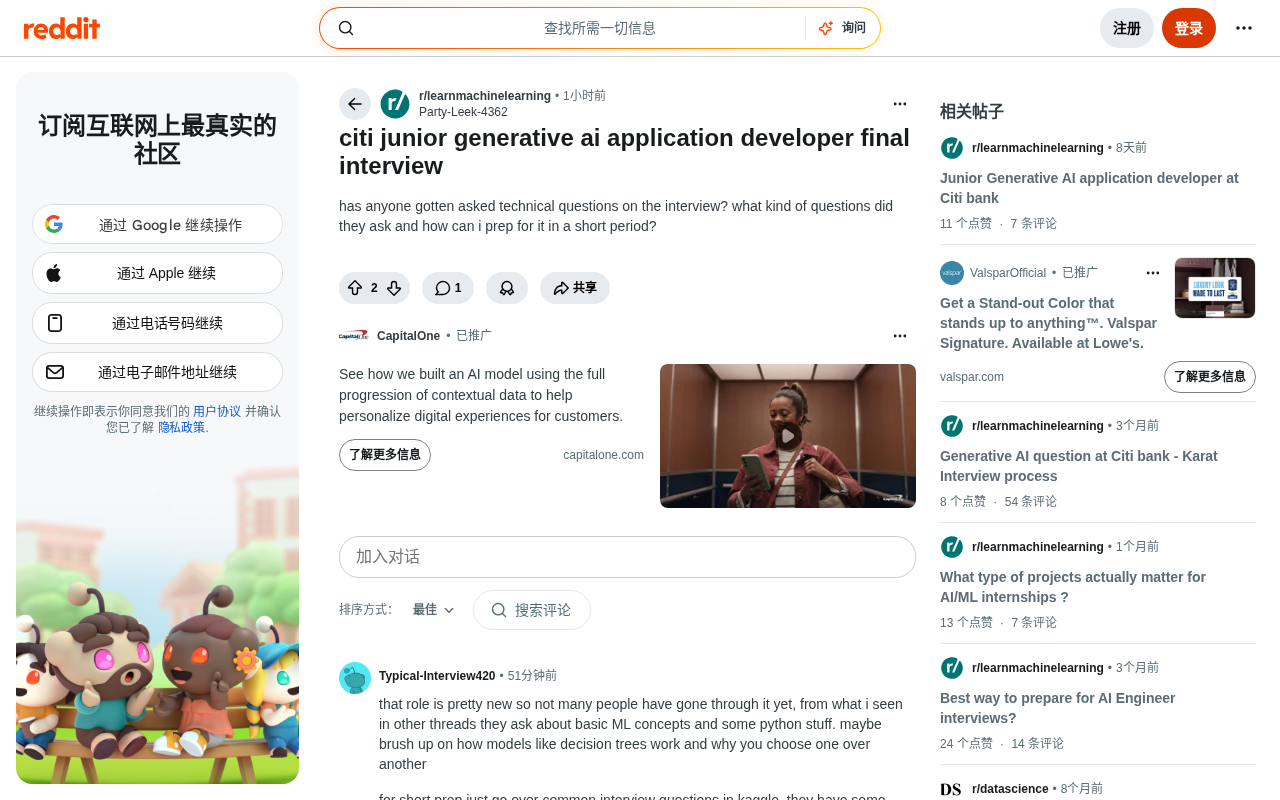
A representative post recently appeared in a Reddit job-seeking community: a candidate about to attend the final interview for Citi's (Citigroup) "Junior Generative AI Application Developer" role had no idea what to expect. The core question was straightforward: Will the final interview include technical questions? What types of questions should I expect? And with limited time, how should I prepare?
The question seems simple, but it reflects a rapidly evolving hiring reality. As the generative AI wave sweeps through finance, tech, and other industries, even traditional financial giants like Citi are creating dedicated "Generative AI Application Development" roles. For job seekers, these positions sit at the intersection of traditional software engineering and emerging AI engineering — making them more multidimensional to assess and more challenging to prepare for.
What Does a Generative AI Application Developer Interview Actually Test?
Role Positioning: Application Layer, Not Model Research
First, let's clarify a critical distinction: a "Generative AI Application Developer" (GenAI Application Developer) is a fundamentally different role from an "ML Researcher." The core responsibility of the former is integrating generative AI capabilities — such as LLMs — into real-world business applications, not training or researching models from scratch.
This means interview assessments typically won't focus on deep-learning math, but rather on the following areas:
- Software Engineering Fundamentals: Data structures and algorithms, object-oriented design, API development, system design, etc. As a financial institution, Citi places particular emphasis on code quality and engineering standards — this is the baseline for all developer roles.
- LLM Application Integration: How to call large model APIs (e.g., OpenAI, Anthropic, or internal enterprise models), how to design effective prompts, and how to handle model outputs.
- RAG (Retrieval-Augmented Generation) Architecture: This is nearly a standard requirement for enterprise-grade generative AI applications. RAG was first proposed by Meta AI Research in 2020. Its core idea is to retrieve relevant document snippets from an external knowledge base before the LLM generates a response, then inject those snippets as context into the prompt — enabling the model to answer based on real-time or private knowledge, rather than relying solely on knowledge encoded during training. This architecture effectively addresses two major LLM pain points: knowledge cutoff limitations and hallucinations. Understanding vector databases, embeddings, document chunking, and retrieval recall are important differentiators. Embeddings are techniques that convert text into high-dimensional numerical vectors, where semantically similar content is closer together in vector space. Vector databases (such as Pinecone, Weaviate, and Chroma) are specifically designed to store and retrieve these high-dimensional vectors, enabling millisecond-level semantic similarity search.
- AI Application Engineering: Practical details including latency optimization, cost control, hallucination mitigation, and evaluation mechanisms. LLM "hallucination" refers to the model generating content that appears plausible but is factually inaccurate or entirely fabricated — a phenomenon rooted in the LLM's nature of predicting the next token based on statistical probability rather than truly "understanding" facts. Common mitigation strategies include using RAG to provide verifiable factual grounding, lowering the temperature parameter, adding citation and attribution mechanisms, and building automated evaluation pipelines.
Special Considerations for the Financial Industry
As a global bank, Citi has extremely strict compliance and risk control requirements for AI applications. In finance, hallucinations are particularly dangerous: incorrect financial data, inaccurate regulatory interpretations, or fabricated market information can trigger serious compliance risks. The final interview will likely touch on:
- Data Security and Privacy: How do you ensure that sensitive customer data is not exposed to third-party models?
- Model Explainability and Auditability: Financial regulations require AI decisions to be traceable and auditable.
- Risk Awareness: Your understanding of, and approach to, accuracy issues, bias, and compliance risks in AI-generated content.
These "soft" industry insights often impress financial institution interviewers more than pure technical ability.
Breaking Down Common Final Interview Question Types
Technical Questions
Based on general experience with similar roles, technical assessments typically fall into three tiers:
Tier 1: Coding Fundamentals. There may be a medium-difficulty algorithm question or a small programming task to assess basic coding ability. It's worth reviewing medium-difficulty LeetCode high-frequency question types in advance, especially string manipulation, hash tables, and array operations.
Tier 2: Generative AI Concept Questions. For example: "What is RAG and what problem does it solve?", "How do you reduce hallucinations in large models?", "What does the Temperature parameter do?", and "When should you use Fine-tuning versus Prompt Engineering?"
On that last question, it's worth deeply understanding the fundamental difference between the two: Prompt Engineering is the practice of carefully crafting input text to guide a pretrained model toward desired outputs, without modifying model parameters — it's low-cost, fast to iterate, and suitable for most application scenarios. Fine-tuning involves further training some or all of a pretrained model's parameters using domain-specific data, improving performance on a specific task — but at the cost of requiring high-quality labeled data and significant compute resources. The industry widely follows a "Prompt First" principle: exhaust the possibilities of Prompt Engineering and RAG before considering Fine-tuning. For enterprises like Citi, Fine-tuning also introduces additional compliance considerations around data security and model hosting.
These questions assess the depth of your genuine understanding of generative AI fundamentals.
Tier 3: System Design Questions. For example: "Design an intelligent Q&A system based on enterprise documents." These questions require a holistic architectural response covering data ingestion, embedding generation, vector retrieval, prompt construction, result delivery, caching, and monitoring across the full pipeline. A typical answer framework should include: document preprocessing and chunking strategies (tradeoffs around chunk size), embedding model selection, vector database indexing approaches, hybrid retrieval design (vector search + keyword search), and citation attribution and audit logging mechanisms tailored to financial use cases.
Behavioral and Project-Based Questions
Final interview rounds typically place greater weight on a candidate's past project experience and soft skills. Interviewers will probe the technical details, decision rationale, and actual outcomes of AI-related projects on your resume. It's recommended to use the STAR framework (Situation — Task — Action — Result) to structure your answers. STAR is a widely adopted structured response framework in behavioral interviews. For technical roles, focus the Action section on the engineering tradeoffs behind your technical decisions, and use quantifiable metrics in the Result section (e.g., latency reduced by X%, accuracy improved to Y%) to make your responses more structured and compelling.
Short-Term, High-Efficiency Preparation Strategy
Prioritization
When time is limited, avoid trying to cover everything at once. Prepare in the following order of priority:
- Review your resume projects (highest priority): Make sure you can clearly explain the technical choices, challenges encountered, and solutions for every AI project on your resume. This is the area most likely to be probed deeply, and the one that best demonstrates your real-world ability.
- Master core concepts: Spend half a day thoroughly understanding RAG, Embeddings, Prompt Engineering, Fine-tuning, hallucinations, and other core terms — well enough to explain them clearly in your own words. Focus on understanding the complete RAG data flow: document chunking → embedding generation → vector storage → query retrieval → context injection → model generation → result validation.
- Targeted practice problems: Do exercises on common data structures to maintain your coding fluency. You don't need to grind through a large volume of problems.
- Prepare system design templates: Familiarize yourself with the architectural design thinking behind typical GenAI applications like "document Q&A systems" and "intelligent customer service," and develop reusable response frameworks.
Demonstrate an "Application Mindset"
For application development roles, what interviewers really want to see is not how many cutting-edge papers you've read, but whether you can reliably deploy AI capabilities into products. Proactively mentioning engineering practice details — how you evaluate models, how you control API costs, how you handle edge cases — is often far more persuasive than stacking up jargon. For example, when discussing hallucination mitigation, don't just propose a RAG solution. Also proactively explain how you'd build an evaluation pipeline to quantify hallucination rates, and how you'd make engineering tradeoffs between accuracy and response latency.
Show Industry Fit
In an interview at a financial institution, appropriately expressing your understanding of and interest in AI applications in financial contexts — such as intelligent investment research, compliance review, and customer service automation — and demonstrating sensitivity to data security and compliance risks will significantly improve interviewers' overall impression of you. It's worth noting that financial regulators are increasingly strict about AI systems. The EU AI Act classifies financial credit scenarios as high-risk AI applications. This means that candidates who proactively express awareness of model explainability, audit trails, and bias detection will demonstrate a level of industry maturity that goes beyond the technical.
Final Thoughts
The fact that traditional financial giants like Citi are opening Generative AI Application Developer positions is itself a clear signal: generative AI is transitioning from a buzzword in tech circles to a genuine productivity tool for enterprises. For job seekers, this is both an opportunity and a challenge — you need solid software engineering fundamentals, hands-on understanding of the generative AI tech stack, and deep knowledge of industry use cases.
The core of short-term preparation is not memorizing every concept cold, but clearly demonstrating your engineering thinking and ability to ship. Best of luck to every candidate who has made it to the final round — may you all land the offer you're aiming for.
Key Takeaways
Related articles

The Truth Behind Codex 'Build a Website in 5 Minutes': AI Isn't Creating Sites—It's Helping You Copy Them
Exposing the truth behind viral Codex 5-minute website videos: creators aren't building original sites with AI—they're copying shared prompts or scraping others' work. Learn AI coding tools' real limits.

Getting Started with AI Agent Development: A Complete Guide from Concept to Practice
A comprehensive guide to AI Agent architecture and development, covering automated marketing, intelligent customer service, and investment analysis scenarios with single and multi-agent collaboration.

The Truth Behind Codex 'Build a Website in 5 Minutes': AI Isn't Creating Sites — It's Helping You Copy Them
Exposing the truth behind viral Codex 5-minute website videos: creators aren't building original sites with AI — they're copying shared prompts or scraping others' work.