CLASP: A New Paradigm for Whole-Slide Pathology Report Generation That Decides Before Decoding
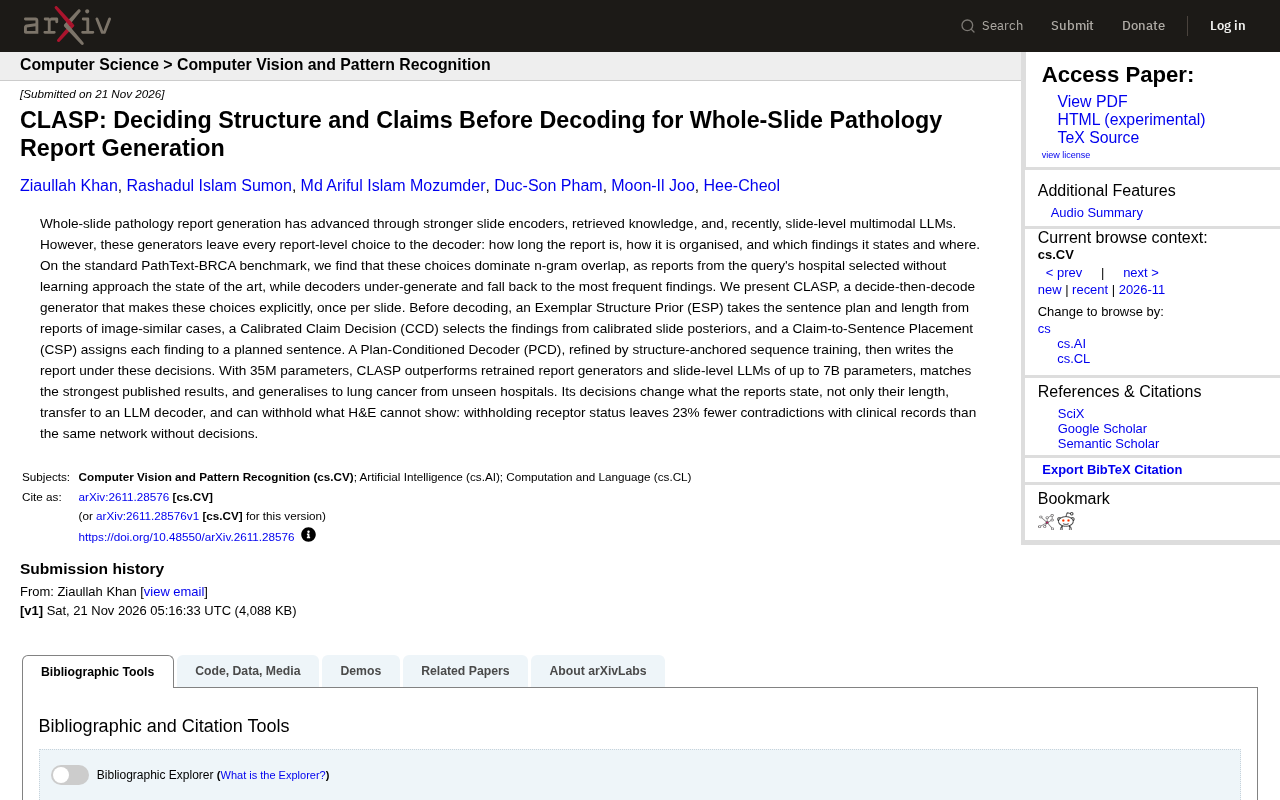
CLASP decouples pathology report structure and content choices from the decoder, surpassing 7B-parameter models with 35M parameters.
The article introduces CLASP, a new pathology report generation method based on "decide first, decode later." Existing slide-level multimodal LLMs leave report length, organization, findings, and placement to implicit decoder decisions, causing under-generation and regression to common findings; on PathText-BRCA, selecting reports by hospital alone nearly matches the best. CLASP makes these choices explicit once via exemplar structure prior, calibrated claim decision, claim-to-sentence placement, and a plan-conditioned decoder. With only 35M parameters, it surpasses retrained generators and 7B slide-level LLMs, generalizes to unseen hospitals' lung cancer data, withholds H&E-invisible information, and cuts clinical record contradictions by 23%. This suggests architecture design and task decomposition matter as much as scale in vertical domains.
Why does pathology report generation need to "decide first"?
Whole-slide pathology report generation has seen remarkable progress in recent years: stronger slide encoders, retrieval-augmented knowledge, and slide-level multimodal large language models (LLMs) have emerged one after another. However, these generators leave all report-level choices to the decoder—how long the report should be, how it should be organized, which findings to state, and where each finding should go. According to observations in the original paper on the standard PathText-BRCA benchmark, these choices even dominate the impact on n-gram overlap: directly selecting reports from the hospital that issued the query (without any learning method) comes close to the current state of the art, while decoders tend to under-generate and fall back on the most common findings.
This finding reveals a neglected problem: decoders are not "unable to write," but rather lack explicit planning of report structure. CLASP was proposed precisely to turn these implicit choices into explicit decisions.
N-gram overlap is the most commonly used automatic evaluation metric in natural language generation (especially medical report generation), with typical representatives including BLEU, ROUGE, and METEOR. Its basic approach is to count the proportion of overlapping contiguous n-word (or character) segments between generated and reference texts, then aggregate with precision, recall, or F-score. These metrics are simple to compute and highly reproducible, making them the default measures for benchmarks such as PathText-BRCA. But they also have clear limitations: they only measure surface-level lexical overlap and cannot judge semantic correctness or clinical factual consistency; they are highly sensitive to report length and sentence structure, with overly long or short reports both lowering scores; and the same clinical finding can have multiple valid phrasings that may not be counted as matches. Understanding this helps explain why a method as simple as "directly selecting a same-hospital report" without any learning can achieve high scores on n-gram metrics—it reproduces the length distribution and common phrasing habits of the target hospital's reports.
CLASP's core idea: decide once, decode once
CLASP is a "decide-then-decode" generator that explicitly makes the above choices for each slide, and makes them only once. The entire pipeline consists of four components:
1. Exemplar Structure Prior (ESP)
Before decoding, ESP extracts the sentence plan and length from reports of visually similar cases. This means report structure is no longer left to the decoder's free rein, but instead borrows the mature organizational patterns of similar cases to provide an explicit skeleton for subsequent generation.
Retrieval-augmented generation (RAG) is a technical paradigm in which a generative model retrieves relevant passages from an external corpus before decoding and then conditions generation on those passages, significantly mitigating the model's lack of domain knowledge or factual grounding. In pathology report scenarios, RAG's retrieval units can be either text reports or slide image features. CLASP's ESP is a form of structure-level retrieval augmentation: it does not directly copy the textual content of similar cases, but extracts their "sentence plan" (i.e., which sentence roles compose the report and what type of information each sentence carries) and length distribution as the skeleton for the report to be generated. The advantage of this approach is that it decouples "format knowledge" from "case-specific content"—structure comes from the mature organizational patterns of similar cases, while specific findings are still filled in by the subsequent calibrated claim decision and decoder based on the current slide's evidence, thus balancing report standardization and individualization.
2. Calibrated Claim Decision (CCD)
CCD selects the findings to state from calibrated slide posterior probabilities. Unlike letting the decoder implicitly decide "what to write," CCD explicitly filters out evidence-supported findings, avoiding omissions or fabrications.
Calibration refers to the property that a model's output confidence matches its actual accuracy. A well-calibrated classifier giving a positive probability of 0.8 means that about 80% of such samples are indeed positive; uncalibrated models often exhibit overconfidence, and directly filtering findings with raw probability thresholds can easily cause under-reporting or fabrication. Slide-level posterior probabilities typically come from multiple instance learning (MIL) frameworks: the label of an entire slide is determined by several key regions within it, and the model outputs a slide-level prediction distribution. CCD performs calibration on this posterior before deciding "which findings to state," essentially converting the classifier's probability output into a list of clinical statements with an evidence threshold. This contrasts with letting the decoder implicitly decide what to write: the latter lacks an explicit evidence threshold and tends to fall back on the most frequent findings in the training set, sacrificing case specificity.
3. Claim-to-Sentence Placement (CSP)
CSP assigns each selected finding to a sentence position in the plan. This step solves the problem of "where each finding goes," keeping the report's logical order consistent with the structural plan.
4. Plan-Conditioned Decoder (PCD)
PCD writes the report under the constraints of the above decisions and is fine-tuned via structure-anchored sequence training. The decoder no longer needs to learn structure and content simultaneously, but focuses on generating fluent text under a given plan.
Performance: a small model surpassing large models
CLASP has only 35 million parameters, yet in experiments it surpasses retrained report generators and slide-level LLMs with up to 7 billion parameters, and matches the strongest published results. More specifically, it can also generalize to lung cancer data from unseen hospitals. This result shows that explicit structural decisions can greatly reduce dependence on model scale—by offloading "how to organize the report" from the decoder, even a small model can write high-quality reports.
Decisions change more than just length
The paper emphasizes that CLASP's decisions change what the report states, not just its length. These decisions can be transferred to LLM decoders and can withhold information that H&E staining cannot reveal. For example, after adopting a withholding strategy on receptor status, contradictions with clinical records decreased by 23% compared to the same network without decisions. This means the decision mechanism not only improves text matching but also enhances consistency between reports and clinical facts.
H&E staining (hematoxylin and eosin staining) is the most fundamental tissue staining method in pathology: hematoxylin stains nuclei blue-purple, and eosin stains cytoplasm and extracellular matrix pink, thereby revealing tissue architecture and cell morphology. But H&E can only reflect morphological information and cannot directly reveal molecular-level features such as receptor status, gene mutations, or protein expression—these typically require immunohistochemistry (IHC) or molecular pathology testing to determine. Therefore, when a slide-level model is asked to generate a complete report, it may "guess" molecular information that does not exist on H&E based on images or data correlations, causing contradictions with clinical records. CLASP's withhold strategy targets exactly this risk: proactively withholding findings that H&E cannot support keeps the report honest within its information boundaries, which is an important reason for its 23% reduction in contradictions with clinical records.
Implications for pathology AI
CLASP's value lies in redefining the division of labor in the generation task: structural planning and content selection are handled by explicit modules, while the decoder is only responsible for linguistic realization. This "separation of decision and decoding" approach may offer lessons for other medical report generation tasks—when domain knowledge imposes strong constraints on report format and content, having the model make explicit decisions before decoding is often more effective than simply scaling up the model. At the same time, the result of 35 million parameters surpassing 7 billion-parameter models also reminds us that in vertical domains, architecture design and task decomposition are no less important than parameter scale.
For practitioners focused on AI deployment in healthcare, CLASP demonstrates a pragmatic path: using interpretable decision modules to improve the factual consistency of reports, rather than leaving everything to a black-box decoder.
One-line Summary
CLASP decouples pathology report structure and content selection from the decoder, with 35 million parameters surpassing 7 billion-parameter models.
Paragraph Summary
The article introduces CLASP, a new method for pathology report generation whose core idea is "decide first, decode later." The authors point out that existing slide-level multimodal large models leave report length, organization, which findings to state, and their placement entirely to implicit decoder decisions, leading to under-generation and regression to common findings; on PathText-BRCA, simply selecting reports by hospital comes close to optimal, showing that report-level choices have a huge impact on n-gram overlap. CLASP makes these choices explicit and only once through four components: exemplar structure prior, calibrated claim decision, claim-to-sentence placement, and plan-conditioned decoder. With only 35 million parameters, CLASP surpasses retrained report generators and 7 billion-parameter slide-level LLMs, generalizes to lung cancer data from unseen hospitals, and can withhold information that H&E cannot reveal, reducing contradictions with clinical records by 23%. The article suggests this implies that in vertical domains, architecture design and task decomposition are no less important than parameter scale.
Related articles

S&P Weighs Downgrading Nvidia's Credit Rating: Governance and Key Man Risk in Focus
S&P is considering downgrading Nvidia's credit rating to AA-, citing corporate governance and key man risk rather than financial performance. We analyze the drivers, potential impact, and the broader trend of governance scrutiny for large tech companies in the AI era.

Generating a 3D Stacking Game from a Few Prompts: Hands-on with the Playground Experimental Platform
Playground lets users generate the 3D stacking game One More Pie from a few text prompts. This article examines the capabilities and limits of prompt-based web game generation.

AI Math Proofs Are Exploding: Humans Can't Read Fast Enough
AI math proof output now outpaces human reading speed. AINews roundup covers Erdős problems, new matrix multiplication bounds, and Fourier transform bounds—verification is the new bottleneck.