Claude 4.5 Haiku Released: A Practical Guide to 7 AI Side Hustle Monetization Methods

Claude 4.5 Haiku cuts AI costs—here are 7 practical methods to monetize AI models as side hustles.
Anthropic's Claude 4.5 Haiku achieves Sonnet 4-level coding performance at one-third the cost and twice the speed, significantly lowering AI entrepreneurship barriers. Based on a real practitioner's experience, this article covers 7 AI monetization paths: copywriting services ($400-500/month starting), social media content ($1,100/month), AI automation services, SEO content production, email marketing, landing page copy, and AI training consulting. Core advice: master prompt engineering, start with small goals, and build your personal brand for the long term.
Anthropic just released the Claude 4.5 Haiku model—a lightweight model that achieves coding performance comparable to Claude Sonnet 4 at one-third the cost, with processing speeds more than twice as fast. For those looking to build AI-powered side hustles or startups, the barrier to building applications and offering services just got lower. This article, based on the real-world experience of an overseas AI entrepreneur, systematically breaks down 7 ways to make money using cost-effective AI models.
Claude 4.5 Haiku: What Can a Faster, Cheaper AI Model Do for You?
Five months ago, Claude Sonnet 4 was the state-of-the-art model. Now Claude 4.5 Haiku has surpassed Sonnet 4 across multiple benchmarks, particularly excelling in computer-use tasks and coding efficiency.
Anthropic's Claude models follow a tiered naming system: Opus (most powerful), Sonnet (balanced), and Haiku (lightweight and fast). The naming draws inspiration from Japanese poetry forms—Haiku is known for its brevity, which aptly corresponds to the lightweight, high-efficiency positioning of this model tier. The numbers represent generations, with 4.5 indicating a mid-cycle iteration of the fourth generation. Understanding this system helps you evaluate the trade-offs between cost, speed, and capability across different models.
Looking at the performance data, Haiku 4.5 actually surpasses Gemini 2.5 Pro in agentic coding and nearly matches GPT-5 on high-school-level programming tasks. "Agentic Coding" is a key trend in AI for 2024-2025—it refers to AI that doesn't just generate code snippets but autonomously plans tasks, calls tools, debugs errors, and iteratively completes complex programming projects. SWE-bench is the mainstream benchmark for measuring this capability, simulating the process of fixing real GitHub issues. This is fundamentally different from traditional code completion—agentic coding requires multi-step reasoning and self-correction abilities. While it hasn't caught up to Sonnet 4.5 and GPT-5 in graduate-level reasoning, considering its price and speed, the cost-performance ratio in real business scenarios is exceptional.
Key advantages at a glance:
- Reduced cost: Only one-third the price of Sonnet 4
- Doubled speed: Processing speed more than 2x faster than Sonnet 4
- Strong coding ability: Excellent scores across multiple coding benchmarks
- Computer use: Outperforms previous models on automation tasks
Bottom line: solo entrepreneurs and small teams can now do more with less money. This is the window of opportunity for AI side hustle monetization.
AI Copywriting Services: The Lowest-Barrier Monetization Method
How It Works
Use Claude 4.5 Haiku to generate high-quality content, then sell your services on freelance platforms like Fiverr and Upwork. This is the fastest to start and lowest barrier of all the methods.
Fiverr and Upwork are the world's two largest freelance platforms, but they operate with different logic. Fiverr uses a "sellers list services, buyers come shopping" e-commerce model, ideal for standardized services. Upwork uses a "buyers post jobs, sellers bid competitively" tender model, better suited for customized projects. Both platforms have rating systems and tier structures—new sellers typically need to accumulate initial reviews through lower pricing before gradually raising rates.
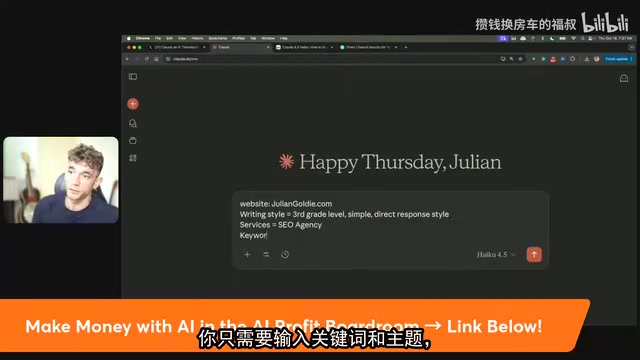
The process is simple: list copywriting services on the platform (blog posts, SEO content, email sequences, etc.), then use AI to efficiently deliver once you get orders. The video creator shared his real data—he's earned over $1.1 million on Upwork with a 100% project success rate.
Key Technique: Making AI Content Read Like It Was Written by a Human
Content generated directly by AI often has an obvious "AI flavor." The creator emphasizes that the core lies in prompt quality. If you just toss in "write a blog post about SEO," the output will be mediocre, filled with phrases like "digital landscape" and "in today's era."
But if you specify writing style, target reader's reading level, formatting details, and other specifics in your prompt, content quality can improve 10x or more. After testing with AI detection tools, optimized content gets flagged as AI-generated about 40% of the time. Run it through a humanization tool once more, and it generally passes.
It's worth explaining how AI content detection works. Tools like GPTZero, Originality.ai, and Copyleaks analyze text perplexity and burstiness to determine whether content was AI-generated. AI-generated text typically has low perplexity (predictable word choices) and low burstiness (uniform sentence structures), while human writing is more random with more rhythmic variation. "Humanization tools" introduce sentence variety, colloquial expressions, and irregular structures to evade detection. However, this field involves an ongoing arms race between detection and anti-detection—you can't rely entirely on tools, and manual editing remains the most reliable approach.
How Much Can You Earn?
- Starting phase: $400-500 per month
- Mature phase: Income grows continuously as clients accumulate
- High repeat rate: Clients typically place orders on a monthly basis
Here's a real Fiverr example: someone sells a package of 30 blog articles per month for $150 and has already received nearly 1,000 reviews. This demonstrates stable market demand and a sustainable model.
Social Media Content Monetization: $1,100/Month Tweeting with AI
How to Make Money on Twitter/X
Use AI tools to rapidly generate social media content and earn directly through the platform's creator revenue sharing program. The creator showed his Twitter income screenshot: just from posting tweets, he earns about $1,100 per month, roughly $13,320 annualized.
Twitter/X's creator ad revenue sharing program launched in 2023, allowing eligible creators to earn a share of revenue from ads displayed in their post replies. Eligibility requirements include: subscribing to X Premium (formerly Twitter Blue), accumulating at least 5 million impressions on posts in the past three months, and having at least 500 followers. The payout amount is directly tied to post engagement and impressions, meaning frequently publishing valuable content is the core strategy for increasing income.
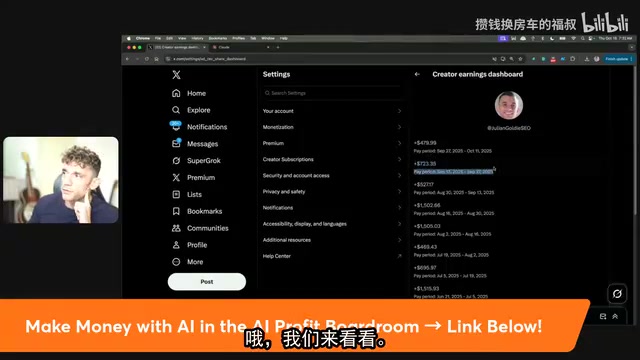
The operation is extremely simple: use Claude 4.5 Haiku to generate multiple tweets in different styles at once—the entire process takes less than 20 seconds. The key is that content needs unique perspectives and practical value; you can't just mindlessly repost.
Specific Steps
- Pick a vertical you're familiar with (AI, marketing, fitness, etc.)
- Use AI to batch-generate content material
- Manually filter and edit before publishing
- Maintain a consistent posting frequency
- Earn income through platform ad revenue sharing
AI Automation Services: Explosive Growth in Enterprise Demand
How Big Is the Market?
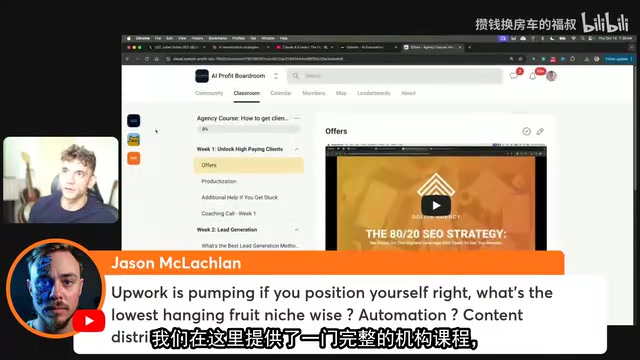
Search "AI automation" on Upwork and you'll see tons of jobs posted within the last few hours. Enterprise demand for AI chatbots, social media automation workflows, and AI virtual assistants is booming.
Enterprise-level AI automation services typically involve several core technology stacks: First, AI chatbot development, using tools like Voiceflow, Botpress, or direct large model API calls. Second, workflow automation, embedding AI capabilities into business processes through platforms like Zapier, Make (formerly Integromat), or n8n—for example, automatically processing customer emails or generating reports. Third, RAG (Retrieval-Augmented Generation) systems that allow AI to answer questions based on a company's proprietary data (such as product documentation and customer records) rather than relying solely on the model's training data. Mastering the combined use of these tools forms the technical foundation for providing AI automation services and is the core competitive advantage that distinguishes this from ordinary copywriting services.
How to Screen Reliable Clients
The creator shared a practical client screening method:
- Choose fixed-price projects: More reliable contracts, more predictable income
- Check client spending history: Prioritize clients who have spent over $3,000
- Look at hire rate: 80%+ means the client is serious about hiring
- Check reviews: Multiple five-star reviews indicate a good collaboration experience
How to Choose a Niche
Don't guess what the market wants—follow these steps:
- Inventory your skills: What are you good at? Which abilities can be combined with AI?
- Observe trending jobs on platforms: Which types of jobs are posted most frequently?
- Validate demand sustainability: Confirm that related jobs are posted daily, not sporadically
- Research competitors: See how successful providers position and price themselves
For example, digital PR and digital marketing currently have new jobs posted almost every day—it's a direction worth entering.
SEO Content, Email Marketing, and More AI Monetization Paths
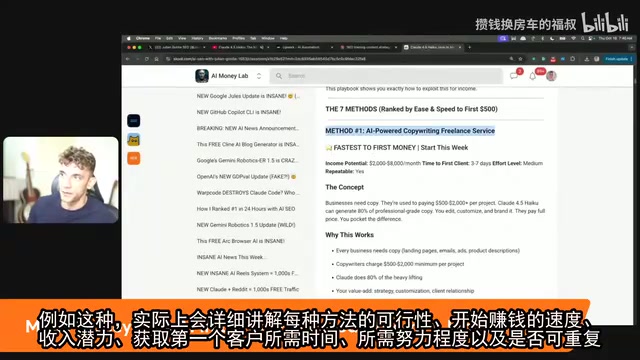
Beyond the three core methods above, the complete monetization system includes four additional paths:
-
Bulk SEO content production: Use AI to produce search engine optimized articles at scale for clients, helping them capture organic search traffic. The core logic of SEO (Search Engine Optimization) is creating high-quality content that matches user search intent so web pages rank higher in search engines like Google. AI's value in this scenario lies in dramatically increasing content production speed—one person with AI can complete in a day what used to take a week. However, note that Google updated its content quality guidelines in 2024, emphasizing E-E-A-T principles (Experience, Expertise, Authoritativeness, Trustworthiness). Low-quality content mass-produced purely by AI may face search ranking penalties, so human review and professional knowledge injection remain essential.
-
Email marketing sequence building: Help businesses create automated email marketing workflows—from welcome emails to conversion sequences—where AI can dramatically improve output efficiency. Email marketing sequences are a series of emails sent automatically according to preset logic, typically including welcome sequences (onboarding new subscribers), nurture sequences (continuously providing value to build trust), and conversion sequences (driving purchase decisions). Common email marketing platforms include Mailchimp, ConvertKit, and ActiveCampaign. AI's role here isn't just writing email copy—it can also help design A/B testing plans, optimize send times, and personalize content.
-
Landing page copy and design: Combine AI to generate high-converting landing page copy and design proposals, helping clients improve ad campaign performance. A landing page is the specific page users arrive at after clicking an ad, with the sole goal of getting visitors to complete a specific action (sign up, purchase, download, etc.). A high-converting landing page typically includes a clear value proposition, social proof (user reviews, case study data), urgency elements, and a clear call-to-action (CTA). AI can quickly generate multiple copy versions for testing, significantly shortening the optimization cycle.
-
AI training and consulting services: Teaching enterprise teams how to use AI tools to improve work efficiency—this type of consulting service typically commands higher per-project fees. With the rapid iteration of AI tools, many businesses face "tool anxiety"—they know AI is important but don't know where to start or how to implement it. AI training and consulting services fill this gap, covering tool selection advice, team workflow restructuring, prompt template library development, and more. This type of service is typically priced hourly or per project, with hourly rates reaching $100-300—the highest per-engagement pricing of all monetization paths.
Each method varies in startup speed, income ceiling, and replicability. The key is to choose the most suitable entry point based on your situation, validate it works, and then expand horizontally.
Practical Advice and Risk Disclosure for AI Side Hustles
Let's be clear: none of these methods guarantee you'll make money. Actual results depend on the time, energy, and execution you invest. Here are some honest recommendations:
Start with small goals. Don't aim for $10,000/month right off the bat. Set your initial target at a few hundred dollars per month, validate that the model works, then scale up.
Keep up with AI tool updates. Claude 4.5 Haiku is just one of many tools. Stay aware of new models and features to avoid falling behind the competition.
Invest effort in prompt engineering. 80% of AI output quality depends on the quality of your input. Spending time learning how to write good prompts is more effective than switching models. Prompt Engineering has evolved from simple instruction optimization into a systematic methodology. Core techniques include: role assignment (having AI act as a specific expert), few-shot learning (providing examples for AI to mimic a style), Chain-of-Thought (guiding AI through step-by-step reasoning), and structured output (specifying format and framework). The 2025 trend is "system prompt" design—writing reusable prompt templates for specific business scenarios, which itself is a professional service you can sell.
Treat your personal brand as a long-term asset. Regardless of which monetization method you choose, in the long run, client trust and professional reputation are the real moats. Anyone can use AI tools, but the industry experience and client relationships you accumulate can't be replicated.
The release of Claude 4.5 Haiku has lowered the cost barrier for AI applications yet again, but opportunity always belongs to those willing to take action and iterate continuously.
Key Takeaways
- Claude 4.5 Haiku achieves Sonnet 4-level coding performance at one-third the cost with 2x+ speed improvement, dramatically lowering the barrier to AI applications
- AI copywriting services are the fastest monetization method—platforms like Fiverr and Upwork provide quick client acquisition, with starting monthly income of $400-500
- Prompt quality determines AI output quality—well-crafted prompts can improve content quality 10x and effectively reduce AI detection flags
- AI automation service demand is exploding on platforms like Upwork—key to screening quality clients is checking their spending history and hire rate
- Niche selection should be based on the intersection of your skills and trending market demand, using job postings for reverse engineering your direction
Related articles
 Tutorials
ChatGPT Plus Subscription Guide: Are GPT-5.5, image-2, and Codex Worth the Upgrade?
A detailed look at ChatGPT Plus features — GPT-5.5, image-2, and Codex — with a Plus vs Pro comparison and a complete step-by-step subscription guide for users outside the US.
 Tutorials
Harness AI Engineering in Practice: Using Claude Code to Master Enterprise-Level E-Commerce Development
Deep dive into Harness AI Engineering: master enterprise e-commerce development with Claude Code using the Rules, Skills, Wiki, and Changes framework.
 Tutorials
Cursor + Codex Dual-IDE Collaboration: A Practical Methodology for Open-Source Project Customization
A complete methodology for open-source project customization based on real-world experience, detailing the Cursor+Codex dual-IDE workflow, seven-stage process, MVP validation, and AI source code reading techniques.