Claude.ai Payment and Subscription System Malfunctions, Official Investigation Underway

Claude.ai is investigating an elevated error rate affecting purchases, upgrades, and cancellations; core AI features remain unaffected.
Claude.ai's official status page published a notice at 02:54 UTC on November 14 stating it is investigating an elevated error rate affecting purchases, plan upgrades, and subscription cancellations, and explicitly noted that core functionality is unaffected. The article analyzes that the fault is concentrated in the payment chain rather than model inference and conversation capabilities, and that subscribed users can most likely continue using the service normally. Blocked cancellations are particularly noteworthy, as failed operations may lead to unnecessary renewals. The author recommends avoiding duplicate payment submissions during the fault window to prevent duplicate charges, keeping screenshots of operation records for billing appeals, and continuously monitoring status page progress from Investigating to Resolved. The article further notes that this incident reflects how billing system reliability is as important as model capabilities in the commercialization of AI products.
Incident Overview
According to a notice published on Claude.ai's official status page, the platform is investigating a technical fault affecting purchases, plan upgrades, and subscription cancellations. The fault occurred at 02:54 UTC on November 14, and officials characterized it as an "elevated error rate," emphasizing that core functionality remains unaffected.
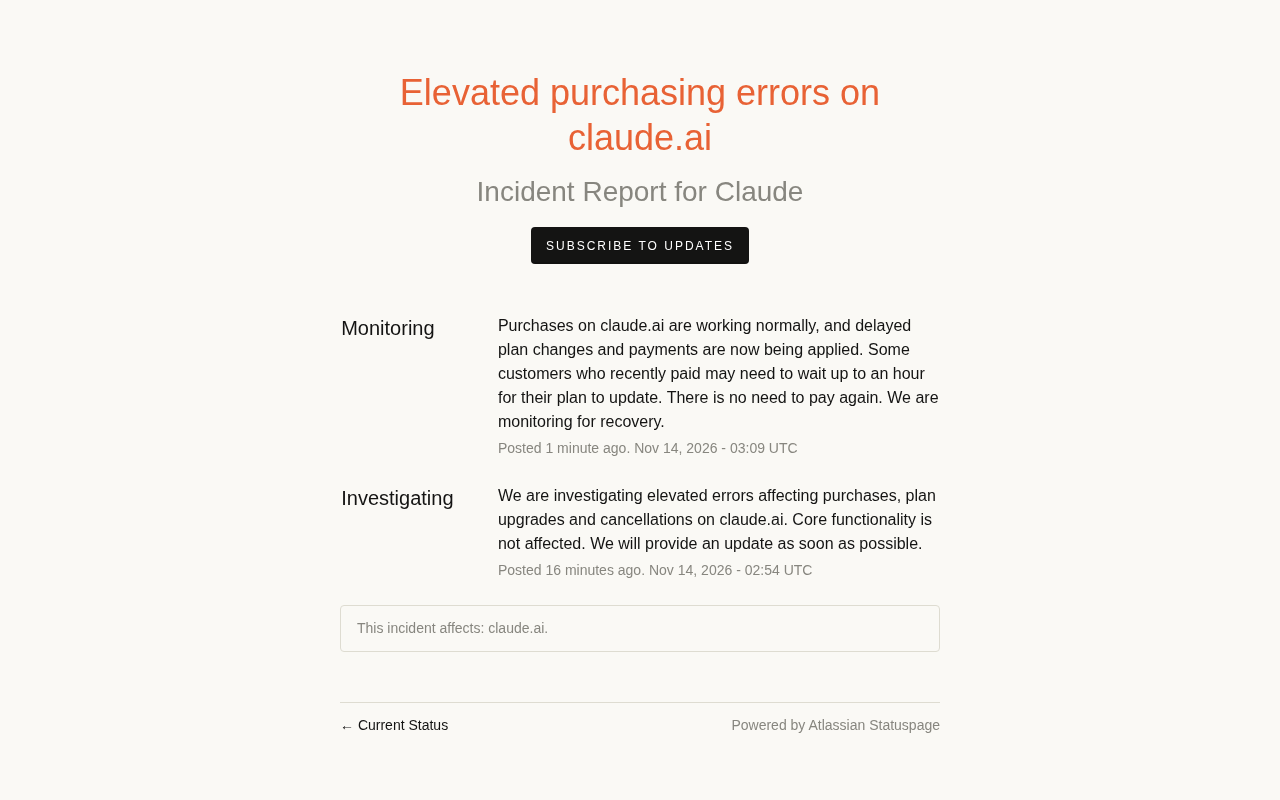
This brief announcement reveals several key points: the problem is concentrated in the transaction flow rather than model inference or conversation services; officials have launched an investigation but have not yet provided a repair timeline. For users who rely on Claude.ai for daily work or business activities, this means that during the fault window, any paid operations may fail or have an unclear status.
Status pages are a standard operational communication mechanism in the SaaS and cloud services industry, typically built in-house by service providers or hosted on third-party platforms such as Statuspage or Instatus. They publish incident progress according to a standard state machine: "Investigating → Identified → Monitoring → Resolved," independent of marketing-oriented official website announcements. The core value of a status page lies in providing an official, traceable, and clearly timestamped information source, so affected users don't have to rely on social media rumors to judge service conditions. Most status pages also support email or Webhook subscriptions, making it easy for enterprise users to integrate fault notifications into their own monitoring and alerting systems. Understanding this mechanism helps users recognize that "Investigating" means the root cause has not yet been confirmed, and repair time typically cannot be estimated.
Scope of Impact: Payment Chain Rather Than Model Capabilities
The official announcement explicitly states that the affected areas include "purchases, plan upgrades and cancellations"—namely new subscription purchases, plan upgrades, and cancellations. These three types of operations together constitute the platform's monetization loop, and any failure in one link directly impacts user experience and revenue recognition.
Core Functionality Unaffected
The phrase "Core functionality is not affected" in the announcement is worth noting. It implies that basic capabilities such as model inference, conversation generation, and file uploads are still operating normally. In other words, users who already have valid subscriptions can most likely continue using the service; the problem lies in the "money" flow rather than the "AI" output.
Cancellations Also Blocked
What's easily overlooked is that cancellations are also within the scope of the fault. For users who want to downgrade or exit their paid plans, this means they may not be able to complete the operation as expected. From a user rights perspective, this is more noteworthy than upgrade failures—if a cancellation fails to take effect due to a system error, users may face unnecessary renewals.
Billing for subscription-based SaaS is typically handled by third-party payment and subscription management platforms (such as Stripe Billing, Chargebee, Recurly). Purchases, upgrades, and cancellations are essentially different state change requests on the same subscription object, often sharing the same API and Webhook callback chain. Therefore, when error rates rise on this chain, all three types of operations tend to be affected simultaneously rather than in isolation. The technical path for cancellation generally includes initiating a request, updating subscription status, and triggering prorated refunds or cancel-at-period-end steps. Failure at any step can lead to inconsistent states: the interface shows cancellation, but the backend subscription remains active and renewals continue as usual. This is also why user rights risk is highest in such faults.
Practical Impact on Users and Recommended Responses
Until officials provide further updates, users within the fault window should exercise caution.
Avoid Duplicate Operations
When payment or upgrade requests fail, users tend to repeatedly click submit. In a state of elevated error rates, duplicate operations may lead to duplicate charges or multiple pending orders. It's advisable to hold off on retrying until official repairs are confirmed, and to monitor bank or payment channel deduction notifications.
The problems caused by duplicate submissions in payment systems are closely related to "idempotency." Idempotency means that executing the same request multiple times produces the same effect as executing it once. Mature payment APIs generally require clients to carry a unique Idempotency Key for each request, and the server deduplicates accordingly. However, in scenarios such as frontend timeout retries, manual user refreshes, or network fluctuations, if the idempotency key is missing or regenerated with each request, duplicate charges or multiple pending orders may result. Additionally, failed requests are sometimes not truly failures but response timeouts—the transaction may have actually been created in the background, but the client didn't receive confirmation. Therefore, the correct approach during a fault is to first verify deduction records and subscription status with the payment channel before deciding whether to retry, rather than continuously clicking submit.
Keep Operation Records
If users attempt upgrades or cancellations during this period, it's recommended to take screenshots of operation records and error messages. Should billing disputes arise later, these records can serve as evidence for appeals. The official announcement promises updates "as soon as possible" but gives no specific timeline, so users need to keep their own records.
Monitor Status Page Updates
Repair progress for such faults is typically published through the official status page. Users should refresh the status page periodically rather than relying on unofficial information on social media. The announcement itself uses the "Investigating" status, meaning the problem is confirmed but the root cause has not yet been identified, and subsequent stages such as "Identified," "Monitoring," and "Resolved" may follow.
Viewing AI Service Commercial Resilience Through One Fault
This incident itself is limited in scale, and officials have clearly delineated the scope of impact, but it reflects a broader issue: as AI products evolve from "toys" to "productivity tools," the reliability of their billing systems becomes as important as model quality.
Claude.ai's subscription model is the core of its monetization. A failure in any of the three paths—purchase, upgrade, or cancellation—leaves users with the impression that "paying is unsafe." Cancellation being blocked in particular easily triggers associations with "hidden charges," and the damage to brand trust may exceed the technical complexity of the fault itself.
For enterprise users, such faults also involve procurement processes and budget approvals. If an upgrade operation fails at a critical moment, teams may be forced to delay projects or seek alternatives. Competition among AI service providers has extended from model capabilities to operational details; a single line of small text on a status page often influences renewal decisions more than benchmark scores.
Summary
Claude.ai is investigating an elevated error rate affecting purchases, upgrades, and cancellations, with core AI functionality unaffected. During the fault, users should avoid resubmitting payment operations, keep records, and monitor subsequent updates on the official status page. This incident reminds us that the competitiveness of AI products is reflected not only in model output but also in "boring but critical" infrastructure such as billing systems.
Related articles

Gemini 4 Neon Leak: A Potential Strong Contender Against Opus 5.5
A Hacker News thread suggests Gemini 4 Neon looks like an Opus 5.5 competitor. This article unpacks the product positioning behind this community signal, shifts in the top-model competitive landscape, and what it means for developers' model selection strategy.

Claude Fable 5.2's Self-Authored Short Film 'Fable' Sparks Discussion
A short film 'Fable,' credited to Claude Fable 5.2 for script, visuals, and directing, appears on Hacker News. This article analyzes the significance of full-pipeline AI creation, community reactions, and what it means for content creators.

Anthropic IPO Pricing: A Signal of AI Giants Going Public
Anthropic's IPO pricing draws attention. This article analyzes its potential impact on AI industry valuation, commercialization paths, and the competitive landscape, and highlights public-market expectations and challenges for AI companies.