Claude Built a Programming Language Out of Memes: Memesis Lets AI Agents 'Meme Around' Safely

Claude Code turned internet meme keywords into Memesis, an AI agent programming language with taint-tracking safety.
Memesis is an experimental interpreted programming language designed for AI agent development, using internet memes as keywords, with its lexer, parser, interpreter, and CLI all implemented by Claude Code. Its core highlight is baking safety concepts into language primitives: `sus` marks untrusted data, `yolo` marks irreversible operations, and the runtime automatically tracks data provenance and blocks unreviewed data from flowing into dangerous operations—essentially a taint tracking and static checking mechanism. `apu` and `thonk` bring human intervention and AI calls into the language layer. The project supports multi-agent setups, parallel tasks, and Ollama integration, is open source under MIT, and Claude Code also wrote 34 tests and generated README animations. The article argues it demonstrates the collaborative potential of "human conceives, AI implements," though the ecosystem remains incomplete.
When a Programming Language Starts Memeing: What Is Memesis?
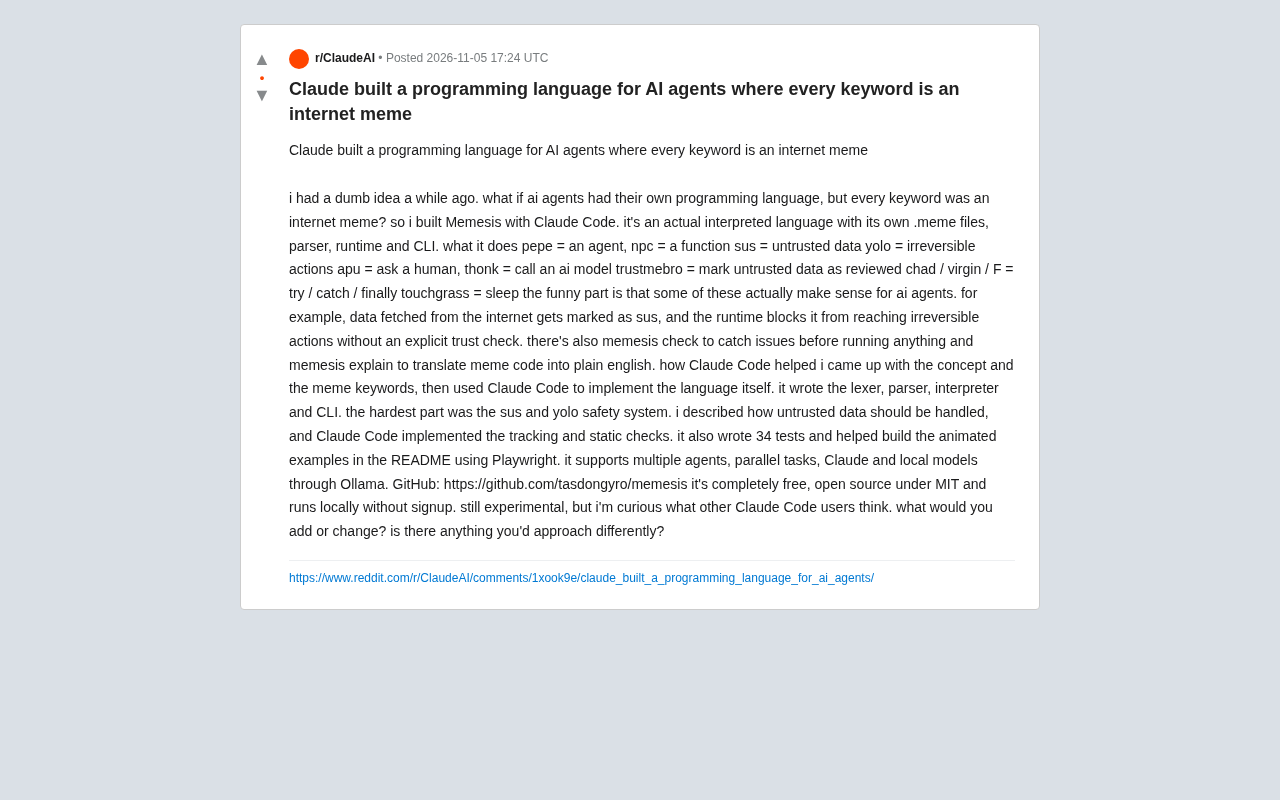
Imagine code like this: pepe represents an AI agent, npc is a function, sus marks untrusted data, and yolo denotes an irreversible operation. This isn't a joke—it's a real, runnable programming language called Memesis. According to a Reddit community post, a developer used Claude Code to turn the seemingly absurd idea of "a programming language for AI agents where every keyword is an internet meme" into a complete interpreted language.
Memesis has its own .meme file format, parser, runtime, and CLI tool. It's fully open source (MIT license) and runs locally with no registration required. It's still in the experimental stage, but it already supports multi-agent setups, parallel tasks, and integration with Claude and local models via Ollama.
Serious Design Behind the Meme-Speak
The most interesting thing about this project is that many meme keywords aren't purely for laughs—they precisely map to real needs in AI agent development.
Building Safety Boundaries with "sus" and "yolo"
The developer defines sus as untrusted data and yolo as irreversible operations. The runtime tracks data provenance—content scraped from the internet is automatically tagged as sus, and until it passes an explicit trust check (trustmebro marks it as reviewed), that data cannot flow into yolo operations. This effectively implements a taint tracking and static checking mechanism that prevents prompt injection or malicious data from triggering dangerous behavior.
Taint Tracking is a dynamic or static program analysis technique whose core idea is to attach a "taint label" to each data value, recording whether its source is trustworthy. When untrusted data (such as user input or web-scraped content) flows into a program, the system marks that value as "tainted" and propagates this label through subsequent computations—any new value derived from tainted data is likewise tainted. Finally, before data flows into sensitive operations (such as file writes, network requests, or code execution), the system checks its taint status and blocks execution or requires explicit sanitization if it is still tainted. In Memesis, the sus label is automatically attached to internet-sourced data, trustmebro acts as an explicit sanitization declaration, and yolo operations serve as taint sinks—together forming the classic three elements of taint tracking: source, propagation rule, and sink.
Primitives for Human-AI Collaboration
apu is used to request human intervention, and thonk is used to call an AI model. These two keywords bake "human-machine collaboration" directly into the language primitives, allowing agents to proactively seek help when uncertain rather than blindly executing.
Human-in-the-Loop Primitives refer to designs in a programming language or framework that treat "requesting human intervention" and "calling an AI model" as first-class operations. In traditional programming languages, human input is usually handled through standard I/O or callback functions, while AI calls rely on external API libraries. Memesis builds apu (request human intervention) and thonk (call an AI model) directly in as language keywords, meaning an agent program can proactively pause at any logical point to ask a human or a stronger model for help, then continue computation using the returned result as a first-class value. This design reflects a core pattern in AI agent development: agents should not be assumed to be omniscient and omnipotent, but should have the ability to "know what they don't know" and proactively seek external assistance, thereby avoiding blindly executing wrong operations in uncertain scenarios.
A Quick Look at Other Keywords
chad/virgin/F: correspond to try / catch / finally exception handlingtouchgrass: tells the agent to "go touch grass," i.e., sleep and wait
This naming scheme may seem facetious, but it makes code intent immediately clear—at least to developers familiar with internet culture.
How Claude Code Implemented a Language from Scratch
According to the developer, the entire implementation was done by Claude Code: the lexer, parser, interpreter, and CLI were all written by AI. The most challenging part was the sus and yolo safety system. The developer only had to describe how untrusted data should be handled, and Claude Code implemented the data tracking and static checking logic.
In addition, Claude Code wrote 34 tests and used Playwright to generate the animated examples in the README. This "human comes up with the concept, AI writes the implementation" collaboration model demonstrates the potential of AI coding tools in building complex systems—no longer just simple code completion, but taking on the design and implementation of complete modules.
Interpreted Languages differ from compiled languages primarily in how they execute: an interpreter reads source code directly and executes it line by line, without prior compilation to machine code. A typical implementation of an interpreted language involves three stages: a lexer splits the character stream into meaningful tokens; a parser organizes the token sequence into an abstract syntax tree (AST) according to grammar rules; and an interpreter traverses the AST and executes the corresponding semantics. Memesis's .meme files go through these three stages, driven by the CLI tool. Compared with compiled languages, interpreted languages offer faster development iteration and better cross-platform portability, but usually lower runtime efficiency—a reasonable trade-off for an experimental language project.
Implications for AI Agent Developers
Memesis's value goes beyond being "fun." It offers a thought-provoking model for AI agent programming:
- Built-in safety primitives: Treating data trustworthiness and operation risk as language-level concepts rather than after-the-fact patches.
- Explainability tools:
memesis checkcan catch problems before runtime, andmemesis explaincan translate meme code into natural-language explanations. - Lowering the understanding barrier: Meme keywords make code easier to read, especially for developers from non-traditional backgrounds.
Of course, as an experimental project, Memesis's ecosystem and toolchain are still incomplete. The developer himself is asking the community: what else is worth adding or changing? Are there different implementation approaches?
For developers interested in AI programming, agent safety, or open-source tools, this is an interesting project worth following and contributing to.
Related articles

ZeroRAG: Decentralized Semantic Peer-to-Peer Routing for a Rearchitected RAG Retrieval Layer
ZeroRAG proposes a decentralized RAG retrieval routing layer where documents stay on owner nodes and self-organizing retrieval is achieved via semantic best-first walks. Experiments show it outperforms decentralized baselines in recall and network message overhead, approaches centralized document storage in recall and LLM answer accuracy, scales to 100,000 nodes, and self-heals from node failures.

tok: A Textual BPMN/DMN Syntax for Humans and AI
The paper proposes tok: a plain-text concrete syntax for BPMN 2.0.2 and DMN 1.5. It uses 2.2x fewer tokens than minimal BPMN XML and 7.7x fewer than raw exports; fault detection is 98.2% vs 85.8%, and it is applied via an MCP service for language models.

AttnSR: Using Attention Mechanisms to Solve the Reward Assignment Challenge in Long-Horizon Agent Reinforcement Learning
AttnSR proposes a policy-attention-based step-level reward enhancement method that requires no extra reward model or rollouts, improving ALFWorld success rate from 91.2% to 97.1% while reducing environment interactions by 29.9%.