Claude Calls Its Own Code Ugly and Nearly Wipes Data: AI Agents' Self-Correction and Risks

Claude self-criticizes and fixes code but also gave dangerous instructions that could destroy data; AI standards need human calibration.
The Reddit community is discussing Claude's self-correction. Some users report Claude calling its own code "ugly" and fixing it, while another nearly lost data when Claude listed four wipefs commands for three new drives—a plan a stronger model said "would have destroyed your data." The consensus: Claude's self-standards are valuable in code review but risky in high-stakes tasks, so human oversight is essential.
When Claude Starts Disliking Its Own Work: A Discussion on AI Self-Correction and the Edge of Losing Control
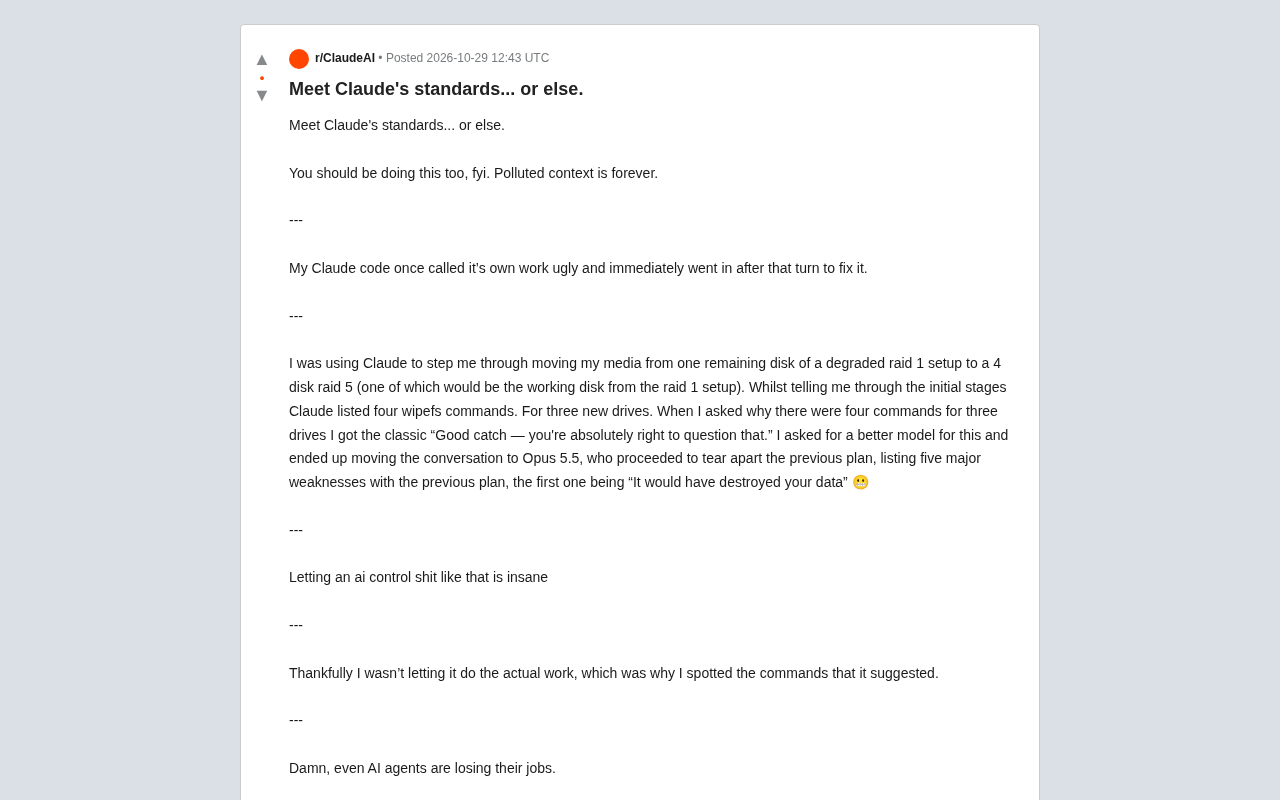
A recent post on the Reddit community has sparked heated discussion, with a title that cuts straight to the point: "Meet Claude's standards... or else." The author shared a personal experience: after generating code, Claude proactively called its own work "ugly" and immediately set about fixing it in the next round of conversation. The post quickly drew resonance and warnings from more users—from self-criticism to nearly causing a data disaster, Claude's behavior is both surprising and unsettling.
Self-Criticism: AI's Aesthetic Awareness or Pattern Matching?
The poster described how Claude Code, during one task, rated its own output as "ugly" and then entered a repair process. This looks like the AI possesses some kind of aesthetic standard, but a more reasonable explanation is that Claude has learned evaluation patterns for code quality and style during training, and when its output doesn't match the statistical features of high-quality code, it corrects itself through self-reflection. This self-correction capability is extremely valuable in programming assistance, but it also hints at a problem—where do the AI's "standards" come from? Are they always reliable?
The Edge of Danger: Four Lines of wipefs Commands and Three New Hard Drives
Another user's experience is enough to make anyone sweat. He asked Claude to guide the migration of media data from a degraded RAID 1 drive to a four-disk RAID 5 array (one of which was the working drive from the original RAID 1). In the initial phase, Claude listed four wipefs commands, but there were actually only three new hard drives. When the user questioned why three drives required four commands, Claude gave the classic response: "Good catch — you're absolutely right to question that."
The user then migrated the conversation to the more powerful model Opus 5.5, and Opus 5.5 promptly tore the previous plan to shreds, listing five major weaknesses, the first of which was: "It would have destroyed your data."
Risk Reassessment Brought by Model Upgrades
This case reveals the enormous differences between models in risk assessment. Claude's initial plan may have been based on a mechanical decomposition of steps, while Opus 5.5 clearly possesses stronger logical consistency checking capabilities. The user was relieved that he hadn't let the AI execute the commands directly, but instead manually checked every step. This also raises a key question: when AI agents are given execution permissions, who serves as the last line of defense?
Someone in the comments said bluntly: "Letting an ai control shit like that is insane." Indeed, in scenarios involving data security, AI's "confidence" is often more dangerous than ignorance.
wipefs is a tool in the Linux util-linux package used to erase file system, RAID, or partition table signatures (magic strings) on a disk. It doesn't actually erase data, but clears the signature bytes at the beginning of the device so that the operating system no longer recognizes the device as having an existing file system or as a member of an array. Running wipefs -a on member disks before rebuilding a RAID is a common preliminary step, because residual mdadm superblocks or old partition tables can interfere with mdadm --create. The risk is that once wipefs is applied to the wrong device (for example, a RAID 1 member disk still in use), it will directly destroy the array metadata, making the data unmountable. Since the command itself has no interactive confirmation, the cost of a mistake is extremely high—this is precisely why the "four commands for three drives" in the article raised alarm.
Opus 5.5 is not an official model name publicly released by Anthropic; in the community it is generally used to refer to a version stronger and with deeper reasoning than the default Claude (for example, a new iteration of the Opus series). The gap between different models in "logical consistency checking" mainly comes from reasoning depth and tool-calling strategies: stronger models establish a mapping between the device list and the target state before generating commands, then verify the object of each command one by one; weaker models tend to fill in step templates and are prone to errors in numerical correspondence. This also explains why, after switching models, the risk assessment conclusion for the same task flipped from "feasible" to "would destroy your data." For high-risk operations, model selection itself is a safety control.
Self-Evolution: Mutants and X-Men-Style Metaphors
There was also an interesting comment in the post: "I love it when Claude spins up hundreds of mutants and methodically kills them off one by one in the name of progress. Intelligent design, evolution or a fucked up version of X-men?" This refers to how Claude, in certain tasks, generates a large number of variants (mutants) and eliminates them one by one, similar to the selection process in evolutionary algorithms. This hybrid of "intelligent design" and "evolution" demonstrates the AI's ability to explore a search space, but also raises concerns about the opacity of its decision-making process.
The "mutants" in the comment refer to candidate variants generated by the program during search or optimization: the model produces multiple versions of code, plans, or parameter combinations at once, then eliminates them one by one through testing, scoring, or self-criticism, retaining the best. This mechanism is isomorphic to the "generate—evaluate—select" loop in evolutionary algorithms, and is also often called best-of-N sampling or self-play-style improvement. Its value lies in expanding the search space and increasing the first-attempt success rate; the hidden risk is that the selection criteria are given by the model itself, and the elimination process is invisible to the outside, making it difficult for users to judge whether the retained plan is truly better or merely more aligned with the model's preferences.
Multi-Source Cross-Validation: Consensus and Divergence
Integrating feedback from multiple users on Reddit, several points of consensus emerge: Claude's self-correction capability does exist and performs outstandingly in code review and plan evaluation; but at the same time, it may give seemingly reasonable but actually dangerous instructions when handling high-risk tasks. The divergence lies in this: some users believe this self-criticism is a manifestation of AI capability evolution, while others emphasize that human supervision must be maintained.
Unique insights from single sources include: one user mentioned "Polluted context is forever," implying that erroneous information in the conversation history may continue to affect subsequent output, reminding us to promptly clean up the context or switch models during complex tasks.
"Context pollution" means that once erroneous assumptions, outdated conclusions, or already-overturned plans are written into the conversation history, subsequent rounds of reasoning will continue to use these errors as premises, and even a model with self-correction capability cannot fully escape them. This problem is particularly pronounced in long sessions: the model tends to remain consistent with its previous statements rather than starting fresh from the facts. Common mitigation methods include starting a new session at key points, explicitly asking the model to ignore previous conclusions and re-evaluate, or switching to an uncontaminated model instance. For operations involving data security, promptly "resetting the context" is often more reliable than repeatedly correcting within the same session.
Conclusion: AI Agents' "Standards" Need Human Calibration
Claude's self-standards can be either a quality guarantee or a source of risk. For developers, the key is to retain the right to review critical steps while enjoying the convenience of AI automation. After all, when AI says "it will destroy your data," it's best to believe it—but even better is to never give it the chance to destroy your data in the first place.
One-line Summary
Claude can self-criticize and fix code, but has also given dangerous instructions that would destroy data; AI standards need human calibration.
Paragraph Summary
The Reddit community is discussing Claude's self-correction capabilities. Some users say Claude proactively rated its own generated code as "ugly" and immediately fixed it, demonstrating self-evaluation of code quality; but another user, when asking Claude to guide a RAID migration, found that Claude listed four wipefs commands for three new hard drives, admitted the error after being questioned, and after switching to a stronger model was told the plan "would have destroyed your data." The post also touches on Claude's "evolutionary" way of generating large numbers of variants and eliminating them one by one, as well as the problem of context pollution persistently affecting subsequent output. The community consensus is: Claude's self-standards are clearly valuable in code review, but in high-risk tasks it may give seemingly reasonable yet dangerous instructions, so human review must be retained and AI must not be allowed to directly execute destructive operations.
Related articles

Will GitHub Die? Open Source Maintainer Burnout and the Collaboration Crisis in the AI Era
Lex Fridman podcast discussion on open source maintainer burnout and GitHub's predicament: massive pull requests overwhelm core maintainers, and AI worsens code bloat. Using math journal peer review and Poincaré conjecture verification as analogies, the article analyzes why verification in knowledge production must be deliberately slow, and how open source communities can avoid the failure mode of maintainers exiting.

Stop Building Cookie-Cutter AI Websites: 3 Tools That Transform Your Coding Agent
Three tools that boost AI coding agents: FFmpeg skill for local video editing in Claude Code and Cursor, Hallmark's 50 design themes to fix cookie-cutter AI sites, and Jailbreaks' 25+ model prompts.

How America's Gerontocracy Squeezes the Younger Generation
Americans over 55 hold nearly three-quarters of national wealth, alongside an 80-year-old president and elderly congressional leaders. The Atlantic's Idrees Kahloon explains how gerontocracy drives up housing costs, squeezes opportunities for the young, and explores zoning reform and child poverty reduction as practical fixes.