Claude-Claw Open Source Project Analysis: The Brain + Hands AI Agent Orchestration Architecture

Claude-Claw combines Claude Code reasoning with OpenClaw GUI automation to create a multi-Agent computer control system.
Claude-Claw is an open-source project adopting a "brain + hands" decoupled architecture, using Claude Code as the cognitive decision layer for task planning and reasoning, and OpenClaw as the execution operation layer for GUI automation. The project supports multi-Agent orchestration, enabling specialized Agents for file management, browser interaction, and application control to work collaboratively. While still in a very early stage, its architectural approach of decoupling AI "thinking" from "acting" and achieving complex task automation through an orchestration layer represents an important technical direction in the Computer Use space.
Project Overview: Enabling AI to Control Computers Like Humans
How can AI truly "control" computers and complete complex GUI interaction tasks just like humans? This is one of the most cutting-edge areas of exploration in the AI Agent field. The open-source project Claude-Claw on GitHub offers a creative answer: combining Claude Code's "Tengu brain" with OpenClawAd's "device hands" to create an autonomous computer-use agent.
Project link: huyuelin/Claude-Claw, developed in Python, currently in its early stages.
Computer Use: A Critical Leap from Text to the Real World
Computer Use refers to the ability of AI systems to autonomously complete computer tasks by visually perceiving screen content, understanding GUI elements, and executing mouse and keyboard operations. The technical foundation of this direction stems from breakthroughs in multimodal large models — models that can not only process text but also understand the semantics and spatial positions of buttons, menus, text fields, and other UI elements in screenshots. In October 2024, Anthropic was the first to release Claude's Computer Use capability, allowing AI to control computers through a loop of capturing screens, identifying interface elements, and sending mouse and keyboard commands. This was regarded as a key milestone in AI Agents transitioning from pure text interaction to real-world operations. Claude-Claw is an open-source exploration project born from this technological wave.
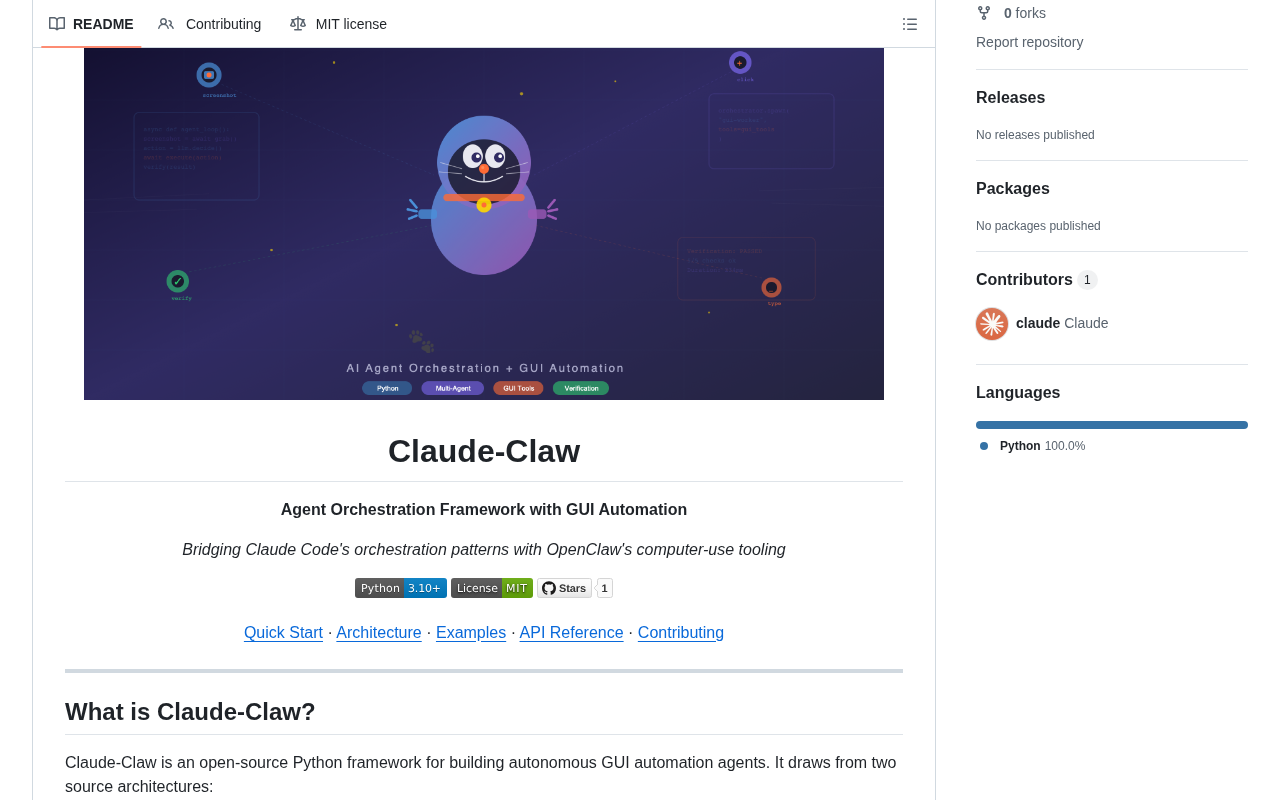
Core Architecture: Division of Labor Between Brain and Hands
Claude-Claw's design philosophy is highly intuitive — it splits AI Agent capabilities into two key layers: the cognitive decision layer (brain) and the execution operation layer (hands).
Claude Code as the Cognitive Decision Layer
At the cognitive decision layer, the project leverages Claude Code's powerful reasoning capabilities as the agent's "brain." Claude Code is a terminal-native AI programming tool launched by Anthropic. It's not just a code completion assistant but a programming Agent with complete task planning and multi-step reasoning capabilities. Claude Code can understand the context of an entire code repository and autonomously execute complex workflows including file editing, terminal command execution, and Git operations. Its core advantage lies in the "agentic coding" mode — users only need to describe high-level goals, and Claude Code can autonomously decompose tasks, execute them step by step, and adjust strategies based on intermediate results. This powerful reasoning and planning capability makes it an ideal candidate for the cognitive layer of AI Agents.
Claude-Claw extends this capability from the code domain to broader computer operation scenarios. Specifically, the agent can:
- Understand users' high-level intentions
- Decompose complex tasks into executable step sequences
- Dynamically adjust based on feedback during execution
OpenClaw Handles GUI Automation Execution
At the execution operation layer, the project introduces OpenClaw as the "hands" for device interaction. To understand OpenClaw's value, it helps to understand the evolution of GUI automation technology. GUI automation has progressed through multiple generations: from script recording and playback, coordinate-based positioning, UI element tree-based approaches (like Windows UI Automation and Android Accessibility Service), to vision-based understanding. Traditional RPA (Robotic Process Automation) tools like UiPath and Automation Anywhere primarily rely on predefined UI element selectors and fixed process scripts, which easily break when interfaces change. The new generation of LLM-based GUI automation solutions locate and manipulate interface elements through visual understanding, offering stronger generalization capability and robustness.
As an open-source GUI automation framework, OpenClaw provides low-level operation primitives including screen capture, element recognition, and mouse/keyboard simulation, offering standardized execution interfaces for upper-level AI decisions. Through this layer, AI decisions can be truly converted into actual operations on computer interfaces — including mouse clicks, keyboard input, screen recognition, and other operation primitives.
Three Major Advantages of the Decoupled Architecture
This "brain + hands" decoupled architecture design brings several significant advantages:
- Modular design: The cognitive layer and execution layer can be upgraded and replaced independently without affecting each other
- Flexible extensibility: Theoretically, different LLMs can be integrated as the brain, or different automation frameworks can be connected as executors
- Convenient debuggability: With decision-making and execution separated, troubleshooting efficiency improves dramatically
It's worth noting that this design philosophy of decoupling "thinking" from "acting" has deep theoretical roots in the AI Agent field. As early as the classic BDI (Belief-Desire-Intention) agent architecture, belief updating, goal reasoning, and action execution were already separated into different modules. In recent years, the ReAct (Reasoning + Acting) paradigm has further validated the effectiveness of this approach — having large models alternate between reasoning and acting, observing environmental feedback after each action before proceeding to the next round of reasoning. Claude-Claw's architecture can be seen as a concrete implementation of this paradigm at the systems engineering level: encapsulating reasoning capabilities in the LLM layer, encapsulating action capabilities in the automation framework layer, with both communicating through standardized interfaces. This maintains independent evolution capability for each while achieving end-to-end task automation.
Multi-Agent Orchestration: From Monolithic to Collaborative Systems
The "Agent Orchestration" in the project name is another core highlight. In complex computer operation scenarios, a single Agent often cannot handle all task types.
Technical Paradigm of Multi-Agent Orchestration
Multi-Agent Orchestration is one of the core research directions in the current AI Agent field. Its core concept originates from the design philosophy of distributed systems and microservice architectures. Unlike monolithic Agents that try to solve all problems with a single model, multi-Agent systems assign complex tasks to multiple sub-Agents with specialized capabilities, with an Orchestrator responsible for task allocation, execution scheduling, and result aggregation. Representative frameworks include Microsoft's AutoGen, CrewAI, LangGraph, and others. The advantage of this pattern is that each Agent can be optimized for specific domains (such as file operations, web browsing, data processing), while the orchestrator focuses on high-level task planning and coordination communication between Agents, thereby achieving higher overall task completion rates and better error recovery capabilities.
Claude-Claw's orchestration framework follows this paradigm, allowing multiple specialized Agents to work collaboratively:
- File management Agent handles file operations
- Browser Agent manages web interactions
- Application interaction Agent manages desktop software operations
- The upper-level orchestrator uniformly schedules execution order and collaboration relationships among Agents
This design pattern is highly consistent with the mainstream trend in the current AI Agent field — evolving from monolithic Agents to multi-Agent collaborative systems, addressing more complex automation scenarios through division of labor and collaboration.
Technical Positioning and Industry Competitive Landscape
Major Players in the Computer Use Space
Since Anthropic released Claude's Computer Use capability, the direction of "letting AI control computers" has rapidly gained momentum. There are already multiple related projects on the market:
| Project | Characteristics |
|---|---|
| Anthropic Computer Use API | Official solution providing basic screenshot + operation capabilities |
| Open Interpreter | Open-source code execution and computer control framework |
| Various AI-enhanced RPA tools | Combination of traditional automation tools with large language models |
Claude-Claw's Differentiated Positioning
Claude-Claw's differentiation lies in two aspects: first, a clear "orchestration + automation" dual-layer architecture design; second, deep integration of Claude Code's reasoning capabilities. Compared to other solutions, this architecture provides clearer logical layering when handling multi-step, cross-application complex tasks.
Project Status and Future Outlook
Objective Assessment of the Current Stage
It should be objectively noted that this project currently has only 1 Star and is in a very early stage. Code maturity, documentation completeness, and community activity all require continued observation.
Reference Value of the Architecture Approach
Although the project itself is still very young, its architectural approach — modularly combining a strong-reasoning LLM with a mature GUI automation framework — represents a technical direction worth watching.
As multimodal large model capabilities continue to improve, AI Agents' ability to autonomously control computers will keep growing stronger. The architecture paradigm explored by Claude-Claw is highly inspiring: decoupling AI's "thinking" from "acting" and achieving automated execution of complex tasks through an orchestration layer.
For developers interested in AI Agents and computer automation, the design philosophy of this project is worth studying and learning from. It's recommended to continue monitoring the project's subsequent feature iterations and community development dynamics.
Key Takeaways
- Claude-Claw adopts a "brain + hands" decoupled architecture, combining Claude Code's reasoning capabilities with OpenClaw's GUI automation capabilities
- The project supports AI Agent Orchestration, allowing multiple specialized Agents to collaboratively complete complex computer operation tasks
- Modular design enables the cognitive decision layer and execution operation layer to be independently upgraded and replaced, offering excellent extensibility
- The project is currently in a very early stage (1 Star), but its architectural approach represents an important technical direction in the Computer Use space
- The project's design philosophy aligns with the industry's mainstream trend of evolving from monolithic Agents to multi-Agent collaborative systems
Related articles
Deep Dive into AI Agent Skill Design: …
Deep Dive into AI Agent Skill Design: Engineering Practices from Anthropic and Perplexity
A deep dive into Skill design philosophy from Anthropic's Claude Code team and Perplexity's Agent team, covering the Tax Test, Gotchas Flywheel, progressive disclosure, and Eval-First practices for building high-quality AI Agent skill systems.
Deep Dive into OpenAI's Official GPT-5…
Deep Dive into OpenAI's Official GPT-5.6 Prompting Guide: The Shift from Manual to Automatic
A deep dive into OpenAI's official GPT-5.6 Sol prompting guide: conciseness-first, outcome-oriented design, autonomy boundaries, tool routing, and reasoning intensity tuning.
 Deep Dives
Deep Dive into How OpenClaw (Open-Source Crayfish) AI Agent Works
Deep analysis of OpenClaw AI Agent internals: System Prompt, tool calling, SubAgents, Skill system, memory, and Context Engineering explained.