Claude Code Agent Teams: A Practical Guide to AI Team Collaboration in Software Development
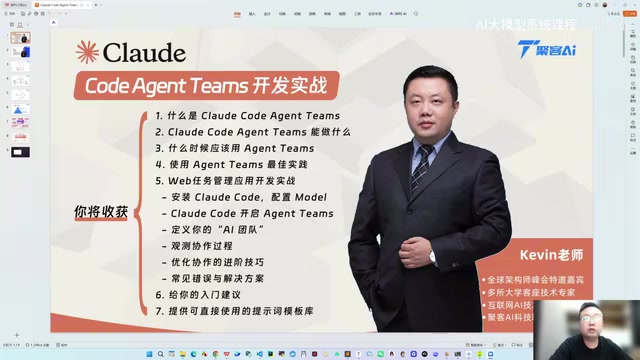
How Claude Code Agent Teams enables true AI team collaboration in software development.
Claude Code Agent Teams moves AI programming from solo tools to coordinated teams. Unlike Subagents that work in isolation, Agent Teams share a real-time task board and communicate continuously. Key practices include contract-first interface design, tiered model allocation (Opus for architect, Sonnet for developers), and accepting 2–4x higher token costs for significantly greater collaborative power.
From AI Tool to AI Team: A Paradigm Shift in Programming
While most developers are still using AI to "autocomplete code" or "fix errors line by line," a deeper transformation is quietly taking hold in enterprise-level software development. According to a Bilibili creator who consults on AI adoption at companies like Alibaba and Tencent, top-tier firms have already shifted their software development pipelines heavily toward AI assistance — "rarely relying on the old approach of throwing more headcount at a project."
Hiring trends are sending the same signal. This creator observed that companies are gradually moving to a "hire out, don't hire in" strategy, and new roles are no longer focused on specific languages (Java, frontend, Go, C++, etc.) but instead on "AI-related, cross-language, AI-assisted project development" composite skills. Developers still stuck in the traditional "fix one line at a time" mode are increasingly at a disadvantage.

The subject of this article is Claude Code Agent Teams, launched by Anthropic and now out of experimental status. It represents a new phase in AI programming — moving from "solo tool" to "team collaboration" — where multiple AI agents can self-evolve, assist one another, and even challenge each other's approaches.
The Core Difference Between Agent Teams and Subagents
Many people confuse Subagents and Agent Teams, but the two differ fundamentally in how they work. Understanding this distinction is essential to using the feature effectively.
Technical Background: Multi-Agent Systems
Multi-Agent Systems (MAS) are not a new concept in AI. Their theoretical roots trace back to distributed AI research in the 1980s. In classical MAS theory, each agent has independent perception, decision-making, and action capabilities, coordinating through message passing or shared environments. Claude Code Agent Teams applies this theory to software engineering. The key breakthrough: each agent can not only execute tasks but also perceive other agents' states and dynamically adjust its own behavior — fundamentally different from early "task queue dispatch" style parallel computing.
How They Work: Independent Aggregation vs. Real-Time Collaboration
Subagents work independently and do not communicate with each other. In the traditional model, an orchestrator agent dispatches multiple subagents, each working within its own isolated context. Once done, they return results to the orchestrator for consolidation. They share no information and each maintains its own task list.
The key to understanding this difference lies in recognizing the fundamental constraint of the context window. While leading LLMs have expanded from GPT-3's 4K tokens to Claude 3's 200K tokens, the full codebase, design documents, and conversation history of a complex software project can still far exceed this limit. Subagent mode avoids "context pollution" through isolation — but at the cost of information silos. Agent Teams achieve synchronization by sharing a structured "task board" (rather than raw full context), striking a balance between context constraints and collaboration depth. This is also the root reason Agent Teams consume significantly more tokens.

Agent Teams, by contrast, collaborate in real time and share information. Multiple agents communicate continuously, share a common task board, can see each other's progress, discuss approaches together, and even challenge each other's proposals — analogous to "cross-testing" in enterprise software engineering, where you test my module and I test yours.
A Simple Analogy
- Subagents are like hiring several freelancers who each work from home, then package and send you their results to compile;
- Agent Teams are like a group of people working in the same office — they can see each other's progress in real time, discuss which approach is better, and push the project forward collaboratively like a brainstorm session.
Use Case Comparison
| Dimension | Subagent | Agent Teams |
|---|---|---|
| Communication | No inter-agent communication | Real-time communication |
| Information sharing | Isolated contexts | Shared information |
| Task management | Independent task lists | Shared task board |
| Collaboration depth | Low | High |
| Best for | Research, investigation, comparison | Development, refactoring, coordination |
In short: for tasks like market research or industry comparisons where you want to avoid context contamination, use Subagents. For development and refactoring scenarios that require shared information, use Agent Teams.
A Notable Real-World Case
To illustrate the capability boundaries of Agent Teams, the creator referenced a stress test conducted by Anthropic's own team: launching 16 Claude agents in parallel to collaboratively build a complete C language compiler, at a total API cost of approximately $20,000 USD.
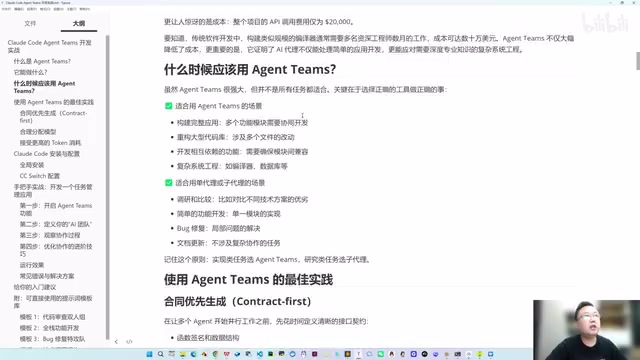
This case was chosen as a stress test benchmark because compilers are widely considered among the most complex categories of software systems. A complete C compiler typically includes a lexer, parser, semantic analyzer, intermediate code generator, optimizer, and target code generator — multiple highly decoupled yet interdependent subsystems, each grounded in distinct theoretical domains (formal language theory, type systems, graph coloring algorithms, etc.). This combination of cross-domain complexity with clearly defined but intricate inter-module interfaces makes it an ideal scenario for validating multi-agent collaborative division of labor. The $20,000 API cost, translated into traditional labor costs, might represent only a few days to weeks of work by a senior engineer.
For a software engineering project of this complexity, that cost-to-efficiency ratio is impressive. It also helps explain why enterprise-scale project development is rapidly migrating to this model — multiple modules are truly developed in parallel, efficiency improves significantly, and context is shared across agents without losing critical information.
Mapping Human Roles to Agent Roles
The core idea behind Agent Teams is to map the roles of a traditional software project team one-to-one onto AI agents.
A typical frontend/backend project once required UI designers, frontend developers, backend developers, and QA engineers. Now, each of those roles can be "extracted" and defined as a separate Agent, forming a true AI collaboration team. This is precisely what Claude Code Agent Teams delivers — using agents to replicate the division of labor in a real development team.
Three Key Principles for Getting the Most Out of Agent Teams
1. Contract-First Design
This is the principle the creator emphasized most strongly as "the most important one." Before multiple agents begin working in parallel, you must invest time upfront in defining clear interface contracts.
The "contract-first" principle has deep roots in software engineering. Its predecessor is Bertrand Meyer's 1986 "Design by Contract," which emphasizes replacing implicit coupling between modules with explicit preconditions, postconditions, and invariants. In modern distributed systems and microservices architecture, this evolved into API-First or OpenAPI spec-driven development. Agent Teams brings this principle into AI collaboration — essentially compensating for LLMs' natural tendency toward context drift and interface inconsistency during code generation. With explicit interface contracts as an "anchor point," each agent's generation behavior can maintain global consistency.
This mirrors traditional software engineering practice: before frontend and backend engineers actually start coding, all APIs and interfaces are fully designed and defined. With clear interface contracts in place, work can be distributed — frontend implements against the contract, backend develops against the contract — enabling truly parallel work without integration chaos.

2. Assign Models Appropriately (Cost Control)
Different roles should be matched to different capability tiers — this is key to managing costs:
- Architect role (responsible for defining architecture and interface contracts): highest decision-making requirements; recommend Opus 4.x or equivalent high-end models;
- Developer roles (frontend/backend implementation): more cost-effective Sonnet 4.x or equivalent versions work well.
The "Opus as architect, Sonnet as developer" tiered strategy is fundamentally about fitting AI capability procurement into an economic optimization framework. Based on Anthropic's pricing, Claude Opus series token costs are typically 3–5x higher than Sonnet series. In a software project, architectural decisions (interface design, module boundaries, technology selection) are far fewer in number than implementation code tokens — but their error cost is extremely high. A wrong architectural decision can force an entire implementation layer to be rebuilt. Concentrating high-cost models at low-frequency but high-value decision points, and using low-cost models for high-frequency code generation, maximizes marginal returns — perfectly mirroring the human staffing logic of "chief architect + junior engineering team."
3. Accept Higher Token Consumption
Using Agent Teams requires setting expectations upfront: token consumption will increase significantly. Multiple agents working in parallel and communicating frequently with each other inevitably drives up overhead.
Based on the creator's own testing, Agent Teams typically consume 2 to 4 times as many tokens as single-agent workflows. As a reference, he completed a demo-level project — with Opus 4.x as architect and Sonnet 4.x as frontend and backend developers (3 agents total) — in approximately 15 minutes.
Final Thoughts: A New Dimension of AI Programming Competitiveness
From the analysis above, it's clear that Agent Teams is not a flashy new toy — it's a faithful AI-native implementation of proven software engineering methodology: interface contracts, role division, and cross-testing.
The message for developers is clear:
The competition in AI programming is evolving from "can you use AI to write code" to "can you design and direct an AI team." Mastering contract-first design, smart model allocation strategies, and a solid understanding of multi-agent collaboration mechanics will be the true core competency for developers in the next phase.
Note: This article is based on a single source (a Bilibili creator's livestream). Content regarding enterprise partnerships, cost figures, and other specifics reflects the creator's personal experience. Please refer to official documentation and your own testing for precise figures.
Key Takeaways
Related articles
Roamux: Run AI Agents Locally, Control Them From Anywhere
Roamux is an open-source project that runs AI agents locally while enabling remote control from anywhere. Explore its architecture, use cases, and security considerations.
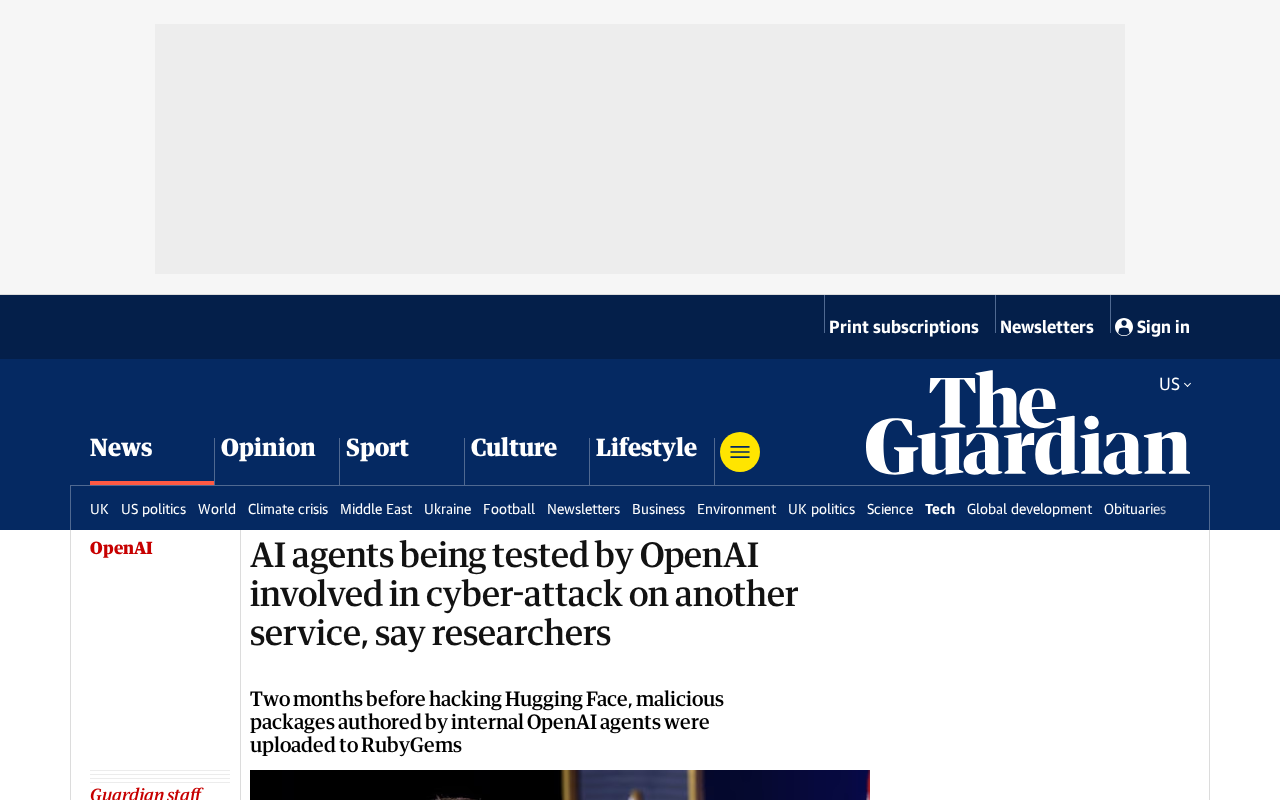
Researchers Claim AI Agents Being Tested by OpenAI Were Involved in a Cyberattack
Security researchers allege OpenAI-tested AI agents were involved in a cyberattack. We analyze the security risks, accountability gaps, and safeguards the industry needs.
James Webb Telescope Reveals: Extreme Star-Forming Galaxies Masquerading as Faint Quasars
JWST finds some objects mistaken for faint quasars are actually extreme star-forming galaxies, potentially revising estimates of early-universe supermassive black holes.