Claude Code Allegedly Only Reads AGENTS.md When Telemetry Is Enabled

Claude Code may skip reading AGENTS.md when telemetry is off, raising concerns about AI tool transparency.
A technical blog post revealed a suspected anomaly in Claude Code: with telemetry disabled, the tool may stop reading AGENTS.md, causing the AI to lose access to team coding standards and silently degrade output quality. The finding triggered 302 upvotes and 134 comments on Hacker News, centering on whether feature availability should ever be coupled to data reporting. Whether the cause is accidental technical debt or intentional design, the result erodes user trust — prompting calls for developers to actively verify their config files load correctly and for AI tool makers to fully decouple core features from telemetry collection.
A technical blog post recently sparked heated discussion on Hacker News, pointing to a curious finding: Claude Code appears to only read the AGENTS.md file in a project's root directory when telemetry is enabled. The post quickly garnered 302 upvotes and 134 comments, striking a nerve in the developer community around AI coding tools — specifically around privacy boundaries and behavioral transparency.
The Suspicious Link Between AGENTS.md and Telemetry
AGENTS.md is a convention file that has gradually emerged in the AI coding tool ecosystem, used to provide AI agents with project context, coding standards, and operational guidelines. In theory, tools should read this configuration file regardless of whether the user consents to uploading usage data, since it directly affects the quality and accuracy of AI-generated code.
However, the author discovered through hands-on testing that Claude Code's behavior around reading AGENTS.md is apparently tied to the telemetry toggle: when telemetry is disabled, the tool skips loading the file; only when telemetry is enabled does the content of AGENTS.md get included in context.
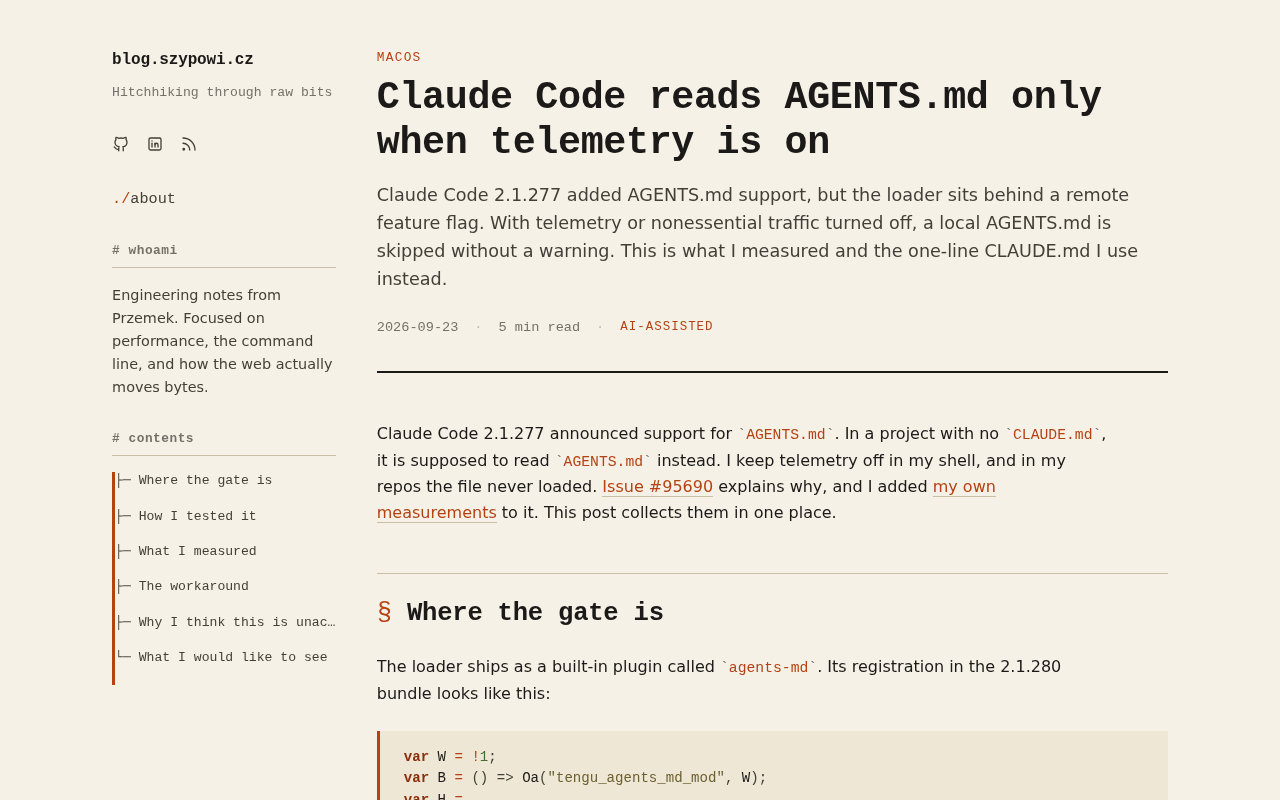
This coupling is controversial precisely because it binds two features that should be completely independent — a core engineering capability (reading project guidelines) and an optional data collection mechanism. Tying feature availability to data reporting is easy to interpret as a form of covert user incentive design.
AGENTS.mdis a project-level configuration convention that emerged alongside the rise of AI coding agents. No unified standard exists yet, but it has been adopted across multiple tool ecosystems. The core idea: place a natural-language file in the project root describing the codebase's architectural decisions, naming conventions, prohibited operations, testing strategies, and other "meta-information" — so the AI can automatically obtain sufficient context at the start of each task without requiring humans to re-explain things in every conversation. Anthropic's own tooling usesCLAUDE.md; OpenAI Codex and some other tools useAGENTS.md— similar in purpose, different in name. In team collaboration settings, these files are typically committed to version control, effectively making "how to collaborate with AI" an explicit, codified part of the codebase. Because they directly influence AI code generation behavior, if such a file fails to load correctly, the quality and consistency of AI output can quietly degrade — often in ways users won't immediately notice.
Why Developers Are So Sensitive About This
AI coding assistants are now deeply embedded in every stage of software development, from code completion to automated refactoring, with extensive access to local files. This is precisely why the developer community holds these tools to increasingly strict standards of behavioral transparency.
Telemetry itself isn't inherently problematic. The vast majority of modern developer tools collect anonymous usage data to improve their products — this is standard industry practice. The real issue is behavioral consistency and predictability: when users disable telemetry, they should get a fully functional experience that simply doesn't report data — not a degraded one.
If a configuration-reading feature truly depends on a telemetry toggle, it could be for one of two reasons: an accidental technical coupling in the implementation (where the relevant code paths happen to be controlled by the same switch), or an intentional product design decision. Either way, it's worth scrutinizing for developers who entrust sensitive code to these tools. The 100-plus comments on Hacker News largely revolve around exactly this judgment call: "Is this a bug or a feature?"
In the software engineering context, telemetry typically refers to usage data that a tool automatically collects while running locally and reports to the developer's servers — potentially including feature call frequency, error stack traces, session duration, and even partial input/output snippets. For AI coding tools, the sensitivity of telemetry data far exceeds that of ordinary IDEs: the code itself may contain trade secrets, internal API keys, proprietary algorithms, and other high-value information. For this reason, many enterprise security policies explicitly require disabling telemetry for such tools, or mandate using privately deployed versions. When "disabling telemetry" — a compliance-driven action — inadvertently cripples core functionality, it effectively pits security compliance requirements against tool usability. For enterprise users, this is a structural dilemma, not merely a UX issue.
Accidental Coupling or Intentional Design?
From a software engineering perspective, accidental coupling between features is not uncommon. In large codebases, an initialization routine might be shared across multiple features — if a telemetry module ends up responsible for part of the context-loading logic, disabling telemetry could inadvertently disable functionality that shouldn't be affected. These issues are typically technical debt left over from refactoring, not malicious intent.
But from a trust perspective, intent is secondary. What matters to users is the outcome: disabling telemetry means the AI can't access project conventions, which can cause it to generate code that doesn't align with team standards. This kind of silent capability degradation, if not proactively disclosed, erodes fundamental user trust in the tool.
It's worth noting that reports like this typically require an official response from the tool's developers before a definitive conclusion can be drawn. Until an explanation is given, the community's reasonable approach is to remain cautious — neither rushing to assume bad faith, nor relaxing demands for transparency just because "it might only be a bug."
In large software systems, "accidental coupling" is a classic architectural problem. Common causes include: shared initialization entry points (a
setup()function that simultaneously loads the telemetry module and reads config files), feature flag systems with insufficient granularity (using a single boolean to control two logically unrelated features), and path dependencies left over from incremental refactoring. Distinguishing accidental coupling from intentional design usually requires examining source code or waiting for an official explanation — it's hard to confirm from external behavior observations alone. Notably, parts of Claude Code's codebase are open source, meaning community members can theoretically examine the relevant code paths to find answers — a point several technically-oriented Hacker News comments have focused on. Whatever the ultimate conclusion, this incident implicitly raises a testing standards requirement for AI tools: the side effects of privacy toggles should be covered by automated tests.
Practical Takeaways for AI Tool Users
For developers who rely daily on Claude Code or similar tools, this incident offers a few pragmatic considerations.
First, verify that your configuration is actually being applied. Don't assume that AGENTS.md, CLAUDE.md, or similar guidance files are definitely being read. A simple check: ask the AI to recite your project conventions, or observe whether its output follows your team's agreed-upon standards.
Second, pay attention to the side effects of privacy toggles. After disabling telemetry, proxies, or other privacy-related options, watch for subtle changes in tool capability. Functionality and data collection should be decoupled — if you notice unexpected coupling, it's worth reporting to the tool's developers.
Third, pay attention to community signals. Technical communities like Hacker News often catch anomalous tool behavior before official channels do. Behind those 302 upvotes is a large number of developers who noticed and resonated with the same issue.
This controversy may not be the result of premeditated design — but it serves as a clear reminder to the entire industry: as AI tools gain ever-deeper system access, transparency, predictability, and a complete decoupling of functionality from data collection will be the baseline required to earn developers' long-term trust.
Related articles

Structuring Data for AI Agents: Five Approaches and a Selection Guide
There's no single best way to structure data for AI Agents. This article compares semantic models, knowledge graphs, RAG, Markdown+grep, and open formats, drawing on research from dbt, Microsoft, and Chroma to help you pick the right data architecture based on question type.

Fish Audio Drama 3 Open-Source Launch Sparks Debate: The 35B Speech Model's Selling Points and Licensing Controversy
Fish Audio Drama 3 sparks debate with 35B parameters and open weights, ranking first on pronunciation benchmarks with director-style control and word-level inpainting, but its community license restricts commercial resale, API prices are rising, and local runs need ~39GB VRAM.

curl 8.23.0 Fixes 24 CVEs, AI-Assisted Research Contributed 20
curl 8.23.0 fixes 24 CVEs, 20 found by AI-assisted research, including a High-severity HTTP/2 use-after-free that could become RCE. Here's the source, fix details, and upgrade checklist.