Claude Code Chinese Manual: A Comprehensive Tutorial from Installation to Practice
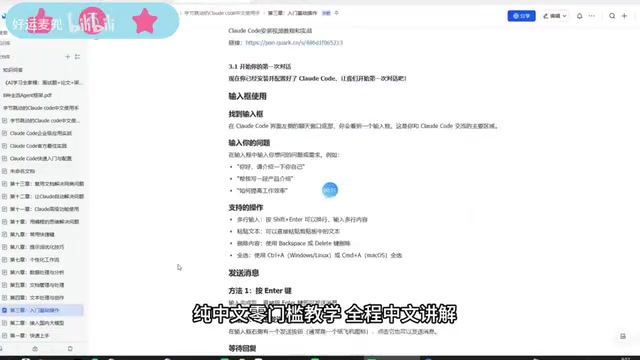
ByteDance Feishu releases Chinese Claude Code manual helping domestic users adopt AI coding tools with zero barriers
ByteDance's Feishu platform released a comprehensive Chinese practical manual for Claude Code, addressing domestic users' pain points with step-by-step Chinese guidance. The manual covers installation and configuration, domestic LLM adaptation (connecting to DeepSeek and others via OpenAI-compatible interfaces), multi-scenario applications (coding, copywriting, data analysis, automation), as well as Prompt templates and pitfall avoidance guides, suitable for programming beginners through working professionals.
Why You Need a Chinese Version of the Claude Code Manual
Claude Code is an AI programming tool launched by Anthropic. With its excellent code generation, debugging, and multi-scenario processing capabilities, it has become the go-to choice for many developers and productivity enthusiasts. However, the English-only official documentation and complex configuration process have kept many Chinese users from getting started.
Recently, ByteDance's Feishu platform released a Claude Code Chinese practical manual specifically designed for domestic users. From installation and configuration to advanced techniques, it provides step-by-step Chinese guidance with one clear goal — helping you get this AI tool up and running in the shortest time possible.
Claude Code Technical Background: Claude Code is developed by Anthropic based on the Claude large language model series. It uses the command line as its primary interface, capable of directly reading and modifying local files, executing shell commands, and deeply integrating with development tools like Git. Founded in 2021 by former core members of OpenAI, Anthropic focuses on AI safety research. The Claude model supports an ultra-long context window of up to 200K tokens and excels in code reasoning. Unlike IDE-integrated tools such as GitHub Copilot and Cursor, Claude Code is an "Agentic" programming assistant with autonomous execution capabilities — it can independently plan multi-step tasks, invoke tools, and modify code across files, representing a new direction in AI programming assistants evolving from "assistive suggestions" to "autonomous execution."
Key Highlights of the Manual
Pure Chinese, Zero-Barrier Learning
The most outstanding feature of this manual is its entirely Chinese instruction without dense technical jargon. For users who aren't comfortable reading English technical documentation, there's no more need to translate while operating. The manual breaks down every feature of Claude Code in plain language — even users with zero programming background can follow the steps from installation to actual use.
The AI programming tool market is highly competitive, with major players including GitHub Copilot (Microsoft/OpenAI), Cursor (an AI editor based on VS Code), Windsurf, and Claude Code. According to multiple developer surveys, over 70% of professional developers were using some form of AI programming assistance in their daily work by 2024. However, official documentation for these tools is almost exclusively in English, creating a significant barrier for Chinese users — which is precisely where a systematic Chinese manual provides its core value.
Domestic LLM Adaptation Solutions
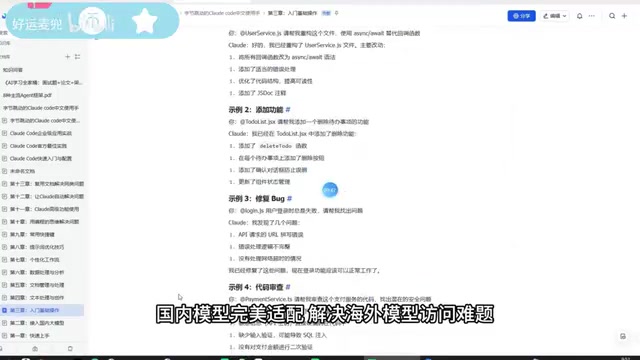
Access stability for overseas AI models has long troubled domestic users. This manual provides a complete solution for connecting with domestic large models, directly addressing real-world issues like network instability and access restrictions. By adapting to domestic models, the user experience becomes smoother, and daily operations can be completed using free quotas, significantly reducing costs.
Technical Principle Explained: Claude Code supports connecting to third-party model services compatible with the OpenAI interface specification by configuring custom API endpoints (Base URL) and API Keys. Mainstream domestic large models such as DeepSeek, Tongyi Qianwen, and Zhipu GLM all provide OpenAI-compatible interfaces — this means that with just a few configuration parameter changes, you can combine Claude Code's frontend interaction capabilities with the inference power of domestic models. The core of this architecture is "interface standardization": the Chat Completions API format established by OpenAI in 2023 has become the de facto industry standard, greatly lowering the technical barrier for model substitution. For domestic users, this not only solves network access stability issues but also allows full utilization of domestic models' free quotas or lower API costs.
Comprehensive Practical Guide Covering All Scenarios
The manual doesn't limit Claude Code to just writing code — it demonstrates its practical applications across multiple work scenarios:
- Code Development: Code generation, bug debugging, code review
- Content Creation: Marketing copy, product documentation, email writing
- Data Analysis: Data cleaning, report generation, trend analysis
- Work Automation: Repetitive task automation, workflow building
This comprehensive scenario coverage means Claude Code isn't exclusively for programmers — any professional can benefit from it. The general capabilities of large language models in natural language understanding and generation make them naturally suited to cross programming boundaries and penetrate into broader knowledge work scenarios like copywriting, analysis, and automation.
Manual Structure and Learning Path
Four Progressive Stages
The manual adopts a progressive structure, divided into four learning stages:
Stage 1: Environment Setup — Claude Code download and installation, basic configuration, domestic model integration, ensuring the tool runs properly.
Stage 2: Basic Operations — Usage methods for core features including common commands, conversation techniques, and file operations.
Stage 3: Advanced Techniques — Advanced approaches like custom templates, complex task decomposition, and multi-step workflows.
Stage 4: Practical Templates — Ready-to-use command templates and scenario examples that can be applied immediately after learning.
Pitfall Avoidance Guide and Efficiency Tips
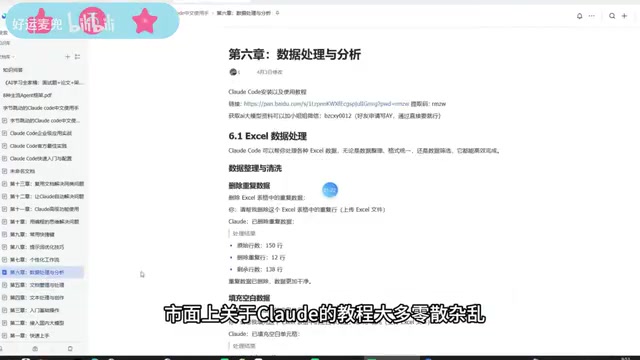
The manual compiles numerous common pitfalls that domestic users encounter in actual use — configuration errors, incorrect command syntax, inappropriate model selection, and other frequent issues, each accompanied by corresponding solutions. These experience summaries help you skip the ineffective trial-and-error phase and directly adopt verified best practices.
The Value of Prompt Engineering: The "custom templates" and "practical command templates" in the manual are essentially the practical results of Prompt Engineering. Prompt Engineering refers to the technical methodology of carefully designing input instructions to guide large language models toward more accurate outputs that better match expectations. Research shows that for the same task, optimized Prompts can improve model output quality by 30%-50% compared to casual input. Common optimization techniques include: Role Prompting, Chain-of-Thought, and Few-shot Learning. For users without technical backgrounds, directly using verified templates is the shortest path to quickly obtaining high-quality outputs, and is one of the most practically valuable parts of such Chinese manuals.
Who Is This For?
This Claude Code Chinese manual has a broad target audience:
- Programming Beginners: Want to use AI tools to learn programming or complete simple development tasks
- Working Professionals: Hope to use AI to improve daily work efficiency and reduce repetitive labor
- AI Tool Enthusiasts: Want to systematically understand Claude Code's complete capability boundaries
- Team Leaders: Considering promoting AI tools within their team and need standardized learning materials
Summary: How to Make the Most of This Manual
In today's era of rapidly iterating AI tools, the ability to efficiently master these tools is becoming a key variable in personal competitiveness. The core value of this Claude Code Chinese manual lies in: systematically organizing scattered usage experiences and completing localization adaptation for the actual environment of domestic users — including network access solutions, domestic model integration, and expression styles that match Chinese user habits.
The recommended approach is to progress step by step along the manual's learning path — first get the basic configuration sorted to ensure the tool works, then practice repeatedly in combination with actual work scenarios, gradually embedding AI tools into your daily workflow. Efficiency improvements won't happen overnight, but with systematic guidance, the learning curve becomes much shorter.
Related articles
 Tutorials
ChatGPT Plus Subscription Guide: Are GPT-5.5, image-2, and Codex Worth the Upgrade?
A detailed look at ChatGPT Plus features — GPT-5.5, image-2, and Codex — with a Plus vs Pro comparison and a complete step-by-step subscription guide for users outside the US.
 Tutorials
Harness AI Engineering in Practice: Using Claude Code to Master Enterprise-Level E-Commerce Development
Deep dive into Harness AI Engineering: master enterprise e-commerce development with Claude Code using the Rules, Skills, Wiki, and Changes framework.
 Tutorials
Cursor + Codex Dual-IDE Collaboration: A Practical Methodology for Open-Source Project Customization
A complete methodology for open-source project customization based on real-world experience, detailing the Cursor+Codex dual-IDE workflow, seven-stage process, MVP validation, and AI source code reading techniques.