Claude Code + DeepSeek in Practice: A Vibe Coding Tutorial for Building a Desktop Pet

Build a desktop pet from scratch using Claude Code with DeepSeek through Vibe Coding
A Bilibili content creator used Claude Code paired with DeepSeek to build a desktop pet from scratch through Vibe Coding — a concept coined by Karpathy where developers describe requirements in natural language and let AI handle the code implementation. Claude Code's 200K-token ultra-long context window and project-level awareness make it a key tool in this workflow, dramatically lowering the barrier to bringing creative ideas to life.
When AI Programming Meets Creativity: The Birth of a Desktop Pet
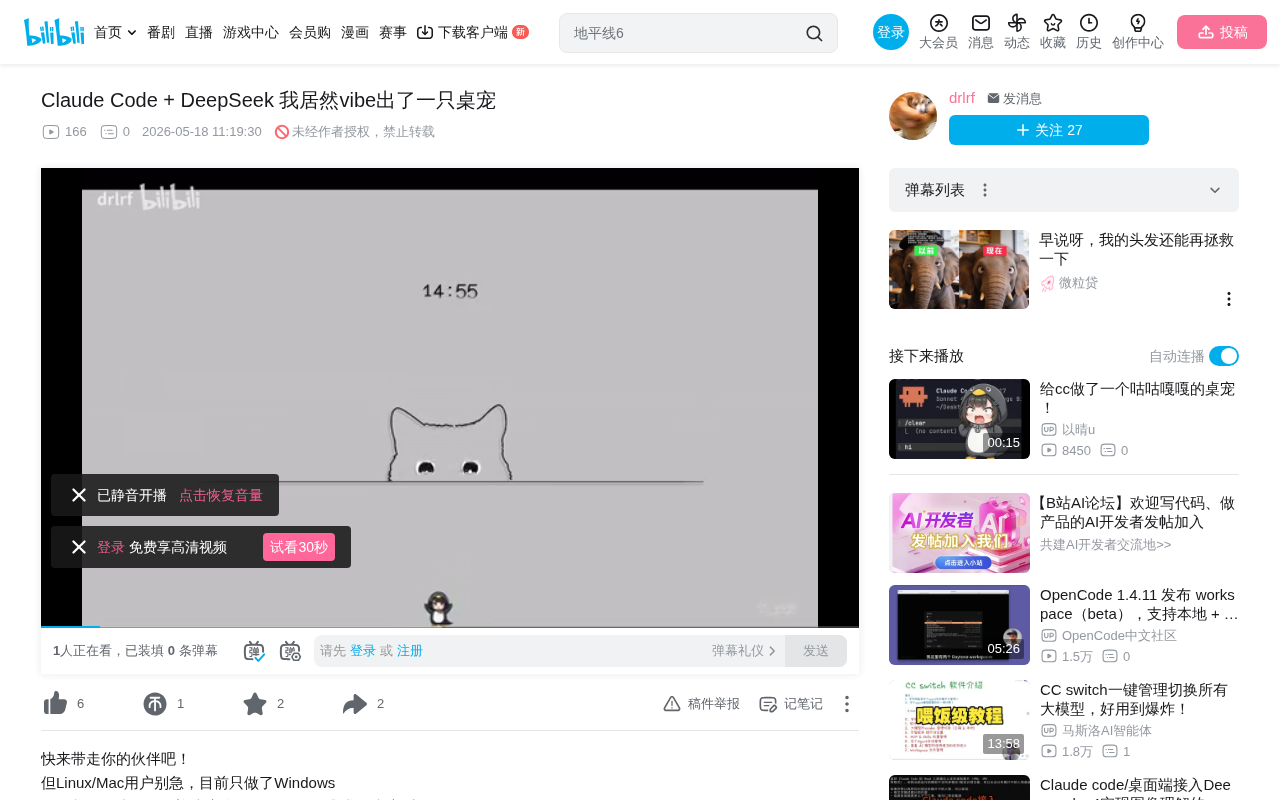
Recently, a Bilibili content creator shared a project that caught everyone's attention — using Claude Code paired with DeepSeek, they built a cute desktop pet from scratch through Vibe Coding. This case once again demonstrates that AI-assisted programming is dramatically lowering the barrier to turning creative ideas into reality, enabling more people to transform the concepts in their heads into working programs.
What Is Vibe Coding? The Core Philosophy of Ambient Programming
Vibe Coding is a concept introduced by Andrej Karpathy that has recently gained widespread popularity in the AI programming community. Karpathy himself is a leading figure in deep learning — former AI Director at Tesla, co-founder of OpenAI, and the instructor behind Stanford's CS231n course. He formally introduced this concept on social media in early 2025, against the backdrop of a quantum leap in large language models' code generation capabilities: models like GPT-4 and Claude 3 can now generate high-quality, runnable, complete programs, making the workflow of "humans describe intent, AI handles implementation" truly viable.
The core philosophy of Vibe Coding is simple: instead of writing code line by line, developers describe the desired outcome in natural language and let the AI generate the actual implementation. The developer plays the role of a "director" — proposing requirements, reviewing results, and adjusting direction.
Notably, when introducing this concept, Karpathy specifically emphasized the fundamental difference from traditional programming paradigms: traditional programming requires developers to constantly switch between the "problem domain" and the "implementation domain" — you need to simultaneously think about "what effect do I want" and "which API or data structure should I use to achieve it." Vibe Coding allows developers to stay entirely in the problem domain, offloading the cognitive burden of the implementation domain entirely to the AI. The feasibility of this philosophy is built on the scaling breakthrough of the Transformer architecture — once model parameters surpass the hundred-billion mark, code generation quality undergoes a qualitative leap, moving beyond simple pattern matching to genuinely understanding program semantics.
The essence of this programming approach is "going with the vibe." You don't need to master the precise implementation details of every technical aspect — you just need to clearly know what kind of end result you want, and the AI will handle all the tedious technical implementation for you.
The Combined Advantages of Claude Code and DeepSeek
Claude Code: A Code Generation Tool That Understands the Full Project Context
Claude Code is a command-line AI programming tool developed by Anthropic. It interacts directly with developers in the terminal, understands project context, and handles code generation, modification, and debugging. Its core technical advantage comes from an ultra-long context window (supporting up to 200K tokens) and deep understanding of code structure.
In engineering practice, a 200K token context window means Claude Code can "read in" approximately 150,000 lines of code at once — equivalent to the entire source code of a mid-sized commercial project. The underlying support for this capability is Anthropic's optimization of the attention mechanism — the attention computation complexity of traditional Transformers is O(n²), and long contexts bring exponential computational overhead. Through sparse attention and positional encoding improvements, Anthropic has made ultra-long context engineering-feasible. For developers, this means the AI assistant no longer "loses its memory" and can maintain a consistent understanding of the entire project throughout the conversation.
Unlike plugin-based tools such as GitHub Copilot, Claude Code runs as a command-line interface (CLI) tool. It can recursively read entire project directories, understand inter-file dependencies, and maintain global consistency when modifying code. This "project-level awareness"
Related articles
 Tutorials
ChatGPT Plus Subscription Guide: Are GPT-5.5, image-2, and Codex Worth the Upgrade?
A detailed look at ChatGPT Plus features — GPT-5.5, image-2, and Codex — with a Plus vs Pro comparison and a complete step-by-step subscription guide for users outside the US.
 Tutorials
Harness AI Engineering in Practice: Using Claude Code to Master Enterprise-Level E-Commerce Development
Deep dive into Harness AI Engineering: master enterprise e-commerce development with Claude Code using the Rules, Skills, Wiki, and Changes framework.
 Tutorials
Cursor + Codex Dual-IDE Collaboration: A Practical Methodology for Open-Source Project Customization
A complete methodology for open-source project customization based on real-world experience, detailing the Cursor+Codex dual-IDE workflow, seven-stage process, MVP validation, and AI source code reading techniques.