Claude Code + DeepSeek in Practice: Instantly Transform Natural Language into Analysis Plans and Code Frameworks

Use Claude Code + DeepSeek to instantly convert natural language research needs into analysis plans and code.
This article demonstrates how Claude Code combined with the DeepSeek model can transform natural language research requirements into structured analysis plans and executable code frameworks in minutes. The workflow requires only an empty folder and a terminal—paste your research question, and the AI automatically generates professional documentation and code, taking researchers from zero to seventy percent completion instantly.
Introduction: Let AI Take You from Requirements to Code in One Step
In academic research and data analysis, going from a vague research question to a clear analysis plan and executable code framework often requires significant time and effort. For researchers in fields like management and other social sciences, translating research hypotheses described in natural language into rigorous empirical analysis plans is itself a considerable hurdle.
Empirical research in management and other social science fields typically involves complex research designs, including variable operationalization, scale selection, sample size estimation, statistical model selection (such as hierarchical regression, structural equation modeling, panel data analysis, etc.), and robustness checks. Researchers are often proficient in theory building but face technical bottlenecks when converting hypotheses into specific statistical testing plans. The traditional approach is to consult methodology textbooks or statistical consultants—a process that can take days or even weeks.
Now, with Claude Code combined with the DeepSeek model, this process can be dramatically simplified—just paste your research requirements in natural language to the AI, and within minutes, a complete analysis plan document and code framework are automatically generated. This article will break down every step of this workflow in detail.
Technical Background: How Claude Code and DeepSeek Work Together
Claude Code is a command-line development tool released by Anthropic that allows users to interact conversationally with the Claude model directly in the terminal, with the ability to automatically read and write to the local file system. Unlike traditional web chat interfaces, Claude Code deeply integrates file operation capabilities, allowing it to create, modify, and organize files directly in the user's working directory. DeepSeek is a leading Chinese large language model that excels in code generation and logical reasoning. By configuring API routing, Claude Code can call the DeepSeek model as a backend inference engine, combining Claude Code's file operation framework with DeepSeek's reasoning capabilities to form an efficient localized workflow.
The advantage of this combination lies in: Claude Code provides an excellent interactive interface and file management capabilities, while the DeepSeek model offers outstanding comprehension in Chinese contexts and high-quality code generation. Together, they complement each other to form an AI-assisted development environment that is very friendly to Chinese-speaking users.
Hands-On Workflow: From an Empty Folder to a Complete Plan
Step 1: Prepare the Working Environment
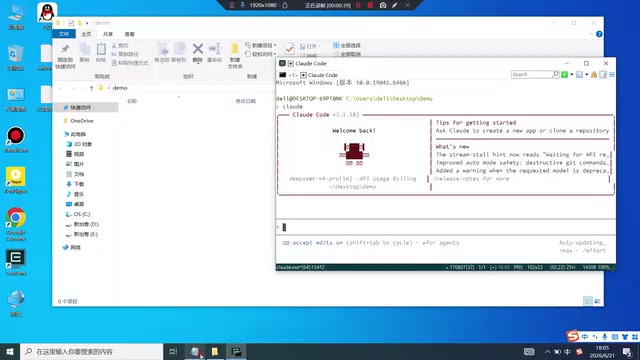
The entire operation is very straightforward. First, create a new empty folder on your desktop, navigate into the folder, open the terminal, and enter the command to invoke Claude Code.
The core idea here is: use Claude Code as a command-line interaction tool to pass the researcher's natural language requirements directly to the AI model for processing. No additional project configuration is needed—an empty folder is the starting point.
Step 2: Input Natural Language Research Requirements
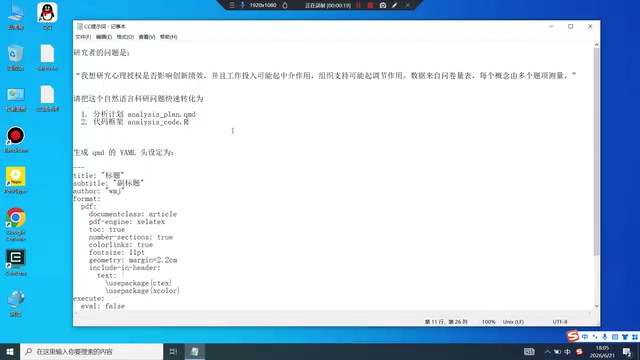
In the demonstration, an empirical research question from the management field was received. The researcher wanted to validate certain hypotheses through data analysis but was still at the natural language description stage.
Paste these requirements directly into the Claude Code terminal, then press Enter and wait for the AI to complete processing.
The key point of this step is: you don't need to pre-format your requirements or write any prompt templates—just throw the researcher's raw problem description to the AI. Claude Code will automatically understand the semantics and transform them into structured output. The reason large language models can accomplish this transformation is that they were exposed to massive amounts of academic papers, technical documentation, and code repositories during pre-training. The model identifies the type of research question, the statistical methods involved, and the analysis workflow through contextual understanding, then generates corresponding plans based on its internal knowledge representations. This process is essentially knowledge retrieval and recombination—the model maps inputs to the most likely output structures based on pattern matching.
Step 3: AI Automatically Generates Documents and Code
After a brief wait, you can see that several documents have been automatically generated in the previously empty folder, primarily including two core files: the execution plan and the code framework.
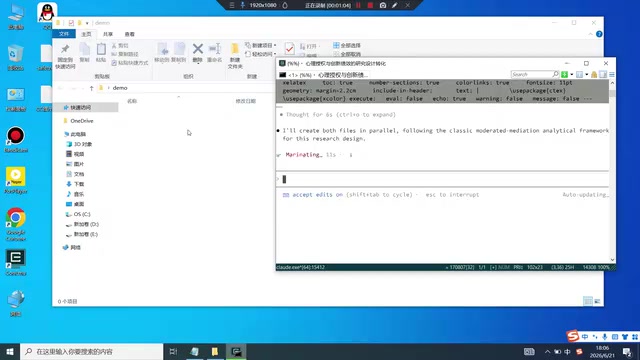
The entire process is fully automated. The AI not only understood the essence of the research question but also proactively split the output into a plan document and code files, with a very clear structure.
Output Quality: Analysis Plan and Code Framework in Detail
Content Quality of the Analysis Plan Document
Opening the generated analysis plan document, you can see the content is quite comprehensive:
- Research workflow is laid out very clearly, with explicit instructions for every step from data preparation to final analysis
- Formulas and code descriptions are complete, covering commonly used statistical methods in empirical analysis
- Tool and package recommendations are clearly listed, such as which R packages or Python libraries are needed
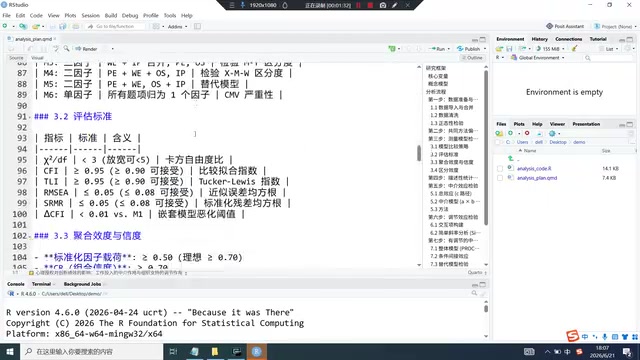
When the Markdown document is rendered to PDF, the entire analysis workflow and research framework are presented very professionally, fully usable as a first draft of a formal research proposal.
Practicality of the Code Framework
Beyond the analysis plan, the generated code framework also has high practical value. It's not a vague piece of pseudocode but includes specific data processing logic, model building steps, and result output formats. Researchers can directly fill in data and run debugging on this foundation.
The Core Value of This Workflow
Lowering the Barrier from "Idea" to "Execution"
For many social science researchers, the biggest pain point isn't a lack of research ideas but not knowing how to transform ideas into executable technical plans. The Claude Code + DeepSeek combination solves exactly this problem—it acts as a "technical translator," converting natural language research requirements into structured analysis plans and runnable code.
Providing a High-Quality Starting Point, Not a Final Answer
The AI-generated plan is not a ready-to-use final version but rather a high-quality starting point. As the executor, the researcher needs to trim, supplement, and refine the AI's output. This "AI drafts + human polishes" collaboration model ensures both efficiency and professionalism.
Applicable Scenarios Go Far Beyond Academic Research
Although the demonstration used a management empirical research case, this natural-language-to-code workflow has a very broad range of applications. Any scenario that requires going from requirement descriptions to analysis plans and code frameworks can benefit, including but not limited to:
- Empirical research design across all social science fields
- Technical planning for business data analysis projects
- Initial architecture setup for machine learning projects
- Technical roadmap planning for grant applications
Usage Considerations: The Boundaries of AI-Assisted Research
Although this workflow is extremely efficient, several key issues need attention. First, the model may recommend statistical methods unsuitable for specific data structures (such as using ordinary OLS regression on non-independent samples), and researchers must have basic methodological judgment. Second, the generated code may contain logical errors or call deprecated functions, requiring step-by-step debugging and verification during actual execution.
On the academic ethics front, researchers need to ensure they truly understand the analysis methods adopted rather than blindly relying on AI output. Most academic journals require authors to take full responsibility for research methods—AI tools can only serve as aids, not replacements. It's recommended to treat AI-generated plans as "intelligent references"—they provide direction and frameworks, but the final academic judgment must still be made by the researcher.
Conclusion: From Starting at Zero to Starting at Seventy Percent
Claude Code combined with the DeepSeek model provides researchers with a fast track from natural language to structured analysis plans. The entire workflow is minimally complex—create a folder, open the terminal, paste requirements, wait for generation—yet the output quality is remarkably professional. For researchers and practitioners who frequently need to design data analysis plans, this is an efficient workflow worth adding to your daily toolkit.
AI-generated content always requires human review and adjustment, but it truly transforms "starting from zero" into "starting from seventy percent," dramatically improving efficiency in the early planning stage. If you face similar requirement-to-execution challenges, give this combination a try.
Key Takeaways
Related articles

Network Doctor: An Open-Source Terminal Tool for Network Fault Diagnosis
Network Doctor is an open-source terminal network diagnostic tool that integrates ping, dig, curl, and traceroute, automatically detecting connectivity in stages and outputting fault conclusions in natural language.

LangChain Guardrails Explained: Building Safe and Controllable AI Agents
A detailed guide to LangChain Guardrails covering layered ecosystem architecture, middleware implementation, deterministic and model-driven protection for building production-grade secure AI Agents.

Deep Dive into Microsoft's AI Security Tools: Does Performance Really Surpass the Competition?
Microsoft launches enterprise AI security tools claiming superior performance. This deep analysis examines core capabilities, ecosystem advantages, and risks to guide enterprise security decisions.