Claude Code Enterprise Deployment Guide: Ecosystem Framework and Hands-On Configuration

Claude Code uses six extension points to build an ecosystem solving AI context management in large codebases.
This article provides a deep breakdown of Claude Code's deployment strategy for enterprise-scale large codebases. Facing million-line repositories, traditional RAG indexing suffers from freshness issues, while Claude Code employs agentic search to traverse the file system in real-time. Its core is an ecosystem framework built around the model, comprising six extension points: CLAUDE.md base context, Hooks for self-evolution, Skills for progressive disclosure, Plugins with LSP semantic understanding, MCP servers for external system connectivity, and sub-agents for safe isolation — collectively resolving the tension between limited context windows and massive codebases.
Introduction: When AI Coding Assistants Meet Million-Line Codebases
What happens when you drop an AI coding assistant into an enterprise repository with millions of lines of code? The answer is usually — it "blacks out." The model's context window gets blown out instantly, the suggestions it returns are completely off-base, and the functions it recommends were deleted by a colleague two weeks ago.
The context window refers to the maximum number of tokens a large language model can process in a single inference pass. Tokens are not equivalent to characters — code tends to have a lower compression ratio due to its symbol density. Even models with million-token context windows face an "attention dilution" problem when dealing with large codebases — as context grows longer, the model's attention to earlier content drops significantly, causing reasoning quality to degrade. This isn't a matter of insufficient AI capability, but rather the lack of a proper supporting architecture. This article provides a deep breakdown of Claude Code's deployment strategy for enterprise-scale large codebases, from underlying principles to hands-on configuration to organizational governance — a complete implementation blueprint.
Navigating Large Codebases: The Battle Between RAG Indexing and Agentic Search
Facing massive legacy systems — whether C, Java, or old PHP projects littered with global variables — getting AI to pinpoint issues accurately is like finding a needle in a haystack. Two fundamentally different technical approaches currently exist.
Traditional approach: Centralized RAG-based indexing. RAG (Retrieval-Augmented Generation) is a technical architecture that combines external knowledge bases with large language models. It works by pre-converting documents or code into high-dimensional embedding vectors stored in a vector database, then retrieving the most relevant snippets to inject into the context at inference time. This approach performs well in static knowledge base scenarios, but in codebases — environments with frequent changes — drift between the index and actual code is nearly unavoidable. The fatal flaw lies in index freshness. When team members commit code frequently, the index quickly becomes stale, and the AI will confidently recommend functions or interfaces that no longer exist.
Claude Code's approach: Agentic search. It traverses the file system in real-time on the local machine, working like an engineer sitting right next to you — reading files, using grep to find keywords, and following code references down the rabbit hole. No complex embedding pipelines to maintain.
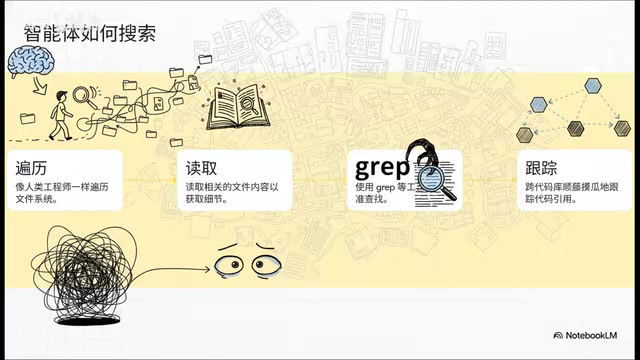
But the key issue is: it must have clear initial context. An AI without directional guidance will thrash around aimlessly in a billion-line codebase, blowing out the context window instantly. This brings us to the real core — the ecosystem framework.
The Ecosystem Framework: Core Architecture for Enterprise AI Coding
A common misconception needs to be shattered here: In enterprise environments, never fixate solely on model benchmarks. What truly determines how well AI performs in real business scenarios is the surrounding ecosystem built around the model.
This ecosystem consists of six extension points, forming a complete architectural blueprint:
- CLAUDE.md context files: Base configuration loaded with every session
- Hooks: Event-triggered automation workflows
- Skills: On-demand professional knowledge packages
- Plugins + LSP: Always-on capability enhancement layer
- MCP Servers: Bridges connecting external tools and systems
- Sub-agents: Independent exploration instances invoked on demand
Deep Dive into the Six Extension Points
CLAUDE.md: Base Context for Every Session
CLAUDE.md is automatically loaded at the start of every session, providing the AI with a big-picture view and specific coding standards. But there's an iron rule here: keep the content lean.
Since it's loaded every single time, if the content isn't concise enough, it becomes dead weight that drags down the performance of every subsequent tool call and task execution. The recommendation is to include only the most essential architectural overview and hard rules that must never be violated.
Hooks: Giving the System Self-Evolution Capabilities
Hooks grant the entire system powerful adaptive capabilities — an exceptionally elegant design:
- Stop Hook: At the end of each session, while the lessons from pitfalls the AI just encountered are still fresh, it automatically proposes updates to CLAUDE.md, crystallizing experience into institutional knowledge
- Start Hook: Automatically loads the freshest contextual information, eliminating tedious manual checks
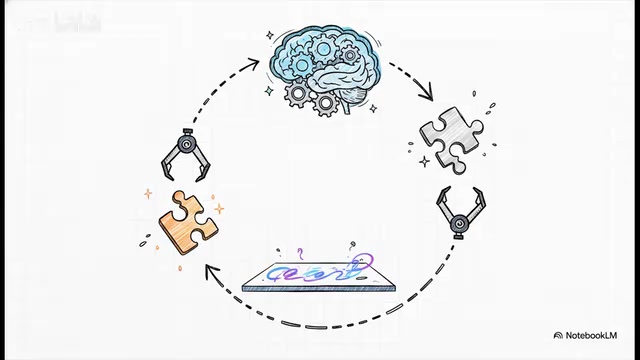
This means the system continuously evolves with use, rather than remaining stuck at its initial configuration level.
Skills: Progressive Disclosure to Prevent Context Overflow
In large codebases, force-feeding the AI all rules and standards at once is an absolute disaster. The Skills mechanism elegantly solves this through Progressive Disclosure.
Progressive disclosure is a concept originating from user experience design. Its core idea is to present information in layers based on need, avoiding the cognitive overload caused by exposing all complexity at once. Applied to AI context management, it addresses the same class of problem: limited "attention resources" should be prioritized for information most relevant to the current task, while other content remains on standby rather than continuously occupying window space.
Security audit guidelines, specific deployment paths, coding standards for particular modules — these packaged professional knowledge sets are only loaded when actually needed. This effectively prevents the context from being stuffed with irrelevant information, preserving the limited window space for what truly matters.
Plugin System and LSP: From Individual Productivity to Organization-Wide Amplification
If the previous components are about building a personal assistant, then the plugin system is an efficiency multiplier for the entire organization. It bundles and distributes useful configurations, completely eliminating "tribal knowledge" that exists only in individual engineers' heads.
LSP (Language Server Protocol) is a standardized protocol proposed and open-sourced by Microsoft in 2016, originally designed for VS Code and later adopted by virtually every mainstream editor. It decouples language analysis capabilities (such as code completion, go-to-definition, and find-references) from the editor, providing them via independent language server processes. For AI coding assistants, connecting to LSP means gaining compiler-level semantic understanding rather than relying on regex or fuzzy text matching. For strongly-typed projects like C++, LSP directly eliminates the noise from basic text searches, giving Claude Code type-level precision to accurately lock onto function definitions and reference chains.
MCP Servers: Connecting Internal Enterprise Systems
MCP (Model Context Protocol) is an open standard protocol released by Anthropic in late 2024, aimed at solving the fragmentation problem of integrating AI models with external tools and data sources. Analogous to how USB-C unified hardware interfaces, MCP attempts to establish a unified specification for AI-to-external-system interactions — through standardized protocol interfaces, developers can expose any data source or tool to AI models without developing separate adaptation layers for each model.
MCP servers act as bridges, seamlessly connecting Claude Code with internal company documentation, ticketing systems, and monitoring platforms. The AI coding assistant can directly query Jira tickets, read Confluence documents, and pull monitoring data without engineers manually copying and pasting context.
Sub-agents: Safe Isolation Between Exploration and Execution
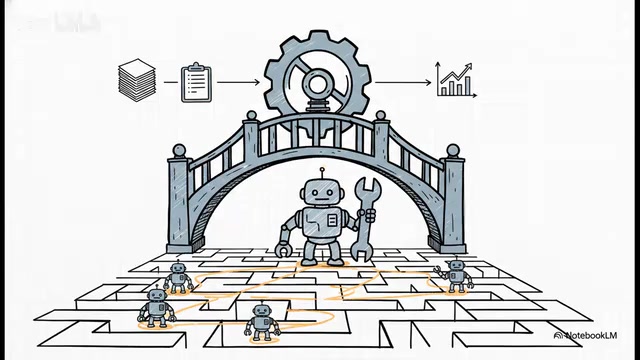
The sub-agent design is even more ingenious — it isolates exploration tasks from modification tasks. The main agent can first dispatch multiple independent Claude instances in parallel to "scout" and understand the state of various subsystems, then concentrate on "making changes" only after the full picture is clear.
Related articles
 Tutorials
ChatGPT Plus Subscription Guide: Are GPT-5.5, image-2, and Codex Worth the Upgrade?
A detailed look at ChatGPT Plus features — GPT-5.5, image-2, and Codex — with a Plus vs Pro comparison and a complete step-by-step subscription guide for users outside the US.
 Tutorials
Harness AI Engineering in Practice: Using Claude Code to Master Enterprise-Level E-Commerce Development
Deep dive into Harness AI Engineering: master enterprise e-commerce development with Claude Code using the Rules, Skills, Wiki, and Changes framework.
 Tutorials
Cursor + Codex Dual-IDE Collaboration: A Practical Methodology for Open-Source Project Customization
A complete methodology for open-source project customization based on real-world experience, detailing the Cursor+Codex dual-IDE workflow, seven-stage process, MVP validation, and AI source code reading techniques.