Claude Code In-Depth: How Vibe Coding Is Reshaping AI Programming

Claude Code uses project-level context and automatic error correction to move AI programming from code completion to task takeover.
Based on Bilibili creator Bao Ge's livestream, the article outlines Claude Code's core differences from web-based conversational coding: it reads the entire project as context and automatically corrects errors to deliver runnable code. After comparing Copilot, Cursor, TRAE, and OpenCode, the creator considers Claude Code more accurate, though this view is subjective and based on limited experience with Codex. The article further argues that Vibe Coding depends on model reliability, that accuracy determines whether efficiency improves or rework ensues, and that Claude Code has a low installation barrier yet few people have actually used it, while tool selection must also weigh invocation cost and network availability.
AI coding assistants are undergoing a highly visible round of iteration. From early code-completion plugins to Agent-style tools that can autonomously read and write project files, the way developers interact with code has fundamentally changed. In a live public class, Bilibili creator "Bao Ge" gave a hands-on presentation centered on Claude Code and compared it side by side with Copilot, Cursor, TRAE, OpenCode, and other tools. Based on the core points of that talk and the broader evolution of AI coding tools, this article attempts to sort out what exactly Claude Code has changed.
From Conversational Coding to Project-Level Agents
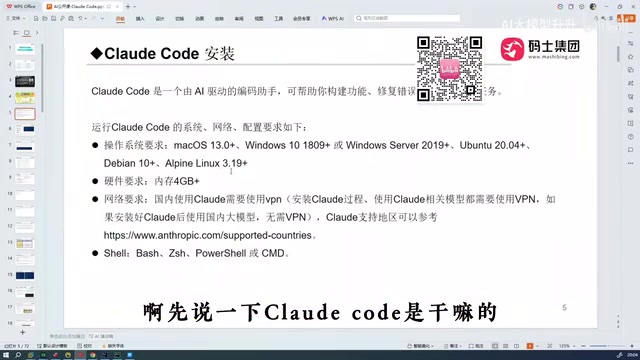
During the livestream, the creator repeatedly emphasized one distinction: writing code in a web chat with DeepSeekAd or ChatGPT is a different working mode from running Claude Code in an IDE. The former gives you code snippets that you must paste, run, and debug yourself, then paste the error back to continue the conversation; the latter can directly read the project directory and feed multiple files to the model as context, generating code that fits the current project structure.
At first glance, this difference sounds like merely "a bit more convenient," but its real impact is significant. The bottleneck of conversational coding is the context window—the model cannot see the full picture of your project and can only reason locally based on the snippets you manually paste. Tools like Claude Code, by contrast, make "reading the project" a default action, and the amount of information the model receives is on a completely different order. The creator's judgment is that Claude Code can read through all project content and use it as context, and can automatically adjust errors after generation to ultimately deliver a runnable version.
Context Window is the upper limit on the total number of tokens a large model can process in a single inference; a token roughly corresponds to an English word or part of a Chinese character. In conversational coding, the snippets developers manually paste are often only a few hundred to a few thousand tokens, so the model sees only local code; tools like Claude Code, however, pack multiple files from the project directory, dependency declarations, and even the directory structure into the context, often consuming tens of thousands of tokens. This explains the gap in output quality between the two: the more complete the engineering information the model sees, the less likely it is to generate code that conflicts with existing function signatures and naming conventions. The size of the context window also directly determines how large a project the tool can "understand"; content beyond the window usually needs to be compressed through retrieval or summarization strategies.
Side-by-Side Comparison: Copilot, Cursor, TRAE, and OpenCode
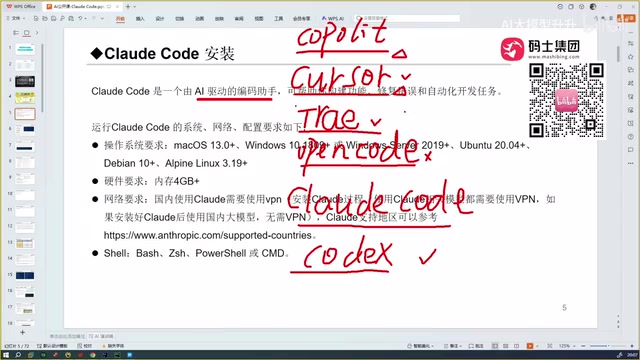
The livestream included a fairly candid review of tools. The creator回顾ed his own usage path: he first used Copilot and felt its completion capability was disruptive; after Cursor appeared, automated coding took another step forward; the domestic version of TRAE was free and understood Chinese well, and for a time he considered it the handiest tool; OpenCode he directly called "one of the harder-to-use programming tools of all."
The turning point came after using Claude Code. In his words, after encountering Claude Code he no longer considered TRAE the most perfect, and Claude Code was "one level above TRAE." The reason comes down to the large model itself—the capability ceiling of every coding assistant depends on the model behind it, and the Sonnet series models called by Claude Code perform outstandingly in code-generation accuracy. He also mentioned that Codex (configured with GPT-5) is likewise very strong and is widely regarded in the industry as comparable to Claude Code, though his own hands-on experience with Codex is limited.
You may not have noticed that the creator's assessment of TRAE was that "being free is an advantage, but less common tech stacks come out rather poorly." This actually points to a real issue: the gap in model capability between free and paid tools is directly reflected in code quality in edge cases.
The Sonnet series mentioned in the article is a branch of Anthropic's Claude models, positioned to balance capability and cost and often used for programming, long-document processing, and similar tasks; Codex is OpenAI's code model series, and GPT-5 is the codename for its subsequent general-purpose model. It should be noted that such model versions iterate extremely quickly, and specific version numbers and capability rankings can change within months, so conclusions about "which model writes code better" are time-sensitive. Differences at the tool level (such as context management strategies, file read/write permissions, and error-correction loop design) also affect the final experience and cannot simply be attributed to the underlying model.
The Essence of Vibe Coding: Accuracy Determines the Experience
When an audience member asked during the livestream where Claude Code's advantage over Cursor lies, the creator's answer was direct: accuracy. All these tools can achieve automated programming, but the perceived difference in use centers on "whether a single generation can run successfully."
Behind this is the core contradiction of the concept of Vibe Coding. So-called Vibe Coding refers to a way of working in which developers describe intent in natural language, AI completes the implementation, and humans play more of a reviewer role. Its premise is that the model is reliable enough—if the generated code requires extensive rework, then so-called "vibe programming" degenerates into more cumbersome conversational debugging. The creator mentioned that "programmers will feel a deep sense of crisis after using it," and the subtext of that statement is that when tools can autonomously read, write, and correct errors at the project level, the value anchor of junior coding work is shifting.
Vibe Coding was coined by Andrej Karpathy in early 2025 to describe a way of programming in which one is "fully immersed in the vibe": developers describe requirements in natural language, accept AI-generated code without reviewing it line by line, and when errors occur, throw the error message back to the model to continue iterating. It differs from traditional "AI-assisted completion" in that the human shifts from writing code to describing intent and accepting results. This mode significantly amplifies the demand for model reliability—if a single generation runs successfully, efficiency multiplies; if repeated rework is needed, debugging costs exceed writing by hand. Industry discussion often distinguishes it from "AI pair programming," which still emphasizes human review of every line of output.
Barriers to Entry and Target Users
One easily overlooked piece of information is that Claude Code's installation barrier is not high. At the opening, the creator pointed out that this tool does not require logging into any website; you install it directly on your local computer and then call it from your development tools. It has system requirements, but the vast majority of mainstream systems are supported.
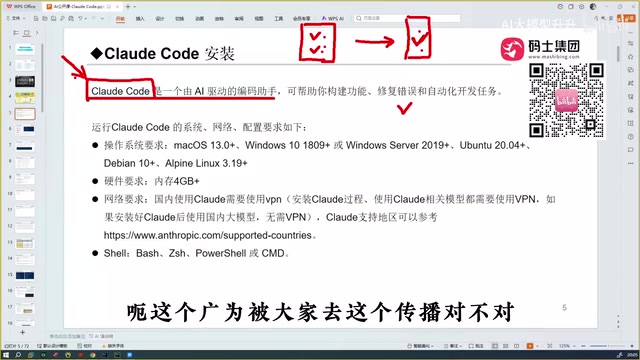
During the livestream he conducted an on-the-spot survey: he asked the audience whether they had used Claude Code—those who had typed 6, those who had not typed 0—and the result was that "quite a lot have not used it." This reflects a perception gap: the tool is widely discussed in technical communities, but the proportion of people who have actually tried it is not high. For complete beginners, the creator's advice is to get it running first rather than struggling through the principles.
The livestream also mentioned accompanying learning resources, including class notes from a four-day bootcamp, hands-on code, the DeepSeek paper, an interview guide号称 to be more than 2.2 million words, and beginner courses on Java and artificial intelligence. This part is course-promotion content and should be viewed separately from the technical discussion of the tool itself.
A Few Sober Judgments
The information density of this talk was not low, but there are several points readers need to weigh for themselves.
The comparison of model capabilities carries a strong subjective, experiential flavor. The creator admitted that he "uses foreign ones relatively little" and has limited hands-on experience with Codex, so the conclusion that Claude Code is the strongest is closer to personal preference than to rigorous evaluation. The accuracy dimension is also hard to illustrate with a single case; performance may differ across tech stacks and project sizes.
In addition, the invocation cost of the model behind Claude Code and its usability in the domestic network environment were not elaborated on in the livestream. These factors affect real-world adoption no less than model capability. Tool selection must ultimately come back to your own project type, budget, and team collaboration style, rather than simply comparing leaderboards.
One judgment, however, does hold: AI coding assistants have evolved from "completing a line of code" to "taking over a task," and developers' core skills are shifting from writing code to describing requirements, reviewing output, and controlling architecture. This trend will not change because of the strength or weakness of any specific tool.
One-line Summary
Through project-level context and automatic error correction, Claude Code pushes AI programming from code completion to taking over tasks.
Paragraph Summary
Based on a livestream by Bilibili creator "Bao Ge," the article outlines the core differences between Claude Code and web-based conversational coding: it can read an entire project as context and automatically adjust errors after generation to output a runnable version. After comparing Copilot, Cursor, TRAE, and OpenCode, the creator considers Claude Code more accurate, but this conclusion is subjective and based on limited hands-on experience with Codex. The article further discusses that Vibe Coding's premise is model reliability, and accuracy directly determines whether efficiency improves or rework ensues, noting that Claude Code's local installation barrier is low yet few people have actually used it, and tool selection must also consider invocation cost and network availability.
Related articles

Second-Model Review in Practice: What 40 Comments Reveal About AI Review's Real Value
A test of seven articles and forty review comments reveals AI second-model review's real value: strong at reconciliation, not judgment; catches unbounded claims, but usability is only 38%, with false positives stemming from missing context.

APSD: Asymmetric Distillation by Correctness for 2.6x Faster LLM Post-Training
APSD proposes a correctness-dependent asymmetric self-distillation objective: interpolation preserves successful behavior on correct rollouts, extrapolation strengthens correction on incorrect ones, reaching SDPO-level performance on Qwen3 with 2.6x fewer training steps.

LP-SMC: Improving Diffusion Language Model Inference with Lineage-Preserving Resampling
LP-SMC introduces lineage-preserving SMC resampling with Chopthin resampling and input weight floors, boosting oracle coverage by up to 25.6 points and end-to-end accuracy by up to 18.3 points on diffusion language models for math reasoning and code generation, without additional training.