Claude Code in Practice: Multi-Model Comparison and Token Cost Control
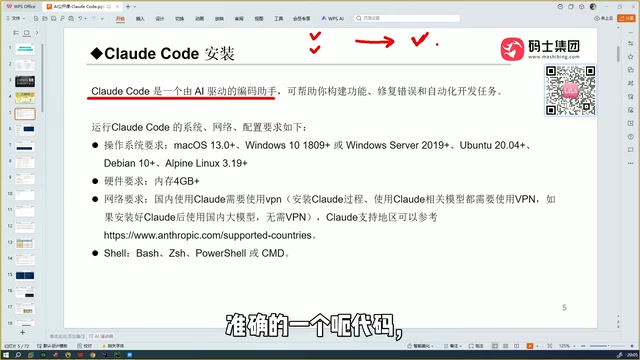
Claude Code leads with project-level context and auto-debugging, but multi-model trade-offs and token costs must be weighed.
Based on a public course, this article outlines Claude Code's core features: as a locally installed coding assistant, it can read the entire project as context and auto-debug, generating runnable code and standing out in accuracy compared with conversational generation. It reviews the evolution of coding assistants from Copilot, Cursor, and Trae to Claude Code and Codex, noting that tool capability ultimately depends on the underlying LLM, with Sonnet behind Claude Code performing notably well. On multi-model configuration, it emphasizes balancing code accuracy against token consumption and choosing models by task complexity, and also introduces packaging common functions via Skills to reduce configuration costs and facilitate team reuse.
Claude Code has recently generated a lot of buzz in the developer community, and many programmers have even felt a "deep sense of crisis" after trying it. What exactly makes it so powerful? How does it differ from tools like Copilot and Cursor? How do you configure multiple models and control token costs in real projects? This article, based on the content of a public course and supplemented with demo screenshots, distills the key points.
Claude Code's Core Capability: Reading the Whole Project and Auto-Debugging
Unlike generating code snippets directly in chat interfaces such as DeepSeekAd or ChatGPT, Claude Code is a locally installed coding assistant that can be used directly within your development tools without logging into a website. Its core difference lies in its ability to read through the entire project, feed it to the LLM as context, and thereby generate code that fits the business logic. According to the instructor's demo, it can also debug automatically and ultimately deliver an accurate, error-free version of the code. This automated development capability is what sets it apart from traditional conversational programming.
As seen in the demo, the code generated by Claude Code can run directly, reducing the back-and-forth of conversational debugging. The instructor emphasized that this capability makes it stand out in terms of accuracy, which is also why it has spread so widely.
Project-level context is the key concept for understanding what makes Claude Code different. Traditional conversational assistants (such as the ChatGPT web version) can only see code snippets that users manually paste in, and the context window is determined by the conversation content; Claude Code, by contrast, runs in the local terminal or IDE, actively scans the project directory, reads relevant source files, configuration files, and even dependency manifests, and assembles this content into the LLM's context window as needed. This allows the model to be aware of the project's existing naming conventions, directory structure, and business entities when generating code, rather than fabricating code with a disjointed style. The trade-off is greater context window consumption; long projects need retrieval and pruning strategies to control how much content is fed to the model, which is one of the root causes of the token cost issue discussed later.
The Evolution of Coding Assistants: From Copilot to Claude Code
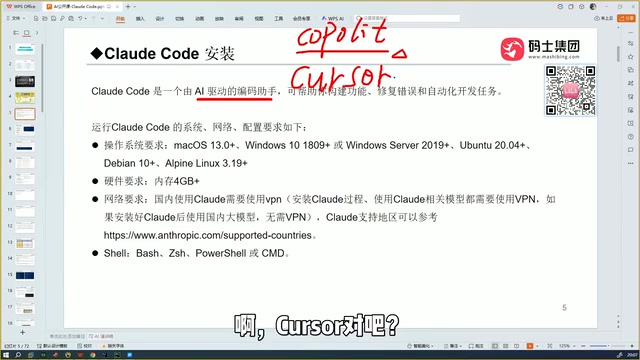
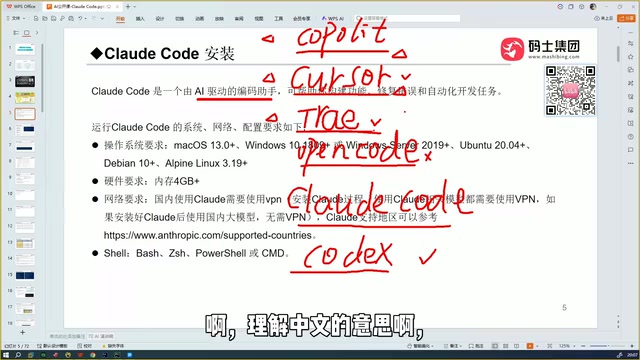
Looking back at the development of coding assistants, Copilot, as an early plugin, delivered a disruptive experience in code autocompletion; then Cursor emerged with a higher degree of intelligence and the ability to code automatically; after that came Trae, available in international and domestic versions, with the domestic version being free and having a solid understanding of Chinese. The instructor's personal experience is that Trae performs well in Chinese scenarios, but after encountering Claude Code, he considers the latter superior.
In addition, Codex was also mentioned; after configuring the OpenAI model, its coding capability can rival Claude Code. OpenCode, meanwhile, was described as "rather difficult to use" and not recommended. The instructor concluded that the capabilities of these tools ultimately depend on the underlying LLMs, and the Sonnet model behind Claude Code is quite powerful, with even stronger models yet to be introduced.
Multi-Model Configuration and Token Cost Considerations
The public course mentioned that Claude Code supports configuring multiple models. After comparing various models (including domestic ones), the instructor's impression is that Claude Code paired with its native model has a clear advantage in accuracy. Although the materials did not provide specific token cost figures, it can be inferred that using stronger models means higher token consumption. For developers, there is a trade-off between code accuracy and cost. The instructor recommends choosing an appropriate model based on task complexity to avoid excessive token consumption on simple tasks.
In practice, installing Claude Code has certain system requirements, but the vast majority of systems support it. Once installed, it can be invoked within development tools without additional website logins. This localized approach also makes it easier to manage API keys and switch models.
Token is the basic unit of measurement for text processed by LLMs; in English, roughly 4 characters correspond to 1 token, while in Chinese, one character usually corresponds to 1 to 2 tokens. The cost of a single request is determined jointly by input tokens (the context fed to the model) and output tokens (the code and explanations generated by the model), and the input side often accounts for the bulk because it must carry project files. Project-level tools like Claude Code may attach thousands to tens of thousands of tokens of context with each call, so the cost is significantly higher than a single-turn conversation. In practice, overhead can be controlled in three ways: configuring models at different price points for different tasks, routing simple tasks to lightweight models, and reducing repeated input through streamlined context and caching mechanisms. Only by understanding this billing structure can you rationally judge "whether a stronger model is worth it."
Model Selection and Skill Packaging Approaches
The instructor mentioned that Claude Code can connect to models such as DeepSeek V4 Pro and package common functions through Skills. Although the materials did not elaborate on the specific packaging steps, a Skill can be understood as a way to modularize repetitive tasks for team reuse. For scenarios that require frequent model switching, packaging can reduce configuration costs.
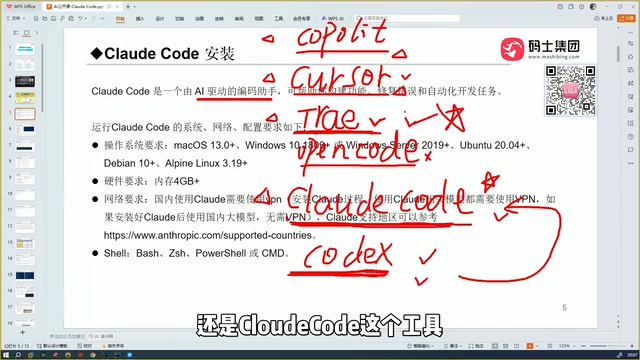
From the demo screenshot's title "Claude Code is still the best tool and model," it is clear that the instructor ultimately leans toward the overall experience of Claude Code. However, he also acknowledges that tools like Codex are equally excellent, and the choice depends on specific needs. For domestic developers, Trae's free pricing and Chinese optimization remain attractive.
A Skill can be understood as a reusable instruction package: it packages the prompts, operating steps, reference files, and invocation conventions for a certain type of task into a module that can be loaded by name when needed, rather than restating the requirements each time. Its difference from traditional "prompt templates" is that a Skill usually also includes trigger conditions and execution flow descriptions, and the model decides on its own when to invoke it. For teams, this is equivalent to solidifying the experience of senior developers in handling a certain type of task into a standard component, so new members don't have to figure it out from scratch; for individuals, it reduces the token consumption caused by repeated input. It should be noted that the quality of a Skill is highly dependent on whether its description is precise, and vague packaging can instead increase the probability of model misjudgment.
Summary and Recommendations
Claude Code's core advantages lie in project-level context understanding and auto-debugging, making it suitable for scenarios that require high-quality code generation. Multi-model configuration provides flexibility, but token costs need attention. Beginners can start with free tools like Trae and migrate to Claude Code once familiar. For teams, consider standardizing workflows through Skill packaging. Ultimately, tool selection should be based on a comprehensive judgment of factors such as accuracy, cost, and Chinese language support.
(Note: This article is compiled based on the content of a public course. For specific configuration details, please refer to the official documentation.)
Related articles
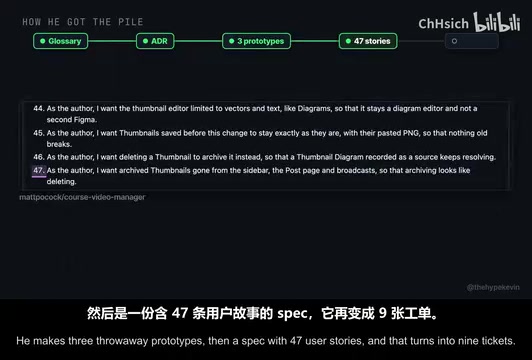
How to Review a 22,505-Line PR? Matt Pocock's Stacked PRs and Ratchet Rules
Matt Pocock split a 22,505-line agent PR into 9 stacked PRs, used a two-way/one-way door framework to isolate the DB change, and enforced ratcheted lint rules and retro.
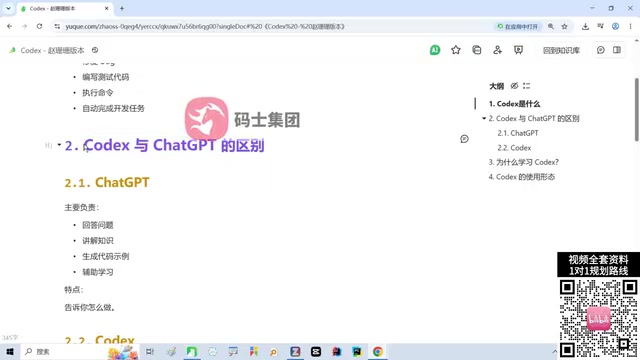
Codex from Beginner to Practitioner: A Complete Analysis of AI Coding Agents
An analysis of OpenAI's coding agent Codex: its positioning, its key difference from ChatGPT (talking vs doing), and why developers should learn it, covering setup, multitasking, automation, and MCP.
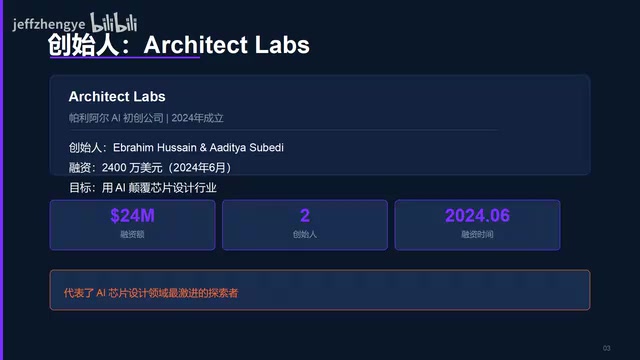
AI Independently Designs CPU Architecture 'Frostbite': 4.59x Energy Efficiency Boost
AI independently designed the complete CPU architecture Frostbite, achieving 4.59x better energy efficiency and 8.77x better performance per unit area. This article analyzes Architect Labs' technical path, five-step design flow, foreign media commentary, and current limitations, exploring the potential impact of AI chip design on Intel, AMD, and the RISC-V ecosystem.