Claude Code Investment Research Tool: A Detailed Guide to AStockData Skill's Six Free Data Modules for China A-Shares

AStockData Skill wraps all A-share data for free, accessible via natural language.
AStockData is a Claude Code Skill that integrates six major categories of A-share data (market quotes, research reports, trading signals, etc.) into a single package — entirely free with no API Key required. Users can have the AI Agent automatically fetch K-lines, order book data, research report PDFs, Dragon Tiger List entries, northbound capital flows, and more through natural language commands, dramatically lowering the data access barrier for retail investors and independent researchers while bridging the longstanding data gap between institutions and individuals.
Overview: One Skill to Access All A-Share Data
Quantitative investment research and AI Agent-assisted stock trading have been gaining significant traction in recent years, but anyone who has actually rolled up their sleeves knows that data sources are the first problem to solve. Free APIs are either unstable or limited in coverage, while paid APIs aren't exactly friendly to retail investors and independent researchers.
Data access for A-share quantitative research has long suffered from a clear institutional-retail divide. Professional data terminals like Wind and Bloomberg charge annual fees of tens of thousands of yuan, primarily serving institutional clients. Quantitative platforms like JoinQuant, RiceQuant, and Goldminer offer free tiers, but data calls have rate limits and are typically locked within their own backtesting environments, making flexible integration into custom workflows difficult. Open-source solutions like tushare offer broad coverage but require a credit system, with some high-frequency data behind paywalls. This ecosystem gap has driven sustained interest from independent researchers in tools that aggregate free public APIs.
Recently, a Claude Code Skill called AStockData hit 100 stars on GitHub within a single day of launch, generating considerable buzz in the investment research community.
Its core value proposition is straightforward: it integrates six major categories of A-share data into a single Skill, all free and requiring no API Key. Once installed, you simply tell Claude Code what data you want in natural language, and the Agent automatically fetches and organizes it. For users doing daily stock analysis, strategy backtesting, or research report reading, the efficiency gains are tangible.
What is a Claude Code Skill? Claude Code is Anthropic's AI programming Agent that runs in the terminal environment, capable of reading/writing files, executing code, and calling external APIs. A Skill is a functional module built on top of this foundation — developers can package domain-specific tools, interfaces, and prompts into Skills and publish them to the Skill Hub, where other users can install and invoke these capabilities directly within Claude Code conversations. This design is similar to VS Code's plugin ecosystem, extending Claude Code from a general programming assistant into a specialized tool for vertical domains. AStockData leverages this mechanism to unify scattered A-share data APIs, so users don't need to understand underlying API details — they simply describe their needs in natural language, and Claude Code automatically selects the appropriate data interface, constructs requests, parses responses, and organizes the output.
Let's break down each of the six data modules to see what it can actually do.
Market Data Layer: From K-Lines to Real-Time Order Book
Market data is the most fundamental need in investment research, and AStockData provides fairly comprehensive coverage in this area:
- K-Line Data: Supports daily, weekly, monthly, and minute-level K-lines, covering everything from long-term trend analysis to short-term trading backtests
- Level-2 Order Book: Real-time five-level bid/ask queue data, very useful for order book microstructure analysis
- Real-Time Quotation Metrics: Common valuation and liquidity indicators including PE (Price-to-Earnings), PB (Price-to-Book), total market cap, and turnover rate
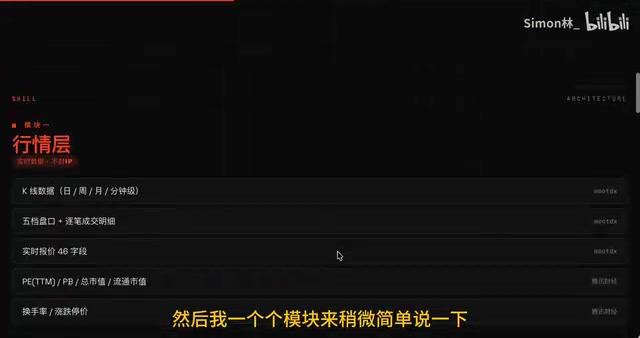
What's the advantage of having this data encapsulated in a Skill? You can simply say in Claude Code, "Pull the last 60 trading days of daily K-lines and PE trend for Kweichow Moutai," and the Agent automatically handles data retrieval and organization — saving you the hassle of writing scrapers or integrating APIs yourself.
Research Report Layer: Direct PDF Report Downloads
The research report layer is one of the Skill's standout features, offering two main capabilities:
- Research Report PDF Downloads: Automatically fetches and downloads broker research report PDFs through East Money's channel interface
- iWenCai Search: Integrates iWenCai's research report search functionality, supporting searches by keyword, industry, individual stock, and other dimensions
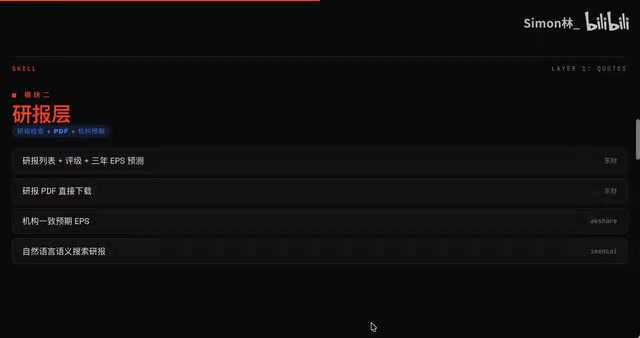
Anyone who has done investment research knows that reading research reports is one of the most time-consuming tasks. With this interface, combined with Claude's strong PDF parsing and long-text comprehension capabilities, you can have the Agent automatically download the latest reports for a given industry and extract core viewpoints and earnings forecast data. For example, asking it to "download broker research reports on the photovoltaic industry from the past week and compile each firm's forecasts for 2025 installation capacity" — the entire workflow can complete in just a few minutes.
Behind this capability is the mature evolution of AI Agent-assisted investment research methodologies. Early approaches mainly used large language models for report summarization and Q&A, representing passive retrieval-augmented information access. As tool-calling capabilities (Function Calling/Tool Use) have matured, next-generation approaches have begun letting AI proactively call data interfaces, execute code, and iterate on analysis, forming truly automated workflows — the complete pipeline of "fetch reports → parse PDFs → extract key data → cross-compare → generate summary reports" can now be automated end-to-end.
Signal Layer: Capturing Market Anomalies
The signal layer targets trading decisions, integrating several categories of high-value market anomaly and capital flow data:
- Dragon Tiger List Data: Daily details of institutional and prominent retail trader seat buying/selling for listed stocks
- Northbound Capital: Inflow/outflow data from Stock Connect northbound funds, an important reference for tracking foreign capital movements
- Daily Strong Stock Attribution: Not just telling you which stocks performed well, but analyzing the driving factors — whether it's policy catalysts, earnings beats, or capital crowding

The Dragon Tiger List is a disclosure mechanism unique to A-shares. Under exchange rules, when a stock's daily price deviation reaches 7%, daily turnover rate hits 20%, or other specific conditions are met, the stock is placed on the Dragon Tiger List, and the top five brokerage seats by trading volume for that day are publicly disclosed. Institutional investors and well-known retail trader seats have tracking value, and the market has developed specialized analytical methods for studying "seat styles." Northbound Capital (Stock Connect northbound) represents overseas funds entering A-shares through the interconnection mechanism. Since these are predominantly backed by foreign institutions with strong value-investing tendencies, changes in their holdings are considered an important reference indicator for gauging foreign capital's attitude toward A-shares. Integrating these two data types into an AI Agent workflow means automating seat identification, capital flow attribution, and other analysis tasks that previously required extensive manual research.
The value of these signal data points lies in the fact that they are already semi-processed "intermediate products"
Related articles
 Tutorials
ChatGPT Plus Subscription Guide: Are GPT-5.5, image-2, and Codex Worth the Upgrade?
A detailed look at ChatGPT Plus features — GPT-5.5, image-2, and Codex — with a Plus vs Pro comparison and a complete step-by-step subscription guide for users outside the US.
 Tutorials
Harness AI Engineering in Practice: Using Claude Code to Master Enterprise-Level E-Commerce Development
Deep dive into Harness AI Engineering: master enterprise e-commerce development with Claude Code using the Rules, Skills, Wiki, and Changes framework.
 Tutorials
Cursor + Codex Dual-IDE Collaboration: A Practical Methodology for Open-Source Project Customization
A complete methodology for open-source project customization based on real-world experience, detailing the Cursor+Codex dual-IDE workflow, seven-stage process, MVP validation, and AI source code reading techniques.