Claude Code Source Code Leak Revealed: Seven Core Mechanisms of the Harness Architecture Explained

Claude Code leak reveals its TypeScript stack and seven core mechanisms of the Harness architecture
In March 2025, a configuration oversight during publishing led to the leak of approximately 510,000 lines of Claude Code's TypeScript source code. The leak revealed two key findings: the core language is TypeScript rather than Python, and it employs a Harness architecture that transforms an uncertain LLM into a reliable coding assistant through seven mechanisms—context management, tool call orchestration, state tracking, error recovery, permission control, output parsing, and flow orchestration—providing industry best practice references for AI Agent engineering.
Background: The Claude Code Source Code Leak
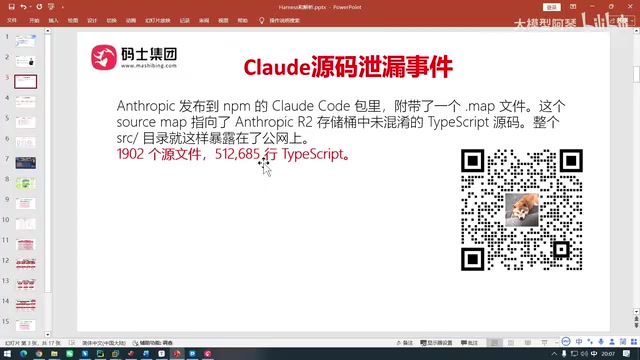
In March 2025, Anthropic experienced a notable source code leak. A developer accidentally included a MAP file when publishing Claude Code to NPM, which pointed to unobfuscated TypeScript source code stored in an Anthropic R2 storage bucket.
NPM (Node Package Manager) is the largest package management platform in the JavaScript/TypeScript ecosystem, where developers use the npm publish command to publish packages to public repositories for others to use. A MAP file (Source Map) is a technical file that maps compiled, minified, or obfuscated code back to the original source code, typically used during development and debugging. In a normal publishing workflow, Source Map files should be strictly excluded from published packages through .npmignore or the files field in package.json, as they fully expose the original code structure and logic. The Anthropic R2 storage bucket refers to cloud storage based on Cloudflare's R2 object storage service—R2 is Cloudflare's Amazon S3-compatible storage service known for zero egress fees. The root cause of this leak was a configuration oversight in the publishing workflow. While such DevOps incidents are not uncommon in the industry, the consequences are particularly noteworthy for a top-tier AI company like Anthropic.
The source code was subsequently exposed on the public internet, attracting widespread attention from the developer community. The leak involved 1,902 source files totaling approximately 510,000 lines of code. It's important to note that this was not the complete Claude Code codebase, but rather its core components.
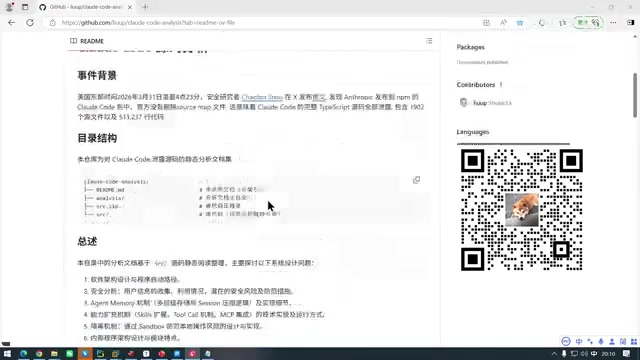
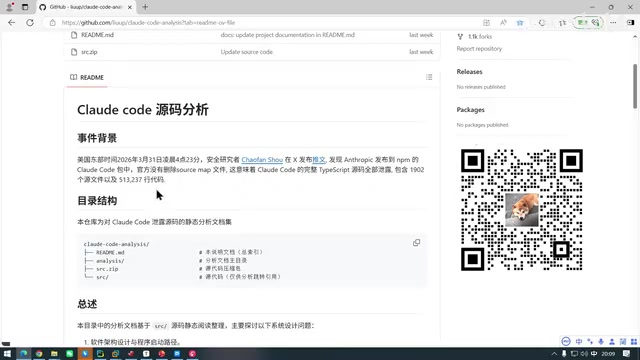
While 510,000 lines of code is a massive undertaking for individual reading, developers on GitHub have already produced systematic analyses of the entire leaked source code, including directory structure, core mechanisms, and software architecture highlights, providing valuable learning resources for the community.
Two Key Discoveries
Discovery One: The Core Language is TypeScript
From the leaked source code, it's clear that Claude Code's core codebase is written in TypeScript—not Python, not Java. This may surprise many developers, but considering that Claude Code is fundamentally a command-line tool and IDE plugin, choosing the TypeScript/Node.js ecosystem is a logical technical decision.
TypeScript is a superset of JavaScript developed by Microsoft that enhances JavaScript's maintainability and developer experience through the addition of a static type system. In the AI coding assistant space, Python is typically considered the default choice since mainstream machine learning frameworks (such as PyTorch, TensorFlow) and AI SDKs are predominantly Python-based. However, Claude Code's positioning is not as a model training or inference engine, but as a developer-facing command-line tool and IDE plugin—meaning it needs deep editor integration, file system operations, and terminal interaction management. VS Code itself is built on Electron and TypeScript, with its extension API entirely based on the TypeScript/JavaScript ecosystem, making this technology choice entirely natural.
The TypeScript choice brings several clear advantages:
- A strong type system provides better code maintainability, offering more safety and reliability when handling complex JSON structures returned by LLMs
- Natural compatibility with editor ecosystems like VS Code, sharing the same language runtime
- The NPM ecosystem provides rich toolchain support, including mature libraries for file operations, terminal control, network requests, and more
- Node.js's non-blocking I/O asynchronous programming model has inherent advantages when simultaneously handling user input, file monitoring, API calls, and other concurrent tasks
Discovery Two: The Harness Architecture is the Core Driving Force
The more significant discovery is the underlying reason why Claude Code works so well—it employs a design pattern called the Harness Architecture. This architecture contains seven core mechanisms that form the skeleton of the entire Agent system.
Deep Dive into the Harness Architecture
What is Harness Engineering?
In the AI Agent domain, Harness can be understood as an engineering framework for "harnessing" large language models. Rather than simply calling an API to get a response, it enables AI Agents to reliably, efficiently, and controllably complete complex tasks through carefully designed components and workflows.
The naming "Harness" borrows from the engineering concept of wire harnesses—in the automotive and aerospace industries, a Wire Harness is a system that organizes large numbers of wires, connectors, and terminals into orderly bundles, ensuring reliable operation of complex electrical systems. In the AI Agent context, the core philosophy of the Harness architecture treats the LLM as a powerful engine that needs to be "harnessed": the model itself possesses powerful reasoning and generation capabilities, but without constraints and orchestration, its outputs may be unstable, unsafe, or unexpected. Unlike simple API wrappers, the Harness architecture emphasizes runtime control and governance—it's not just concerned with "how to call the model" but more importantly "how to ensure the model works reliably throughout complex tasks." This design philosophy deeply reflects Anthropic's expertise in AI safety. They understand that LLM outputs have inherent uncertainty, and therefore require an engineered "safety harness" to ensure predictable system behavior.
Before the Claude Code source code leak, Anthropic had actually provided a brief introduction to this software architecture. The leak allowed the community to glimpse its complete implementation details.
Core Design Philosophy of the Harness Architecture
The design philosophy of the Harness architecture can be summarized in four principles:
- Modularity: Each core mechanism operates independently and can be individually optimized or replaced
- Observability: System runtime state is transparent, facilitating debugging and monitoring
- Fault Tolerance: Comprehensive handling mechanisms for the uncertainty of LLM outputs
- Extensibility: New tools and capabilities can be easily integrated into the system
The Seven Core Mechanisms Explained
From an architectural perspective, these seven mechanisms collectively solve the most challenging problems in AI Agent development:
-
Context Management: How to efficiently utilize information within a limited context window. The Context Window is one of the core limitations of LLMs, determining the total amount of information the model can "see" in a single inference. Even though the Claude model supports context windows up to 200K tokens, this is still far from sufficient when processing large codebases—a medium-sized project might contain hundreds of thousands of lines of code. Claude Code's context management mechanism needs to intelligently select code snippets most relevant to the current task (rather than simply stuffing all files into the context), maintain context coherence across multiple conversation turns, and perform graceful compression or summarization as the context approaches its limit. This involves the combined application of multiple techniques including Retrieval-Augmented Generation (RAG), sliding window strategies, and context distillation, directly determining the Agent's task completion quality and token consumption costs.
-
Tool Call Orchestration: How to enable the Agent to correctly and safely use various tools. Tool Use (Function Calling) is the core capability that distinguishes modern AI Agents from traditional chatbots. In Claude Code, tools include file read/write, terminal command execution, code search, Git operations, and more. Anthropic's Claude model natively supports the Tool Use protocol—the model generates structured tool call requests in its responses, and the Harness layer handles actual execution and feeds results back to the model. The orchestration layer needs to decide when to call which tool, what parameters to pass, how to handle return results, and also manage operational concerns like concurrency, timeouts, and retries for tool calls.
-
State Tracking: How to maintain execution state for complex tasks
-
Error Recovery: How to handle various exceptions during execution
-
Permission Control: How to ensure the security boundaries of Agent operations. This is particularly critical—for example, requiring user confirmation before executing dangerous commands like
rm -rf, checking permission boundaries before writing files, and ensuring the Agent doesn't exceed its authority over the user's file system. -
Output Parsing: How to reliably extract structured information from LLM outputs
-
Flow Orchestration: How to organize multi-step tasks into coherent execution flows
These seven mechanisms work together to form a complete Agent runtime environment, enabling Claude Code to handle everything from simple code completion to complex project refactoring.
Implications for Developers
Why Learn the Harness Architecture?
As AI Agents transition from concept to productization, how to build reliable Agent systems through engineering becomes a key challenge. As one of the most successful AI coding assistants currently available, Claude Code's architectural design represents industry best practices.
Practical value of understanding the Harness architecture:
- Reference model for building Agents: Knowing how top industry products solve similar problems
- More efficient use of existing tools: Understanding the underlying logic helps you better leverage Claude Code's capabilities
- Evidence-based technology selection: Making more informed architectural decisions when designing Agent systems
Recommended Learning Path
For developers who want to dive deeper into the Harness architecture, the following progression is recommended:
- Start by reading the source code analysis summaries on GitHub to build overall understanding
- Focus on the design intent and interactions of the seven core mechanisms
- Try implementing a simplified version of the Harness architecture in your own projects
- Compare design differences with other Agent frameworks (such as LangChain, AutoGen) to understand the tradeoffs of different approaches
Regarding comparative learning, understanding the design philosophy differences between mainstream frameworks is particularly important. LangChain is currently the most popular LLM application development framework, created by Harrison Chase in 2022. It provides abstractions like Chains, Agents, and Memory to help developers quickly build LLM-based applications. Its strengths lie in its rich integration ecosystem and rapid prototyping capabilities, but it has also been criticized by the community for over-abstraction and frequent API changes. AutoGen is a multi-Agent conversation framework from Microsoft Research, with the core concept of completing complex tasks through collaborative conversations between multiple AI Agents, where each Agent can play different roles (such as programmer, reviewer, executor). Compared to these two frameworks, Claude Code's Harness architecture leans more toward deep optimization of a single Agent—it doesn't pursue the flexibility of multi-Agent collaboration, but focuses on achieving ultimate reliability and efficiency for a single Agent in programming scenarios. This design tradeoff reflects an important industry insight: at the current stage of technology, a carefully tuned single-Agent system is often more practical and stable than a loosely collaborating multi-Agent system.
Conclusion
While the Claude Code source code leak was a security incident, it objectively provided extremely valuable learning material for the AI Agent engineering field. The Harness architecture, as its core design pattern, demonstrates how to transform a powerful but uncertain LLM into a reliable, controllable, and efficient coding assistant.
For every developer committed to building AI Agents, investing time in deeply understanding the design philosophy and implementation details of this architecture is well worthwhile. It can not only help you build better Agent products but also give you clearer judgment about the future direction of AI engineering.
Key Takeaways
- The Claude Code source code leak exposed 1,902 files with approximately 510,000 lines of core TypeScript code
- Claude Code's core language is TypeScript, not Python or Java
- The Harness architecture is the underlying foundation of Claude Code's powerful capabilities, comprising seven core mechanisms
- The Harness architecture addresses critical challenges including context management, tool call orchestration, state tracking, and error recovery
- Understanding Harness Engineering provides significant reference value for building reliable AI Agent systems
Related articles
Deep Dive into AI Agent Skill Design: …
Deep Dive into AI Agent Skill Design: Engineering Practices from Anthropic and Perplexity
A deep dive into Skill design philosophy from Anthropic's Claude Code team and Perplexity's Agent team, covering the Tax Test, Gotchas Flywheel, progressive disclosure, and Eval-First practices for building high-quality AI Agent skill systems.
Deep Dive into OpenAI's Official GPT-5…
Deep Dive into OpenAI's Official GPT-5.6 Prompting Guide: The Shift from Manual to Automatic
A deep dive into OpenAI's official GPT-5.6 Sol prompting guide: conciseness-first, outcome-oriented design, autonomy boundaries, tool routing, and reasoning intensity tuning.
 Deep Dives
Deep Dive into How OpenClaw (Open-Source Crayfish) AI Agent Works
Deep analysis of OpenClaw AI Agent internals: System Prompt, tool calling, SubAgents, Skill system, memory, and Context Engineering explained.