Claude Code v2.1.293 Update: Haiku 5.5 Default Model and Dozens of Fixes

Claude Code v2.1.293 introduces Haiku 5.5 and fixes dozens of session, tool, and terminal issues.
Anthropic's Claude Code v2.1.293 advances on two fronts: it adds Claude Haiku 5.5 with a 1M token context window as the default lightweight API model starting at $0.10 per million input tokens, and delivers sweeping bug fixes across subagent communication, session stability, terminal interaction, and enterprise integration. Specific improvements include an agentType field in subagent status lines, an isDeferred parameter for tool registration, fixes for erroneous rollbacks during context compaction, an HTTP MCP memory leak patch, and multiple Vim mode and background message loss corrections. The team also reverted two changes from v2.1.281 and v2.1.290 that had introduced side effects.
Anthropic has released v2.1.293 of the Claude Code CLI tool. The most notable addition in this update is the new Claude Haiku 5.5 model, along with dozens of fixes and improvements targeting session management, permission controls, the plugin system, and subagents. For developers who rely heavily on Claude Code for AI-assisted programming, this is a release focused on polish with a side of new capability.
Core Highlight: Haiku 5.5 Becomes the Default Lightweight Model
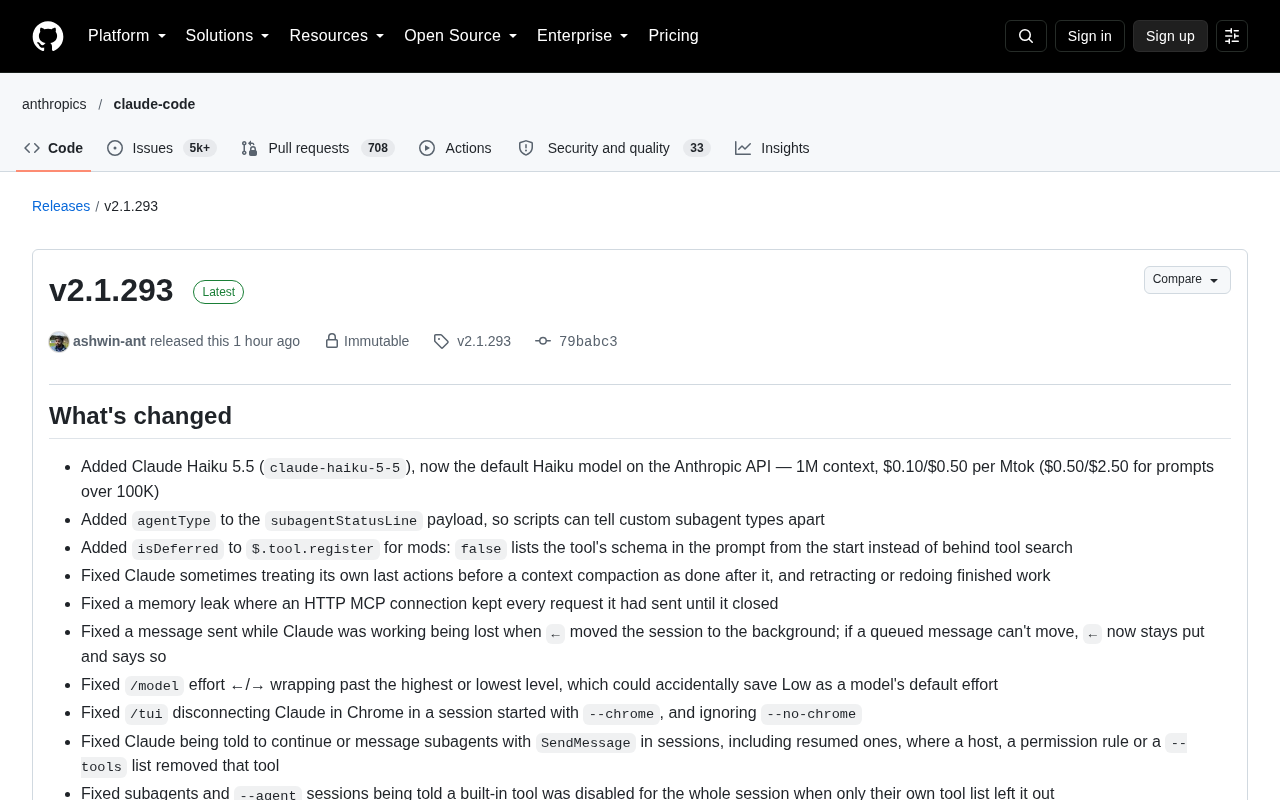
The most substantive change in this update is the addition of the claude-haiku-5-5 model, now set as the default Haiku model on the Anthropic API. This model targets lightweight, cost-efficient use cases:
- A context window of 1 million tokens (1M context), which is a critical capability for tasks involving large codebases or long documents.
- Priced at $0.10 per million input tokens and $0.50 per million output tokens; when prompts exceed 100K tokens, pricing rises to $0.50 input and $2.50 output per million tokens.
This tiered pricing strategy means developers pay very little for typical workloads, only incurring higher costs when they push into ultra-long context territory. For batch code analysis, log parsing, automated scripting, and other tasks where Haiku excels, this is a meaningful upgrade worth paying attention to.
Haiku is the "lightweight and fast" tier in Anthropic's Claude model family, sitting alongside the high-performance Sonnet and the top-tier Opus in a three-tier product stack. Haiku is designed to handle highly structured tasks with relatively straightforward context needs — such as code completion, classification, and summarization — at minimal latency and cost. A 1M context window is roughly equivalent to 750,000 English words or tens of thousands of lines of code, enough to load an entire mid-sized codebase into a single conversation. This makes it a key capability for cross-file dependency analysis or large log reviews. The tiered pricing (5x increase beyond 100K tokens) is standard industry practice — it essentially differentiates between users who occasionally need long context and those who depend on it continuously, incentivizing developers to keep their prompts lean.
Enhancements to the Subagent and Tool System
This release includes several improvements to agent-related mechanisms, reflecting Claude Code's ongoing effort to strengthen multi-agent collaboration:
- The
subagentStatusLinepayload now includes anagentTypefield, allowing scripts to distinguish between different types of custom subagents. $.tool.registeradds anisDeferredparameter for mod use: when set tofalse, the tool's schema appears in the prompt from the start rather than being hidden behind tool search.
Several agent-related bugs were also fixed — for example, cases where Claude was still told it could continue or message a subagent even after the SendMessage tool had been removed by the host, permission rules, or the --tools list; and cases where subagents and --agent sessions were incorrectly told that a built-in tool was disabled for the entire session when it was simply absent from their own tool list. These fixes make tool visibility significantly more accurate in multi-agent scenarios.
A subagent refers to an independent agent instance dynamically spawned or invoked by a primary Claude session, commonly used to decompose complex tasks into parallelizable or specialized subtasks — for example, one agent handling code review while another runs tests. The
SendMessagetool is the core primitive for communication between the primary agent and subagents. If this tool is accidentally removed by a permission rule but Claude is still told it can use it, "hallucinated calls" occur — the model believes it issued an instruction when nothing actually happened. TheisDeferredparameter in$.tool.registerrelates to prompt construction strategy: deferring a tool's schema until after search saves token space in the initial prompt, but for tools that must be immediately available (like core editing operations), settingisDeferredtofalseensures they always appear in context.
Fixing Risks in Session and Context Management
Session stability is a major focus of this update. Several fixes directly affect the reliability of long-running sessions:
- Fixed an issue where Claude would sometimes consider its last action already completed before context compaction, causing it to undo or redo already-finished work — a bug that could easily cause progress loss in long sessions.
- Fixed a memory leak where HTTP MCP connections retained every request they had ever sent until the connection was closed.
- Fixed an issue where messages sent while Claude was working would be lost after using
←to send the session to the background; now, if a queued message cannot be moved,←will stay put and show a prompt instead.
Additionally, the /model effort level switcher had a bug where cycling past the highest or lowest level would loop incorrectly and potentially save "Low" as the default model effort — this has also been fixed.
Context compaction refers to the process where, as conversation history approaches the model's context window limit, the system automatically summarizes or truncates earlier content to free up space for the conversation to continue. This is very common in long-running coding sessions, but can cause the model to misjudge the "current state" — especially when the compaction boundary falls in the middle of an operation sequence, potentially causing the model to treat already-executed steps as incomplete and trigger repetition or rollback. HTTP MCP (Model Context Protocol) is a standardized protocol Anthropic is promoting for connecting external tools and data sources to Claude via persistent HTTP connections. The memory leak fixed here means that in older versions, memory usage on the connection side would grow linearly with session duration under high-frequency tool call scenarios, only being released when the connection closed.
Terminal Interaction and Vim Mode Polish
As a CLI tool, Claude Code's commitment to terminal interaction quality shines through in this update:
- Fixed an issue where
←would still send the session to the background after 10 seconds even when there was unsent text in the prompt or Claude was waiting for a user response (it now cancels the move). - Fixed an issue where pasted text starting and ending with the same word would sometimes be treated as manually typed input sent to Claude.
- Vim mode received several fixes: cursor overrun on
>>and<<applied to all-whitespace lines, cursor positioning after deleting a full line in Visual mode, and.repeat behavior — all corrected.
These seemingly minor interaction fixes are precisely what makes daily usage smoother, and they demonstrate the team's ongoing responsiveness to power user feedback.
Enterprise and Slack Integration (Claude Tag) Improvements
Features aimed at team and enterprise users also saw progress. The startup flow has been optimized for Team and Enterprise organizations: policies and managed settings are fetched earlier, and stalled requests are retried after 3 seconds.
On the Claude Tag (Slack integration) side:
- Fixed an issue where Claude would incorrectly report that a workspace wasn't set up in Enterprise Grid channels shared across workspaces.
- Raised the channel rule limit per workspace and organization-level Slack page from 20 to 50.
- Adjusted Claude's behavior when joining announcement channels where only admins can post — it no longer publishes an introduction message.
The Code Review feature also improved the "Add Repository" dialog, which now lists each repository that cannot be added along with the reason (such as missing GitHub write permissions).
Two Noteworthy Reversions
This update isn't purely additive. The team reverted two prior changes:
- Reverted the change from v2.1.281 regarding auto-mode rejection messages (which originally told Claude that rejections applied to the outcome rather than the specific command).
- Reverted the fix from v2.1.290 for cloud sessions remaining asleep after container restarts lost pending
/loopwake-ups or scheduled tasks — Claude is no longer told about this, and sessions stay asleep.
Reversions are a normal part of software iteration and suggest the earlier fixes introduced new side effects. Users who care about cloud session scheduling should take note.
Summary
v2.1.293 is a classic "new capability + extensive polish" release. The addition of Haiku 5.5 opens up new options for low-cost, long-context scenarios, while the fixes that make up the bulk of the changelog address real pain points around session loss, tool visibility, permission consistency, and terminal interaction. For developers and teams with Claude Code deeply integrated into their workflows, upgrading promptly is recommended for a more stable experience.
Related articles

Gemini 4 Argon Hands-On: AI Builds Board Games, Constructs Temples, and Trains Robots Autonomously
Gemini 4 Argon hands-on roundup: AI autonomously builds a desk racetrack and temple in Blender, writes a ray tracing engine, trains a humanoid robot to sink 7 shots, plus API pricing and developer access.

The Magic Octagonal Coin: Why Only 9% of People Can Predict Its Flip?
Only 9% of people can correctly predict the Magic Octagon coin flip. This article explains its spatial rotation mechanism, common cognitive pitfalls, and a new hypothesis based on Relevance Theory, exploring the limits of human spatial reasoning.

Sam Altman: AI Is Entering the Era of Scientific Discovery — Math Breakthroughs Will Replicate in Biology and Energy
Sam Altman says AI is entering the era of scientific discovery — math breakthroughs will replicate in biology, materials science, and energy to help develop new drugs and energy sources.