Claude Code Weekly Limit Cut by 17%: How Should Developers Respond?

Claude Code's 17% weekly limit cut pushes developers to rethink AI tool usage and explore alternatives.
Anthropic's Claude Code recently reduced its weekly usage limit by approximately 17%, sparking widespread discussion among developers. This article examines the underlying reasons — rising LLM inference costs and sustainability pressures — and explores the real-world impact on heavy users. It offers practical strategies including prompt optimization, context caching, and workload distribution, while comparing alternatives like GitHub Copilot, Cursor, and open-source tools. The adjustment reflects broader industry challenges around unit economics and sustainable AI business models.
Overview
Recently, Anthropic's AI coding tool Claude Code was reported to have adjusted its usage policy, reducing the weekly usage limit by approximately 17%. The news quickly sparked discussion across tech communities like Hacker News. For users who rely on Claude Code for their daily development work, any change to usage limits is impossible to ignore.
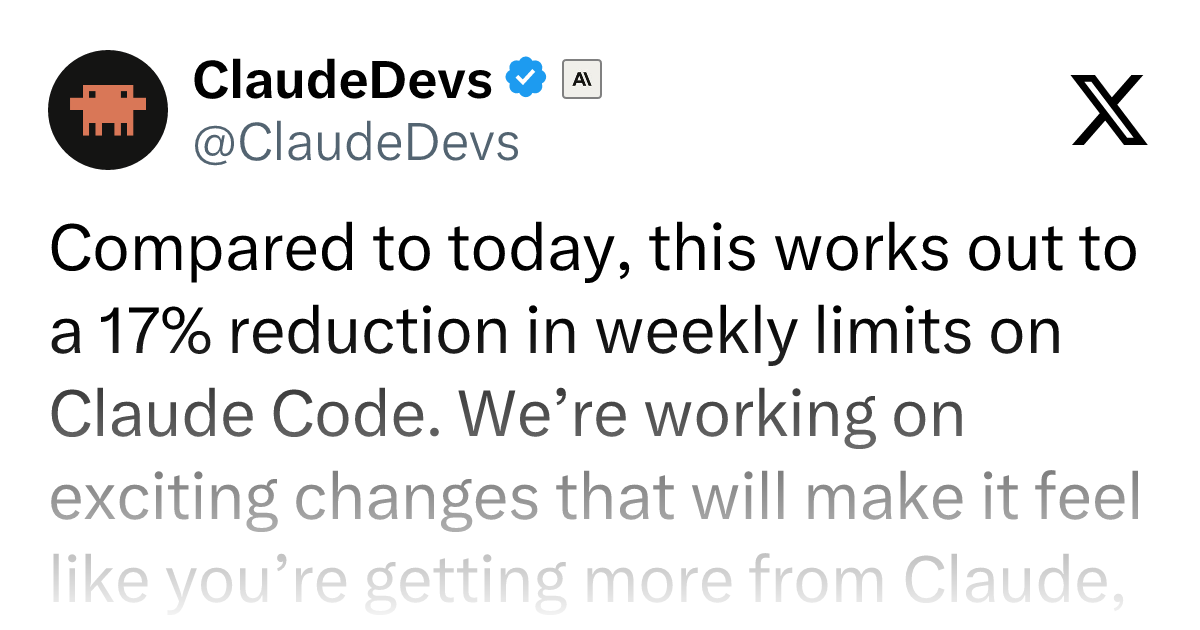
As an AI-assisted coding tool highly favored by developers, Claude Code has woven itself into many programmers' daily workflows thanks to its excellent code comprehension and generation capabilities. Unlike traditional IDE plugin-style coding assistants, Claude Code operates as a Terminal Agent, capable of directly reading and modifying project files, executing shell commands, running tests, managing git, and more. This "agentic coding" paradigm means it's not just a code completion tool — it's a programming agent with multi-step reasoning and tool-calling abilities. When tackling complex tasks, it performs multiple rounds of internal reasoning — understanding project structure, locating relevant files, generating modification plans, verifying results — each round consuming a significant number of tokens. While the limit adjustment may seem modest on the surface, in high-intensity usage scenarios, a 17% cut is enough to have a tangible impact on development efficiency.
Background Analysis of the Limit Adjustment
Why AI Tools Frequently Adjust Their Limits
AI coding tools adjusting their usage limits is far from an isolated case. As the inference costs of large language models continue to climb, major AI service providers are constantly balancing commercial sustainability with user experience. Claude Code's reduction in weekly limits is most likely a trade-off Anthropic made between compute costs, server load, and its subscription-based revenue model.
To understand the logic behind this decision, it helps to understand the basic cost structure of LLM inference. Each time a user sends a request, the model must perform massive matrix operations on GPU clusters, with the compute consumed roughly proportional to the number of input and output tokens. Taking the Claude model family as an example, its API pricing charges separately for input and output tokens, with output tokens typically costing 3–5x more than input tokens due to the autoregressive, token-by-token nature of the generation phase. The KV Cache (Key-Value Cache) used during inference also consumes substantial GPU memory, limiting the number of concurrent requests a single card can serve. These underlying technical constraints directly dictate that AI service providers must make trade-offs between service quality and operational costs.
For AI coding assistants specifically, code generation tasks often involve longer context windows and complex reasoning chains, with per-request token consumption far exceeding that of ordinary conversational scenarios. The Context Window refers to the maximum number of tokens a model can process in a single inference pass. The Claude 3.5 series supports context windows of up to 200K tokens, which is particularly critical in coding scenarios. A medium-sized software project might contain tens of thousands of lines of code, and when developers ask the AI to understand cross-file dependencies or perform a global refactor, large volumes of code files need to be loaded into the context simultaneously. However, longer contexts mean higher computational overhead — the attention mechanism in the Transformer architecture has a computational complexity that scales quadratically with sequence length (though modern models employ various optimization techniques to mitigate this). This means service providers face higher marginal costs when operating such tools, and adjusting usage limits to control resource consumption is a common operational strategy.
What a 17% Cut Really Means
From a numbers perspective, a 17% reduction falls in a subtle range — light users may not notice much difference, but heavy users can easily hit the ceiling during an intensive weekend development session. For teams that rely on Claude Code for large-scale project refactoring, batch code reviews, or complex debugging tasks, this change means they need to rethink their usage cadence and resource allocation.
It's worth noting that due to Claude Code's agentic workflow, a seemingly simple large-scale refactoring task might trigger dozens of internal tool calls behind the scenes, with actual token consumption far exceeding the user's intuitive perception. This means users often underestimate their real usage, and a 17% limit reduction may impose constraints that feel more restrictive than expected in practice.
Practical Impact on Developers
Workflow Adjustment Strategies
Facing tighter limits, developers can consider the following approaches:
- Prioritize tasks: Focus Claude Code usage on critical tasks that benefit most from AI assistance, and delegate simpler code completion to local tools or other free alternatives.
- Optimize prompts: Reduce ineffective requests and redundant calls by streamlining prompts to lower token consumption.
- Leverage context caching: Organize conversation context efficiently to avoid repeatedly passing the same code snippets. Anthropic's Context Caching technology allows reuse of previously processed context prefixes, reducing redundant computation costs in multi-turn conversations. Making good use of this mechanism can significantly conserve your quota.
- Spread usage across the week: Distribute high-intensity AI-assisted tasks evenly throughout the week rather than concentrating them in one or two days.
Comparison with Competitors
The AI coding tools market is fiercely competitive and has developed a multi-layered competitive landscape. GitHub Copilot leverages the ecosystem advantages of Microsoft and OpenAI, occupying the largest market share as an IDE plugin with over a million monthly active developers. Cursor has redefined the editor experience with its "AI-first IDE" philosophy, deeply integrating AI into every aspect of code editing, search, and refactoring. Additionally, open-source projects like Cline and Aider offer self-hostable alternatives, allowing developers to connect to different model backends.
Business models also vary across providers: Copilot uses a flat monthly fee ($10/month for the individual plan), Cursor offers a hybrid of usage-based and subscription pricing, while Claude Code is included in Anthropic's Pro/Max subscription plans with usage tied to the subscription tier. When Claude Code tightens its limits, cost-sensitive users may start evaluating alternatives.
This also reminds us that when choosing an AI coding tool, beyond the model's capabilities, service stability and the predictability of usage policies are equally important decision factors. Spreading your eggs across multiple baskets and maintaining flexibility in your tool stack is often a safer bet than relying solely on a single product.
A Reflection of Industry Trends
This limit adjustment reflects a common challenge facing the entire AI services industry: how to achieve a sustainable business model while maintaining technological leadership. Most AI tools are still in a growth-through-subsidies phase, with the industry widely facing a "the more usage, the more losses" unit economics dilemma. According to industry analysis, OpenAI's revenue in 2024 was approximately $3.7 billion, yet its operating losses still amounted to billions of dollars, with GPU compute costs being the largest expense item. Anthropic faces a similar situation — despite receiving billions of dollars in investment from Amazon and Google, the high costs of training and inference mean that the path to profitability remains unclear.
Against this backdrop, AI service providers are actively exploring cost optimization strategies: model distillation (compressing the capabilities of large models into smaller ones), inference optimization (such as speculative decoding and quantized deployment), and more granular resource scheduling strategies. Limit adjustments are essentially a form of demand-side management — by constraining heavy users' consumption to smooth peak loads, providers can reduce the peak compute capacity they need to maintain, thereby improving overall operational efficiency. But as the market matures, providers will inevitably pay closer attention to unit economics.
For users, understanding this trend helps set more reasonable expectations. Usage limits, pricing, and even feature boundaries of AI tools may all continue to shift as the industry evolves. Deeply embedding a tool into your critical workflows while maintaining a degree of technical flexibility is a pragmatic approach to navigating this uncertainty.
Conclusion
Claude Code's 17% weekly limit reduction, while just a minor operational adjustment for an AI tool, offers us a window into the direction of the AI services industry. Rather than overreacting to a single adjustment, developers would be better served using this as an opportunity to reassess their AI tool usage habits and explore more efficient, more resilient development workflows. In an era where AI coding assistants are becoming increasingly ubiquitous, finding the optimal balance between capability, cost, and reliability is a question that every technology professional needs to keep thinking about.
Related articles

Cursor Beginner's Guide: A Six-Step Workflow for Managing Changes, Rollbacks, and Validation
New to Cursor and keep breaking things? Learn a six-step dev workflow covering Cursor Rules, Plan mode, Diff review, and Checkpoint rollback to go from guesswork to engineering.
Is Cheap Cursor Reselling Reliable? The Real Risks of Shared Account Pools Exposed
An in-depth analysis of Cursor Pro budget reselling services, exposing the shared account pool model behind so-called legitimate accounts and deep discounts from technical, compliance, and data security perspectives.

FHRR Hyperdimensional Computing Explained: Replacing Complex Multiplication with Phase Angle Addition
Deep dive into FHRR Fourier Holographic Reduced Representations: how hyperdimensional computing replaces complex multiplication with phase angle addition for ultra-low-power AI at the edge.