Claude Cowork vs. Claude Code: Pricing, Use Cases, and How to Choose

Claude Code and Claude Cowork share one agent engine, serving engineers and knowledge workers, bundled from $17/month.
Anthropic splits the same agent loop into Claude Code for engineers and Claude Cowork for knowledge workers, both included in paid subscriptions starting at $17/month. The choice is straightforward: use Code for development workflows and Cowork for documents, spreadsheets, and research. The bundled pricing lets users try both without extra cost and switch freely based on the task at hand.
Anthropic has split the same agent loop into two products aimed at different audiences: Claude Code focuses on software engineering, while Claude Cowork applies the same capabilities to documents, spreadsheets, and research work. Both are included with any paid Claude plan, starting at $17 per month. For individual users and teams alike, the real question isn't "should I use these" — it's "which one do I use and when" and "what will it actually cost me."
The Core Idea: Same Agent, Different Focus
The key to understanding Claude Code and Claude Cowork is recognizing that they share the same underlying agent architecture. The so-called agent loop refers to the model's ability to autonomously plan tasks, invoke tools, execute actions, and iterate based on results — all in a closed loop. This mechanism was originally applied in Claude Code for reading and writing code, running commands, and debugging programs.
Claude Cowork does essentially the same thing, but swaps the "working material" from code repositories to office documents, spreadsheets, and research materials. It can help you summarize a lengthy report, organize data tables, or gather and synthesize information from multiple sources. In short, Code is an automation assistant for engineers; Cowork is an automation assistant for knowledge workers. Both run on the same engine.
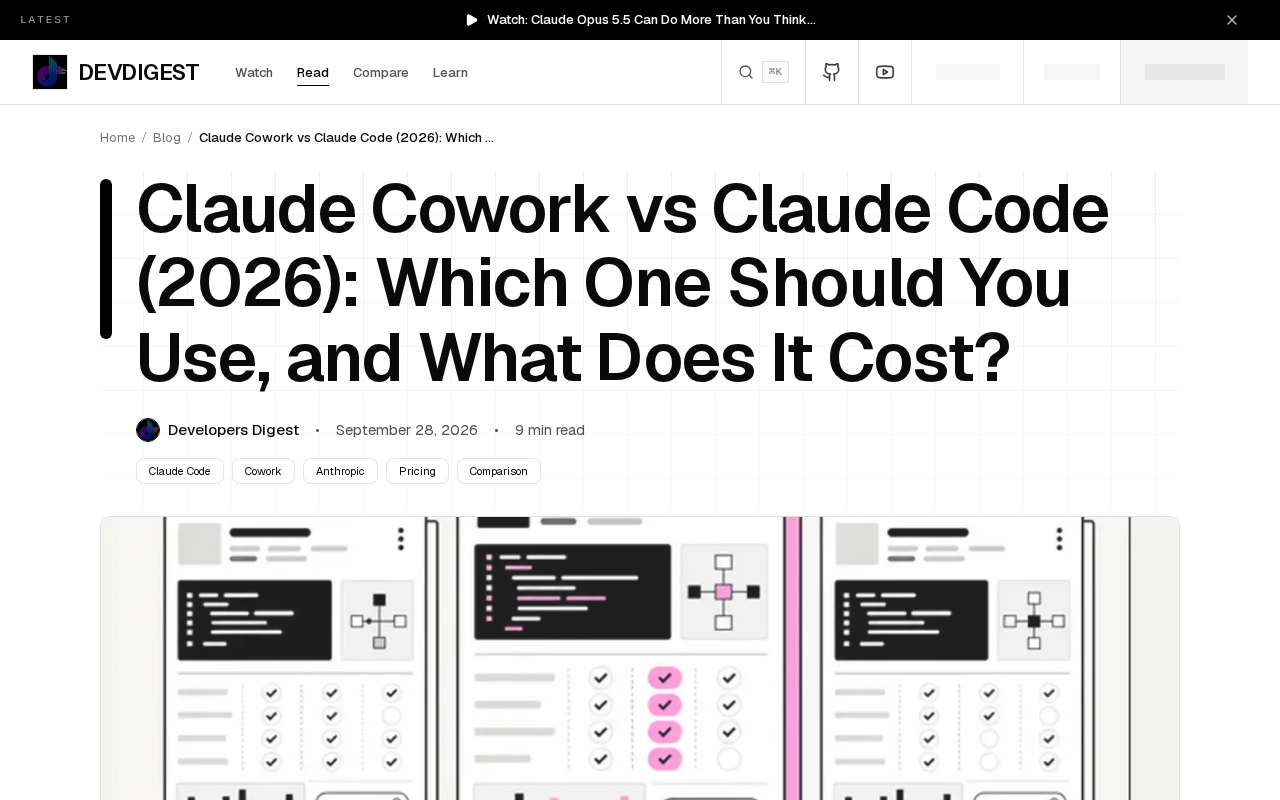
The agent loop is the core mechanism that upgrades large language models from "conversational assistants" to "autonomous executors." Here's how it works: after receiving a goal, the model formulates a step-by-step plan, then sequentially invokes external tools (such as file read/write, terminal commands, web search, API calls, etc.), observes the result of each step, and decides the next action accordingly — repeating until the task is complete or an unresolvable blocker is encountered. This is fundamentally different from the traditional single-turn model of "input question, output answer" — the model isn't just making suggestions; it's actually taking action. The advantage of this architecture is its ability to handle complex tasks requiring multiple steps and cross-tool collaboration. The trade-off is that each step consumes tokens, and the actual usage on long tasks can far exceed expectations — something worth factoring in when evaluating cost-effectiveness.
How to Choose Between the Two
The decision logic is actually quite straightforward and depends on what you primarily work with day to day.
When to Use Claude Code
If your work revolves around codebases, the command line, script debugging, and software development workflows, Claude Code is the more fitting entry point. It has deeper integration with development environments, version control, and programming toolchains, and can automate tasks from requirements to implementation within a real engineering context.
When to Use Claude Cowork
If you spend more time writing documents, doing data analysis, or organizing research materials, Claude Cowork will feel like a better fit. It brings the autonomous execution capabilities of an agent into workflows familiar to non-technical users — you don't need to know how to code to let the agent help you complete multi-step document and research tasks.
For those who both write code and work with documents, the good news is that both products are included in the same paid subscription — no need to pay extra to access the other one.
Pricing: Starting at $17/Month
Based on verified pricing information from September 2026 as provided in the source material, both Claude Code and Claude Cowork are included with every paid Claude plan, starting at $17 per month. This means the subscription itself unlocks both products rather than treating them as separate paid add-ons.
The significance of this bundled approach is that it lowers the barrier to experimentation: users don't need to agonize over which product to "buy" — they can freely switch between the two depending on the task at hand. For teams, it also simplifies procurement decisions, since a single subscription covers both engineering and non-engineering use cases.
It's worth noting that "subscription unlocks the product" and "usage-based billing" are typically two parallel billing dimensions. The monthly fee addresses access, but agent-type products tend to consume far more tokens during long tasks than ordinary conversations — a single multi-step document organization or code debugging task could easily consume the equivalent of dozens of standard queries. Different subscription tiers typically come with different usage caps or rate limits, so heavy users should pay attention to the specific quotas at each tier rather than just the starting price. It's recommended to confirm the current usage policies for Claude Code and Claude Cowork at each tier directly on Anthropic's official pricing page.
Summary and Recommendations
Claude Code and Claude Cowork are not competing products — they are two entry points into the same agent capabilities, each aimed at a different type of work. The decision framework is simple: use Code when facing code, use Cowork when facing documents and data. Since both are included in the same subscription starting at $17/month, the most practical approach is to activate a paid plan and try both in your actual workflow to find the combination that works best for you.
One final note: the pricing information in this article is based on a specific point in time as described in the source material. Specific tiers and benefits may change as Anthropic updates its offerings. Always refer to Anthropic's official page before subscribing.
Related articles

Why Does the Tesla Roadster Need to Fly? A Deep Dive into Musk's Wild Demo
Tesla's Roadster launch showed wall-climbing, upside-down driving, and flying stunts—but The Vergecast notes the demo car may lack a battery, the Rocket version is invite-only and not street-legal, and the website terms don't guarantee delivery. After nine years of delays, why does this car still need to exist?

AI Is Not a Replacement: Human-AI Collaboration Through the Lens of Factory Root Cause Analysis
Starting from factory root cause analysis, this article explains how AI accelerates evidence chain construction rather than replacing human experts, exploring the pragmatic implementation logic and business value of 'AI supporting people rather than replacing them.'

AI Agent Decision Auditing: Building an Evidence Chain in Regulated Workflows
Starting from a Reddit discussion, this article analyzes three core issues in AI agent decision auditing within regulated workflows: what fields audit records should contain, how to handle feedback latency for erroneous decisions, and how to continuously calibrate LLM judge consistency with human judgment.